 Ashigrain
Colour reversal · Experimental
Trucolor (two-colour)
Two-colour prints for Republic's westerns and second features.
A two-colour palette from a blue and a red dye on a sunlit western scene. A model inspired by the process, not a reproduction. Original vs Ashigrain.
At a glance
- Exposure index
- 16
- Daylight
- Introduced
- mid 1940s
- Discontinued
- Process
- Trucolor double-coated coupler print (one colour developer forms a blue dye on one side and a red dye on the other; silver bleached and fixed out)
- Prints on
- Reversal, viewed directly
About the film
Trucolor was a two-colour subtractive process owned by Consolidated Film Industries, which processed its prints for Republic Pictures, mostly for second features and westerns.
Brian Coe, quoted by the Timeline of Historical Film Colors, says it was used in 1946 for Out California Way, and the SMPE Progress Committee counted Republic features in Trucolor among the progress of 1947. By then most two-colour subtractive processes except Cinecolor were obsolete, and Trucolor was the only significant new two-colour process after the Second World War. Bipack camera negatives were printed on a safety base coated on both sides with positive emulsions that were not colour-sensitive, one holding a coupler that formed a blue dye and the other a coupler that formed a red dye in the same developer. Bleaching and fixing then removed the silver, while the sound track was a silver compound left by a special bleach treatment. In 1947 the SMPE reported a sharp rise in two-colour feature production, as such methods filled the studios' needs for westerns and other pictures not planned for three-colour work. After 1950 the Trucolor name passed to prints from modern multilayer colour films, and Coe writes that by 1954 the two-colour process was obsolete and its last printing service had closed.
Sources for this history
- Trucolor 2 color, Timeline of Historical Film Colors
- Report of SMPE Progress Committee (Journal of the SMPE 50, June 1948, pp. 523–542), Society of Motion Picture Engineers, Internet Archive
The look
Trucolor was Consolidated Film Industries' two-colour process for Republic Pictures, printed on film coated on both sides with emulsions forming a blue and a red dye. It served mostly westerns and second features from the mid 1940s. Ashigrain's version is a labelled surrogate, a model inspired by the process rather than a reproduction.


Best for
- Postwar westerns and outdoor adventure
- Two-colour pastiche of 1940s second features
- Sunlit desert and ranch scenes
Compare camera films
Science & sources

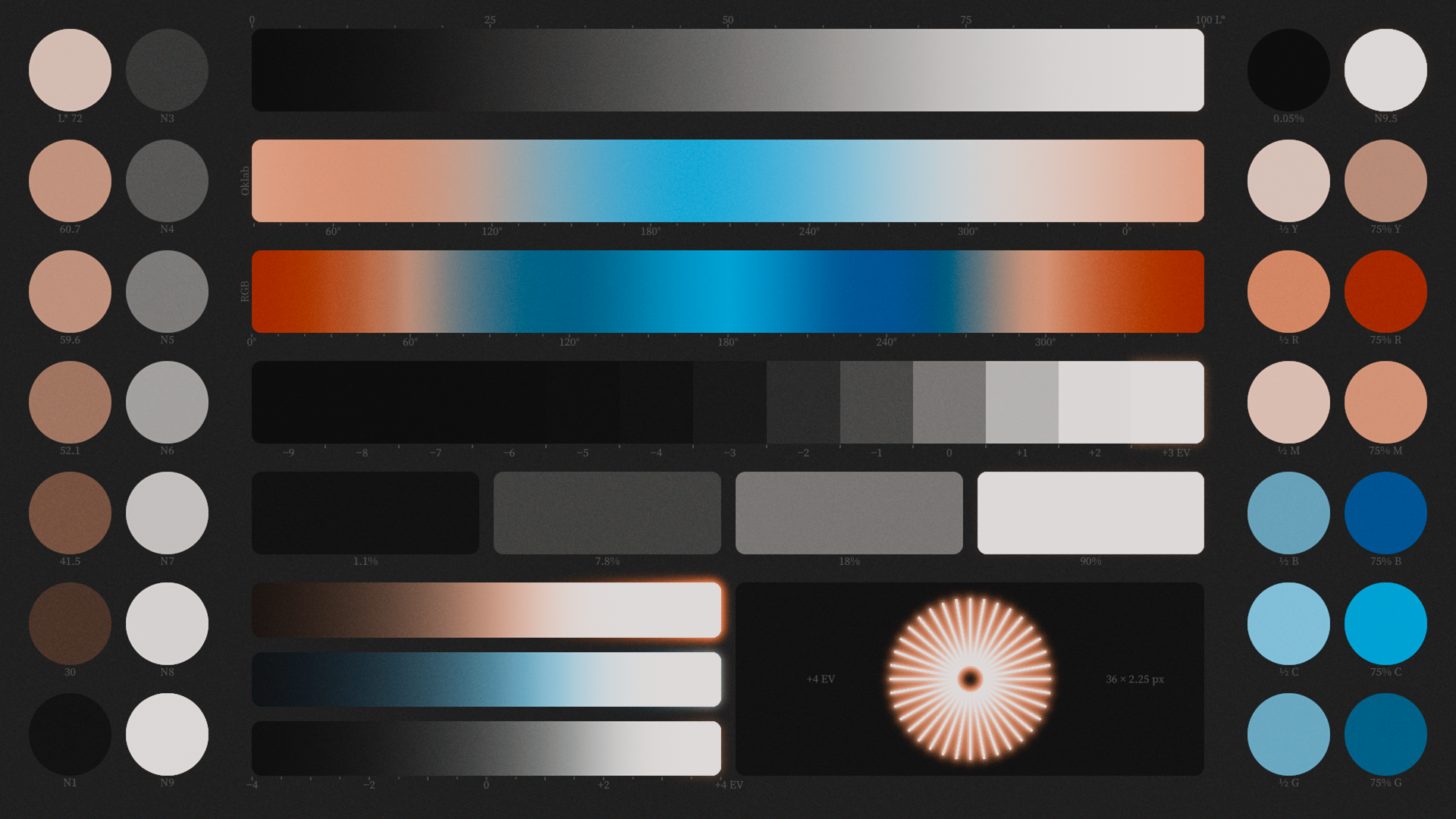
A two-colour model inspired by the process, not a reproduction of Trucolor. No curve, sensitivity or dye measurement exists, so every curve is generated from named assumptions guided by a 1948 SMPE report and a museum timeline; its MTF is borrowed from Kodak Vision3 50D and its grain from Kodak Ektachrome 100D.
Response curves and the evidence behind the model
Compare manufacturer data with Ashigrain’s response on the same axes. These curves show how the model is calibrated to its sources; they do not establish a match to photographed film.
Characteristic response
RMS granularity
Density variation (σD). Where the datasheet gives a single grain value, the response away from that point is an approximation.
| Channel | Density | Datasheet-based σD | Model σD |
|---|---|---|---|
| R | 0.3 | 0.007803 | 0.007669 |
| G | 0.3 | 0.005515 | 0.005404 |
| B | 0.3 | 0.009648 | 0.009629 |
| R | 0.6 | 0.014313 | 0.014067 |
| G | 0.6 | 0.01121 | 0.010985 |
| B | 0.6 | 0.022259 | 0.022215 |
| R | 1 | 0.02296 | 0.022565 |
| G | 1 | 0.019274 | 0.018886 |
| B | 1 | 0.038135 | 0.03806 |
| R | 1.5 | 0.029592 | 0.029083 |
| G | 1.5 | 0.028175 | 0.027608 |
| B | 1.5 | 0.059435 | 0.059317 |
| R | 2 | 0.030736 | 0.030207 |
| G | 2 | 0.033158 | 0.032492 |
Model limits
These images show the film model in use. Spectral response, lighting and viewing conditions include approximations. Halation, bloom, grain size, weave and flicker are not fully measured for each film. The look of real film also depends on development and print timing.
- This is a two-colour model inspired by two-colour Trucolor, rather than a reproduction of the original process. The later three-colour Trucolor is a different process.
- No characteristic curve, spectral sensitivity, dye spectrum, MTF or grain measurement of Trucolor exists in the sources. Every curve is generated from named assumptions, guided by a 1948 SMPE progress report and a museum timeline entry.
- The model runs the two records in a three-layer path: the blue layer copies the second record and there is no yellow dye.
- The bipack record sensitivities, the blue and red dye shapes and the single tone curve are assumptions, chosen for a neutral grey.
- The exposure index of 16, the daylight balance and the 35 mm format are assumptions.
- The silver sound track and the softer rear record of the bipack are not modelled.
- MTF is proxied from Kodak Vision3 50D (5203) and grain from Kodak Ektachrome 100D (5294).
- Custom lighting spectra, camera metering and the spectral reflectance inferred from fixed-white-balance footage are assumptions used by the model, not measurements of this film.
- Push and pull have no published curves for this film and use a generic model.
- Characteristic response outside the published exposure range is an extrapolation, not measured film data.
- The available sources do not measure veiling flare during projection. The model approximates its contribution to lifted blacks on screen, so the result is not a measured projection contrast.
Reciprocity: not modelled. Exposure time has no effect on this film.
Film guide: assumptions and practical choices
Sources
- Process: Timeline of Historical Film Colors entry 1294: Trucolor 2 color, Live page filmcolors.org/timeline-entry/1294/ (byte-stable across two fetches 2026-10-28), p. 1
- Reconstructed: Journal of the SMPE vol. 50 (Jan-Jun 1948), incl. Report of SMPE Progress Committee (June 1948), pp.523-542, archive.org item journalofsociety50socirich (Prelinger Library scan), file journalofsociety50socirich.pdf (derivative, 47493669 bytes), p. 550