 Ashigrain
Colour negative · Natural
Kodak Vision3 50D
Kodak's finest cine grain, for blazing daylight.
Clean, bright daylight on the finest-grain Vision3 film: sky highlights roll off instead of clipping, sun on water keeps its sparkle, skin looks natural and the grain stays in the background. Original vs Ashigrain.
At a glance
- Exposure index
- 50
- Daylight
- Introduced
- 2011
- In production
- Process
- ECN-2
About the film
Kodak presents Vision3 50D as its finest-grain motion-picture camera negative, aimed at high-contrast daylight exteriors.
Kodak introduced it in 2011, when it became the fourth colour negative in the Vision3 family after 500T, 250D and 200T, and its announcement compared it with the earlier Vision2 50D. Robbie Ryan used it for the Queen's horse-riding scene in The Favourite (2018) and pulled it two stops, further than he had ever pulled a stock, to soften its strong contrast. Rodrigo Prieto chose it for the Osage ritual scenes of Killers of the Flower Moon (2023) for the clarity of its grain, and said it suited nature and epic landscapes. Linus Sandgren used it for day exteriors on No Time to Die (2021) and Babylon (2022), and in its 16 mm form, 7203, on First Man (2018). It is coded 5203 in 35 mm and 65 mm and 7203 in 16 mm and Super 8, and is processed in ECN-2. Kodak credits the Vision3 dye-layering and sub-micron grain technologies with up to two extra stops of overexposure latitude. In August 2025 Kodak announced that 5203 would move, under the same name, to a structure with an anti-halation undercoat instead of rem-jet, with sensitometry and processing unchanged.
Sources for this history
- KODAK VISION3 50D Color Negative Film 5203 / 7203 Technical Data, Eastman Kodak Company
- Chronology of Film, Eastman Kodak Company
- Kodak launches new daylight stock in VISION3 film family, IF Magazine
- Kodak Introduces New Motion Picture Film, IF Magazine
- The Essential Reference Guide for Filmmakers, Eastman Kodak Company
- KODAK VISION3 AHU Camera Negative Films: Talking points for Filmmakers, Eastman Kodak Company
- Kodak Enhances Vision3, American Society of Cinematographers
- Introducing KODAK VISION3 Color Negative Films with AHU Technology, Eastman Kodak Company
Shot on Kodak Vision3 50D
The Favourite
Partly: day exteriors, mainly the ultra-wide shots that could not take ND filters, pulled two stops. The main stock was 500T 5219.

Partly: the day-exterior stock, rated at EI 25 and then push-processed one stop, alongside 250D 5207 and 500T 5219.
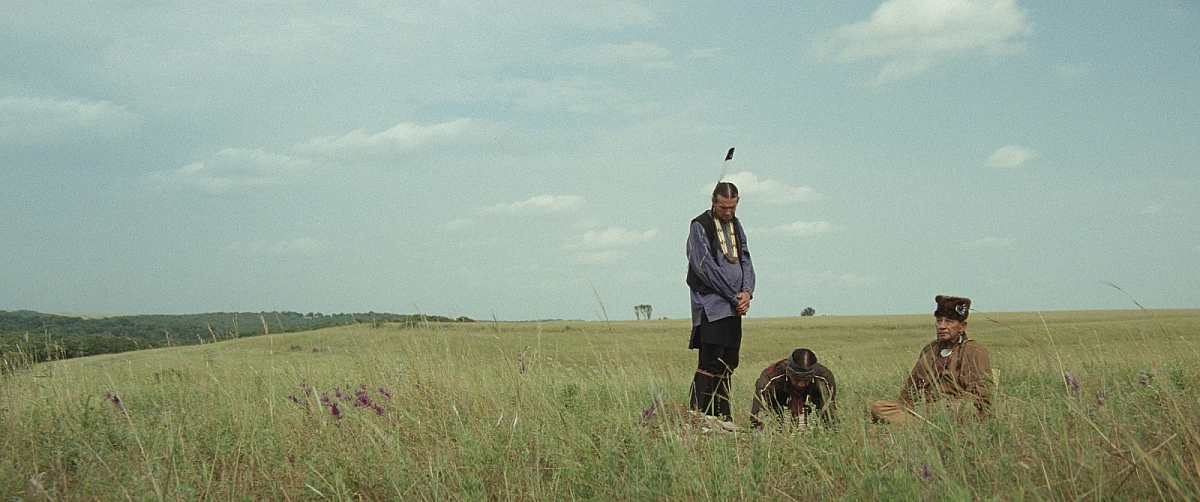
Partly: scenes of Osage rituals and some exteriors, for its fine grain. The main day stock was 250D 5207.
No Time to Die
Partly: the 35 mm day exteriors. The main stock was 500T 5219.
First Man
Partly: as 7203, one of three Super 16 stocks for the early part of the story, with 250D and 500T.
The look
Kodak Vision3 50D is a daylight colour negative rated EI 50, with the finest grain of the Vision3 films. Cinematographers use it beside faster stocks for hard sun and wide landscapes, where the grain should vanish. It prints on Kodak 2383 by default.
Skin and fine detail at EI 50: smooth tones, crisp texture and almost no visible grain.
Fine texture across the whole frame, with the grain staying in the background: the look of a slow daylight film.
Best for
- Hard midday sun on landscapes
- Sunlit architecture and fine texture
- Open-shade daylight portraits
Among the films
Science & sources


A daylight-balanced colour negative with an exposure index of 50. Explore colour and fine density variation through the same scene.
Response curves and the evidence behind the model
Compare manufacturer data with the Ashigrain model on the same axes. This shows the calibration to source curves; comparison with photographed film is a separate question.
Characteristic response
RMS granularity
Density variation (σD) measured through a 48 µm aperture. Where the datasheet gives a single grain value, the response away from that point is an approximation.
| Channel | Density | Datasheet-based σD | Model σD |
|---|---|---|---|
| R | 0.3 | 0.005421 | 0.005639 |
| G | 0.3 | 0.005464 | 0.005696 |
| B | 0.3 | 0.009411 | 0.009769 |
| R | 0.6 | 0.00472 | 0.00491 |
| G | 0.6 | 0.00473 | 0.004931 |
| B | 0.6 | 0.010243 | 0.010632 |
| R | 1 | 0.00459 | 0.004775 |
| G | 1 | 0.004404 | 0.004591 |
| B | 1 | 0.008288 | 0.008603 |
| R | 1.5 | 0.003401 | 0.003538 |
| G | 1.5 | 0.004838 | 0.005043 |
| B | 1.5 | 0.008036 | 0.008341 |
| G | 2 | 0.003545 | 0.003696 |
Model limits
These images show the film model in use. Spectral response, lighting and viewing conditions include approximations, while halation, bloom, grain size, weave and flicker are not fully measured for each film. A real film capture also depends on development and print timing.
- The model assumes custom lighting spectra, camera metering and the spectral reflectance inferred from fixed-white-balance footage. These inputs are not measurements of the film.
- The model calculates colour-print timing and scan balance for arbitrary lighting. Scanner colour balance is expressed without a standard physical unit.
- The prescribed 80A conversion filter's spectral transmission is modelled, not supplied by the datasheet.
- Where calibration data is missing, the model approximates dye amounts, interactions between layers and push/pull behaviour. Grain size is an assumption: published RMS granularity does not determine dye-cloud size.
- The characteristic response beyond log H −3.03 to 2.00 is extrapolated. Dye amounts per layer density are not measured.
- Halation strength, radius and layer weights use modelled values because the datasheet does not quantify them. Removing the antihalation layer and adding bloom also rely on approximations.
- This preview approximates the printer lamp and filter spectra and the Status A grey target. The source does not provide the spectral data or laboratory target needed to calibrate them.
Film guide: assumptions and practical choices
Sources
- Exposure index: KODAK VISION3 50D Color Negative Film 5203 / 7203 Technical Data, H-1-5203t, Revised 7-15, p. 1
- Process: KODAK VISION3 50D Color Negative Film 5203 / 7203 Technical Data, H-1-5203t, Revised 7-15, p. 2
- Characteristic curves: KODAK VISION3 50D Color Negative Film 5203 / 7203 Technical Data, H-1-5203t, Revised 7-15, p. 4
- Diffuse RMS granularity: KODAK VISION3 50D Color Negative Film 5203 / 7203 Technical Data, H-1-5203t, Revised 7-15, p. 4
- Granularity density: KODAK VISION3 50D Color Negative Film 5203 / 7203 Technical Data, H-1-5203t, Revised 7-15, p. 4