 Ashigrain
Colour negative · Natural
Kodak Vision2 Expression 500T
Lubezki's low-contrast stock for Children of Men.
A tough, contrasty scene rendered gently: lower contrast and softer colour by design hold detail in the bright and the dark parts. Original vs Ashigrain.
At a glance
- Exposure index
- 500
- Tungsten
- Introduced
- 2003
- Discontinued
- Process
- ECN-2
About the film
Emmanuel Lubezki shot all of Alfonso Cuarón's Children of Men (2006) on Vision2 Expression 500T, a choice Variety traces to early tests for the film's long car sequence.
American Cinematographer reported that its low contrast let him work in extreme conditions with little added light; he said its blacks were not rich but could be crushed in the digital intermediate. Kodak unveiled the film in December 2003, coded 5229 in 35 mm and 7229 in 16 mm, as the second 500-speed negative of its Vision2 family after Vision2 500T. Kodak gave it lower contrast and colour saturation than the standard Vision2 500T, for a softer image and smooth skin tones. Early in 2004 Kodak added Vision2 100T and 200T to the same family, which it presented as the first designed for both film and digital postproduction. On Martin Scorsese's The Departed (2006), Michael Ballhaus kept Expression for Billy Costigan's sessions with his psychiatrist, calling it softer, less contrasty and more pastel than his other stocks. The film is tungsten-balanced, rated EI 500, coated on an acetate base with a rem-jet backing and processed in ECN-2. It has since been discontinued.
Sources for this history
- KODAK VISION2 Expression 500T Color Negative Film 5229 / 7229 Technical Data, Eastman Kodak Company
- Chronology of Film, Eastman Kodak Company
- Kodak Expands Palette Of New Generation Films, Widescreen Review
- Kodak Reaffirms Film Commitment, SHOOT
- Children of Men: Humanity's Last Hope, American Society of Cinematographers
- Emmanuel Lubezki, 'Children of Men', Variety
- Deep Cover: The Departed, American Society of Cinematographers
Shot on Kodak Vision2 Expression 500T
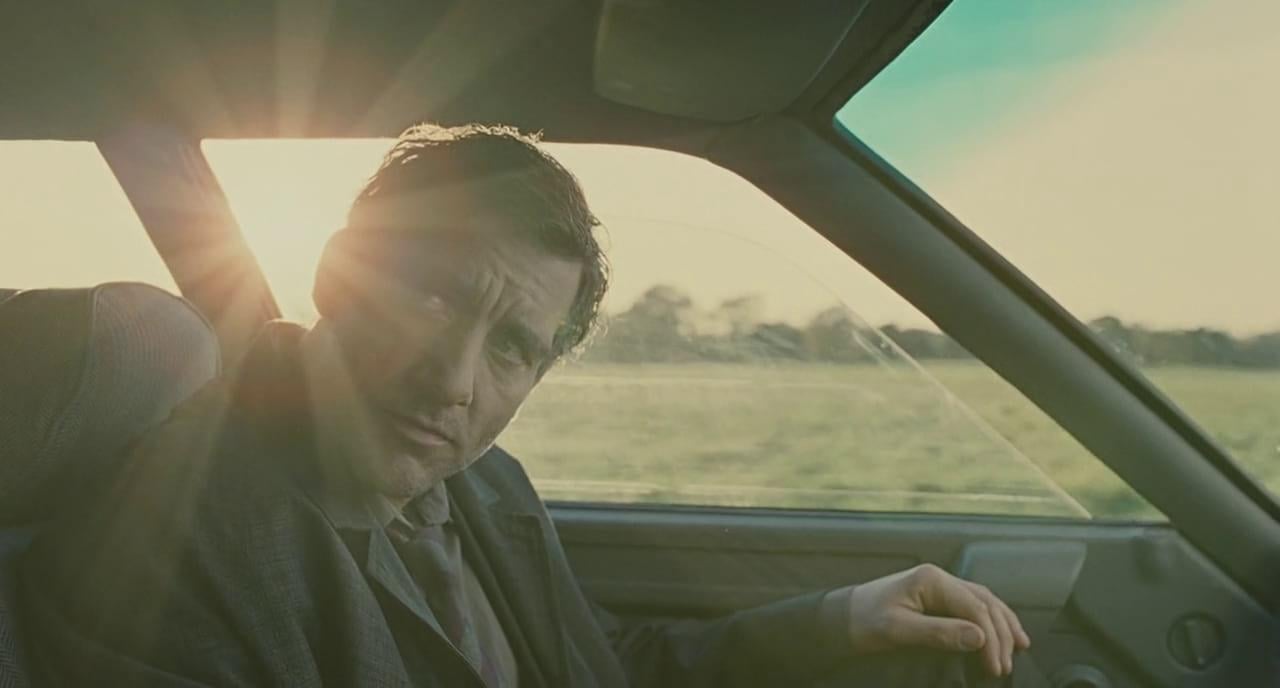
Shot entirely on 5229, chosen for its low contrast in long takes with little added light.
The Departed
Expression 5229 was kept for Billy Costigan's sessions with his psychiatrist, for a softer, more pastel look than the film's other stocks.
Little Children
One of five stocks, used for most night exteriors and moonlit interiors and pull-processed for a subtler moonlight effect.
Cinderella Man
Totino shot every boxing sequence and night scene on 5229, keeping older, less saturated EXR stocks for the Depression-era day scenes.
The look
Kodak Vision2 Expression 500T is a tungsten-balanced colour negative rated EI 500, made deliberately softer than standard Vision2 500T: lower contrast, gentler colour, smooth skin. Its blacks stay thin, so Emmanuel Lubezki could shoot Children of Men in harsh conditions with little added light and deepen them later.
Skin in mixed light, rendered softly: the lower saturation keeps the warm and cool sides gentle.
A muted, low-contrast dusk: the gentle default look closest to Vision3 50D's in the menus.
Best for
- Harsh light with little added fill
- Long takes in mixed practical light
- Muted, desaturated drama
Among the films
Science & sources


A tungsten-balanced motion-picture colour negative with an exposure index of 500. Kodak presents it as lower in contrast and colour saturation than its other negatives. Compare it through the Kodak 2383 print stage.
Response curves and the evidence behind the model
Compare manufacturer data with the Ashigrain model on the same axes. This shows the calibration to source curves; comparison with photographed film is a separate question.
Characteristic response
RMS granularity
Density variation (σD). Where the datasheet gives a single grain value, the response away from that point is an approximation.
| Channel | Density | Datasheet-based σD | Model σD |
|---|---|---|---|
| R | 0.3 | 0.008507 | 0.008779 |
| G | 0.3 | 0.013126 | 0.013559 |
| B | 0.3 | 0.037086 | 0.038342 |
| R | 0.6 | 0.006741 | 0.006956 |
| G | 0.6 | 0.0094 | 0.009709 |
| B | 0.6 | 0.029342 | 0.030336 |
| R | 1 | 0.006666 | 0.006878 |
| G | 1 | 0.00912 | 0.009421 |
| B | 1 | 0.020824 | 0.02153 |
| G | 1.5 | 0.009802 | 0.010126 |
| B | 1.5 | 0.016718 | 0.017285 |
Model limits
These images show the film model in use. Spectral response, lighting and viewing conditions include approximations, while halation, bloom, grain size, weave and flicker are not fully measured for each film. A real film capture also depends on development and print timing.
- The model assumes custom lighting spectra, camera metering and the spectral reflectance inferred from fixed-white-balance footage. These inputs are not measurements of the film.
- The model calculates colour-print timing and scan balance for arbitrary lighting. Scanner colour balance is expressed without a standard physical unit.
- A 3200 K tungsten source is specified as the design light. Its spectrum and the conversion filter’s transmission are approximated because the source supplies no spectrum.
- The spectral transmission of the conversion filter the source prescribes (80A for daylight films under tungsten, 85 for tungsten films in daylight) is modelled, not supplied by the source.
- Peak-normalised dye curves do not establish dye amounts per unit layer density.
- Where calibration data is missing, the model approximates dye amounts, interactions between layers and push/pull behaviour. Grain size is an assumption: published RMS granularity does not determine dye-cloud size.
- The characteristic response beyond log H −3.90 to 0.00 is extrapolated.
- Halation strength, radius and layer weights use modelled values because the datasheet does not quantify them. Removing the antihalation layer and adding bloom also rely on approximations.
- This preview approximates the printer lamp and filter spectra and the Status A grey target. The source does not provide the spectral data or laboratory target needed to calibrate them.
Film guide: assumptions and practical choices
Sources
- Exposure index: KODAK VISION2 Expression 500T Color Negative Film 5229 / 7229 Technical Data, H-1-5229, New 10-2005, p. 2
- Process: KODAK VISION2 Expression 500T Color Negative Film 5229 / 7229 Technical Data, H-1-5229, New 10-2005, p. 2
- Characteristic curves: KODAK VISION2 Expression 500T Color Negative Film 5229 / 7229 Technical Data, H-1-5229, New 10-2005, p. 3
- Diffuse RMS granularity: KODAK VISION2 Expression 500T Color Negative Film 5229 / 7229 Technical Data, H-1-5229, New 10-2005, p. 3
- Granularity density: KODAK VISION2 Expression 500T Color Negative Film 5229 / 7229 Technical Data, H-1-5229, New 10-2005, p. 3