 Ashigrain
Black-and-white negative · Black & white
Kodak T-Max 100
Kodak's finest-grained T-Grain film for big enlargements.
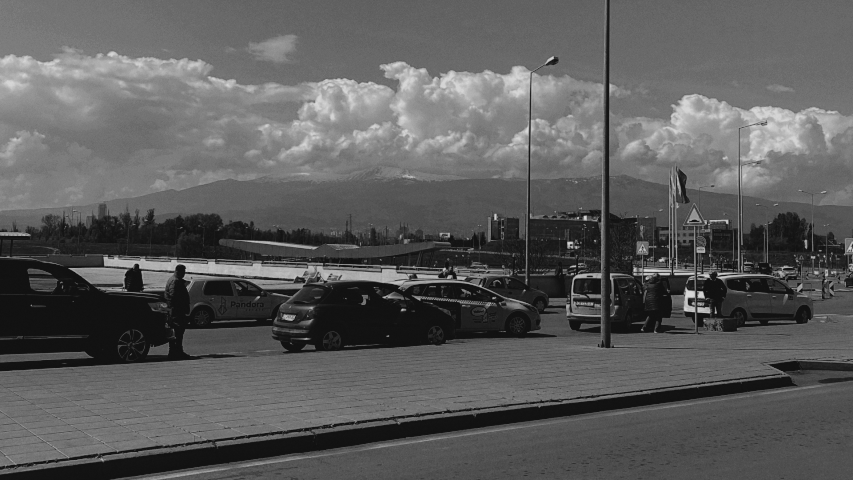
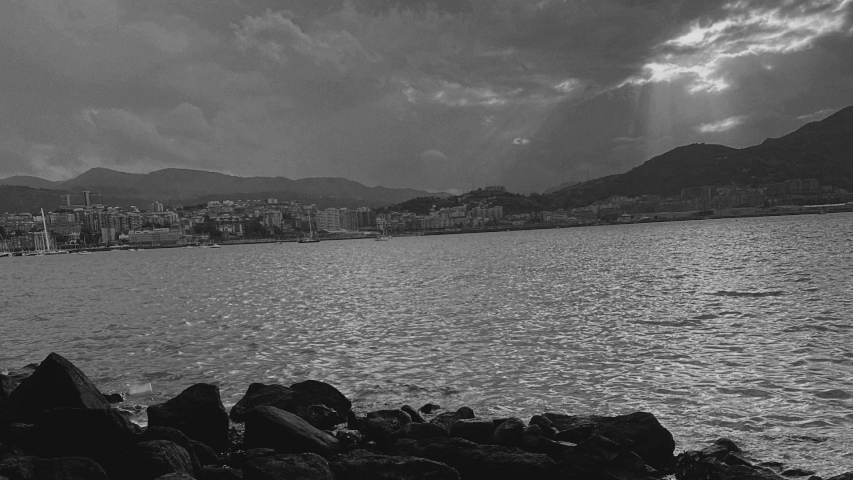
Kodak T-Max 100 printed on Kodak 2302: fine grain and high sharpness. Original vs Ashigrain.
At a glance
- Exposure index
- 100
- Introduced
- c. 1986
- In production
- Process
- KODAK PROFESSIONAL Developer D-76, small tank, 20 C (68 F)
About the film
Kodak T-Max 100, code 100TMX, is a continuous-tone panchromatic black-and-white negative rated ISO 100, built on Kodak's T-Grain emulsion.
Kodak's first black-and-white T-Grain films, T-Max 100 and 400, date from c. 1986, the year The New York Times gave for them when it reported the launch of T-Max P3200 in 1988. Kodak positioned it for general photography where the highest image quality and very large enlargements matter, and for copying photographs and photomicrography. In October 1999 Kodak documented it with T-Max 400 and P3200 in one Professional data sheet. A March 2002 notice said those films had been replaced by Kodak Professional T-Max films that needed different development times. Kodak's 2004 sheet explained that production was moving to a more advanced coating facility, with new technology applied to the existing emulsions, which changed processing times slightly but gave the same results. Kodak Alaris's current sheet, of June 2018, still lists the T-Grain emulsion as its first feature. Kodak Alaris lists the film in 135, 120, sheet and long-roll sizes.
Sources for this history
- KODAK PROFESSIONAL T-MAX 100 Film Technical Data (F-4016, June 2018), Kodak Alaris Inc.
- KODAK T-MAX Professional Films Technical Data (F-32, October 1999), Eastman Kodak Company
- KODAK T-MAX Professional Films Technical Data, Eastman Kodak Company
- KODAK PROFESSIONAL T-MAX Films Technical Data (F-4016, February 2004), Eastman Kodak Company
- KODAK PROFESSIONAL T-MAX 100 Film, Kodak Alaris Inc.
- Increasing the Speed of Film: Kodak's New Development, The New York Times
The look
Kodak T-Max 100 is a medium-speed panchromatic black-and-white negative with a T-Grain emulsion, made for the finest grain, high sharpness and very large enlargements. It prints on Kodak B&W Print Film 2302 by default, or on a colour print film for a near-neutral image with the print's own tint.




Best for
- Landscapes printed very large
- Architecture and fine detail
- Copy work and close-up studies
Compare camera films
Science & sources

A medium-speed panchromatic black-and-white negative rated at EI 100. Its curve, spectral sensitivity and MTF are digitised from Kodak Alaris's 2018 sheet, and its grain is built from the sheet's single RMS granularity value. The sheet charts no curve at the table's normal development time, so the nearest charted curve is used. It prints on Kodak B&W Print Film 2302 by default.
Response curves and the evidence behind the model
Compare manufacturer data with Ashigrain’s response on the same axes. These curves show how the model is calibrated to its sources; they do not establish a match to photographed film.
Characteristic response
RMS granularity
Density variation (σD) measured through a 48 µm aperture. Where the datasheet gives a single grain value, the response away from that point is an approximation.
| Channel | Density | Datasheet-based σD | Model σD |
|---|---|---|---|
| N | 0.3 | 0.004382 | 0.004261 |
| N | 0.6 | 0.006197 | 0.006026 |
| N | 1 | 0.008 | 0.007779 |
| N | 1.5 | 0.009798 | 0.009527 |
Model limits
These images show the film model in use. Spectral response, lighting and viewing conditions include approximations. Halation, bloom, grain size, weave and flicker are not fully measured for each film. The look of real film also depends on development and print timing.
- Custom lighting spectra, camera metering and the spectral reflectance inferred from fixed-white-balance footage are assumptions used by the model, not measurements of this film.
- The source gives a daylight exposure index but no colour balance. Daylight calibration and spectrally neutral silver density are assumptions.
- The source gives only diffuse RMS granularity 8 × 10⁻³ at net density 1.0 (D-76). The response away from that point and the silver-clump size are modelled.
- No characteristic curve is charted at the table's normal D-76 development of 6½ minutes; the nearest charted curve, 6 minutes, stands in for it.
- No push curves are used; push and pull use a generic model.
- The printed MTF rises above 100 %, which the model renders as a development adjacency effect. Its width, amplitude and dependence on density and development are not published and are approximated.
- The sheet prints reciprocity corrections at a few exposure times; the correction between them is interpolated.
- The sheet names no antihalation layer; an undercoat is assumed, and the single-layer halation response is not measured.
- The characteristic response beyond log H −3.15 to 0.65 is extrapolated.
- In the print branch it prints on Kodak B&W Print Film 2302 by default. Black-and-white print timing is modelled.
Reciprocity: modelled from 1/10000 s to 100 s, following the datasheet's corrections for long and short exposures. Exposure time stops at the ends of that range.
Film guide: assumptions and practical choices
Sources
- Exposure index: KODAK PROFESSIONAL T-MAX 100 Film Technical Data, F-4016, Revised 6-18, p. 1
- Process: KODAK PROFESSIONAL T-MAX 100 Film Technical Data, F-4016, Revised 6-18, p. 3
- Characteristic curves: KODAK PROFESSIONAL T-MAX 100 Film Technical Data, F-4016, Revised 6-18, p. 8
- Diffuse RMS granularity: KODAK PROFESSIONAL T-MAX 100 Film Technical Data, F-4016, Revised 6-18, p. 8