 Ashigrain
Colour reversal · 1990s
Kodak Ektachrome E100S
Neutral daylight slides with stronger colour.
Kodak Ektachrome E100S in Reversal mode. Original vs Ashigrain.
At a glance
- Exposure index
- 100
- Daylight
- Introduced
- by 1996
- Discontinued
- Process
- E-6
- Prints on
- Reversal, viewed directly
About the film
Kodak Professional Ektachrome E100S is a daylight-balanced ISO 100 colour transparency film for E-6 processing.
It existed by June 1996, when David Gallant reviewed it alongside E100SW in Photon. Kodak distinguished the neutral-colour E100S from the warmer E100SW and described the S version as offering enhanced saturation. The maker listed advertising, product, fashion, industrial and nature photography among its applications. Gallant compared the two films with Fuji Provia and Agfa RSX 100 in studio and location work and reported neutral results for E100S. Kodak documented T-Grain emulsions and new spectral-sensitising dyes, with acetate roll supports and an ESTAR option in its format table. Its June 2003 sheet announced that E100G and E100GX would replace E100S and E100SW as stocks turned over. E100S is discontinued, but that replacement notice does not establish its final coating or sale year.
Sources for this history
- KODAK PROFESSIONAL EKTACHROME Films E100S and E100SW Technical Data, Eastman Kodak Company
- Kodak's New Ektachromes, Photon / Icon Publications (David Gallant)
The look
Kodak Ektachrome E100S is a daylight-balanced ISO 100 slide film, the neutral-colour partner to the warmer E100SW. Kodak aimed its enhanced saturation at advertising, fashion, products and nature. Ashigrain uses Reversal mode by default and models grain from E100S's own RMS 10 headline.






Best for
- Daylight product and advertising photographs
- Fashion with neutral colour balance
- Nature and wildlife slides
Compare camera films
Science & sources

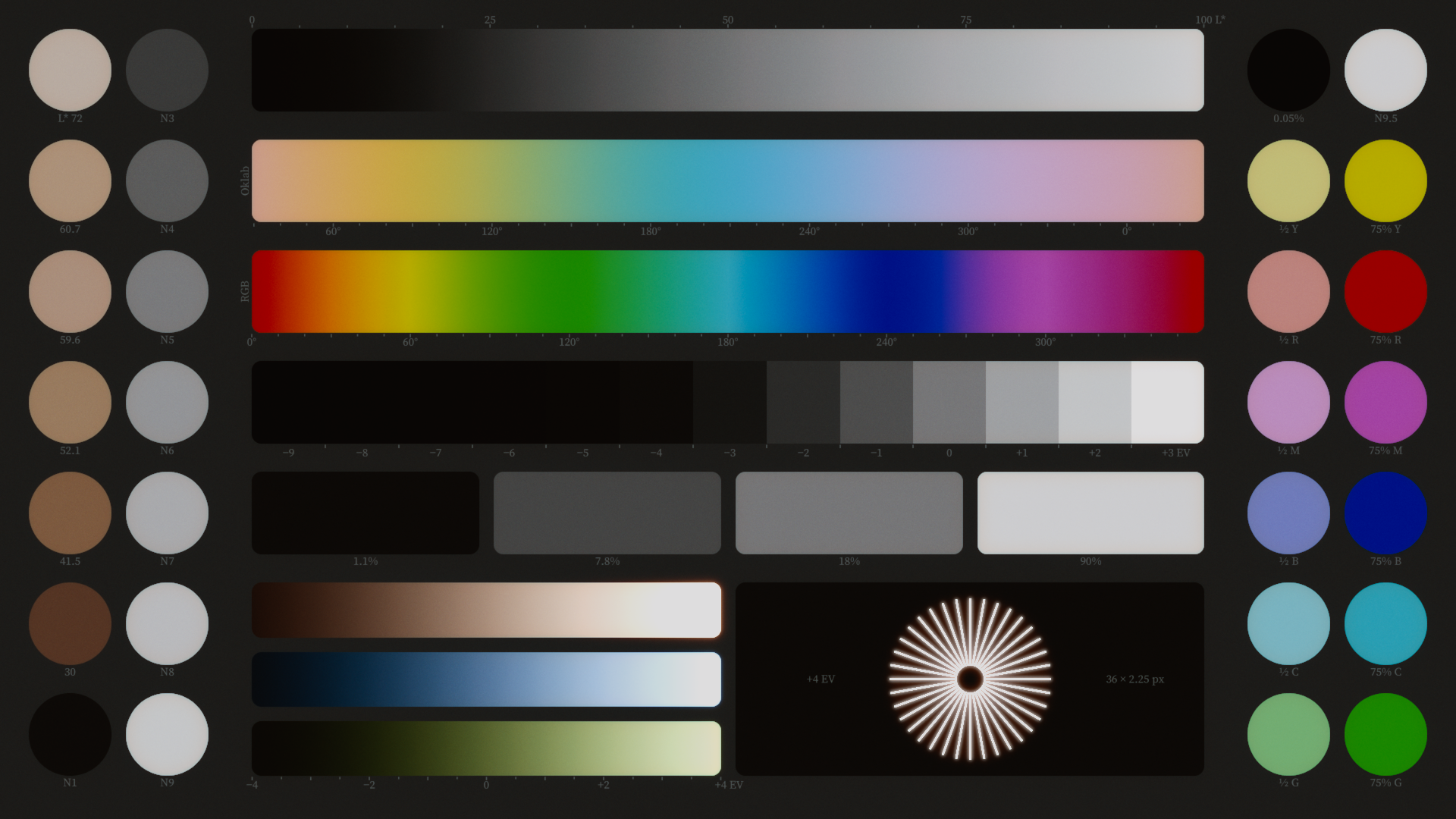
The E100S tone curves come from Kodak's June 2003 E-164 sheet; that sheet shares its spectral, dye and MTF charts with E100SW. E100SW's separate tone curve is not included. Grain uses E100S's own gross-density RMS 10 headline, while push processing remains generic despite the published EI 160 and EI 320 guidance.
Response curves and the evidence behind the model
Compare manufacturer data with Ashigrain’s response on the same axes. These curves show how the model is calibrated to its sources; they do not establish a match to photographed film.
Characteristic response
RMS granularity
Density variation (σD) measured through a 48 µm aperture. Where the datasheet gives a single grain value, the response away from that point is an approximation.
| Channel | Density | Datasheet-based σD | Model σD |
|---|---|---|---|
| R | 0.3 | 0.006795 | 0.006698 |
| G | 0.3 | 0.004556 | 0.004446 |
| B | 0.3 | 0.006758 | 0.006649 |
| R | 0.6 | 0.013442 | 0.013252 |
| G | 0.6 | 0.009193 | 0.008969 |
| B | 0.6 | 0.016806 | 0.016536 |
| R | 1 | 0.020188 | 0.019902 |
| G | 1 | 0.015111 | 0.014744 |
| B | 1 | 0.028772 | 0.028309 |
| R | 1.5 | 0.030121 | 0.029695 |
| G | 1.5 | 0.023621 | 0.023047 |
| B | 1.5 | 0.044528 | 0.043812 |
| R | 2 | 0.034492 | 0.034005 |
| G | 2 | 0.031785 | 0.031012 |
| B | 2 | 0.06518 | 0.064132 |
Model limits
These images show the film model in use. Spectral response, lighting and viewing conditions include approximations. Halation, bloom, grain size, weave and flicker are not fully measured for each film. The look of real film also depends on development and print timing.
- Custom lighting spectra, camera metering and the spectral reflectance inferred from fixed-white-balance footage are assumptions used by the model, not measurements of this film.
- Conversion-filter spectra (80A for daylight films under tungsten, 85 for tungsten films in daylight) come from separate measured filter data, not from this film’s source. Applying those filters to this film remains modelled.
- The only grain datum is RMS granularity 10 × 10⁻³ at gross diffuse visual density 1.0, measured with a 48 µm aperture. Conversion to net density and extension with a square-root density law are modelled.
- The printed EI 160 and EI 320 push guidance supplies no pushed curves. Push and pull use a generic model.
- Only the E100S characteristic curves are modelled. E100SW has a separate tone curve, although the sheet shares its spectral, dye and MTF charts between both films.
- Only one edition is available in the research set, so there is no independent edition cross-check.
- The sheet prints reciprocity corrections at a few exposure times; the correction between them is interpolated, and the colour-compensating filter it prescribes is taken at its nominal value.
- The physical dye-cloud or grain-clump size is inferred from the film's speed class, not measured for this film.
- Individual dye amounts, layer interactions and push/pull behaviour are approximated where the datasheet provides no calibration. Grain size is assumed; published RMS granularity does not specify dye-cloud size.
- The source names no antihalation layer; an undercoat is inferred rather than documented.
- Characteristic response outside the published exposure range is an extrapolation, not measured film data.
- Halation strength, radius and layer weights are not quantified by the datasheet. The effect of removing antihalation and the bloom response are also approximations.
- The available sources do not measure veiling flare during projection. The model approximates its contribution to lifted blacks on screen, so the result is not a measured projection contrast.
Reciprocity: modelled from 1/10000 s to 120 s, following the datasheet's corrections for long and short exposures. Exposure time stops at the ends of that range.
Film guide: assumptions and practical choices
Sources
- Exposure index: KODAK PROFESSIONAL EKTACHROME Films E100S and E100SW Technical Data, E-164, June 2003, p. 2
- Process: KODAK PROFESSIONAL EKTACHROME Films E100S and E100SW Technical Data, E-164, June 2003, p. 3
- Characteristic curves: KODAK PROFESSIONAL EKTACHROME Films E100S and E100SW Technical Data, E-164, June 2003, p. 5
- Diffuse RMS granularity: KODAK PROFESSIONAL EKTACHROME Films E100S and E100SW Technical Data, E-164, June 2003, p. 5