 Ashigrain
Colour reversal · Experimental
ORWOCOLOR UK 14
East German colour slides and home movies.
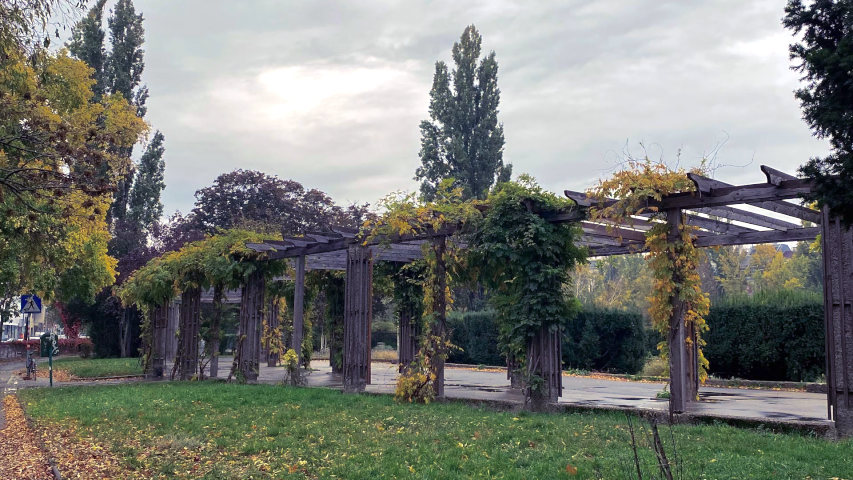
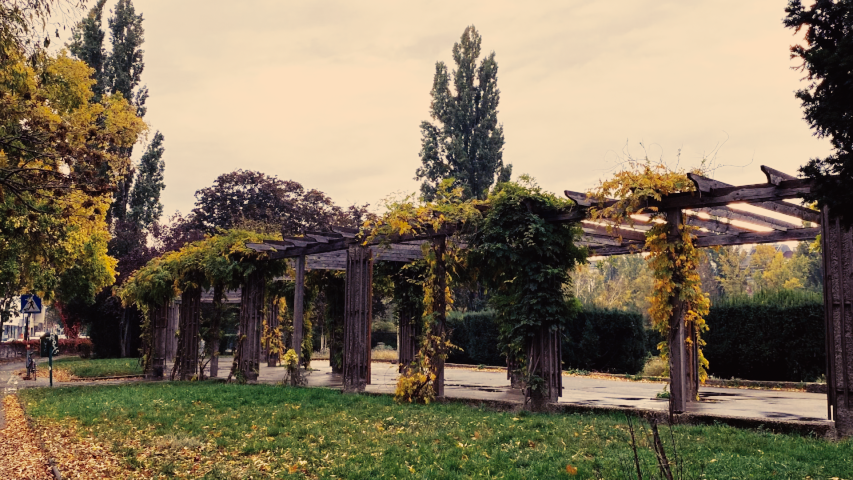
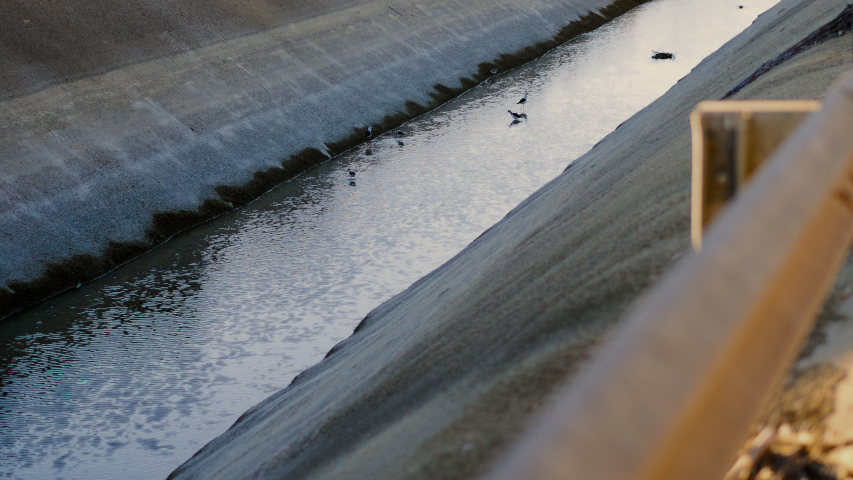
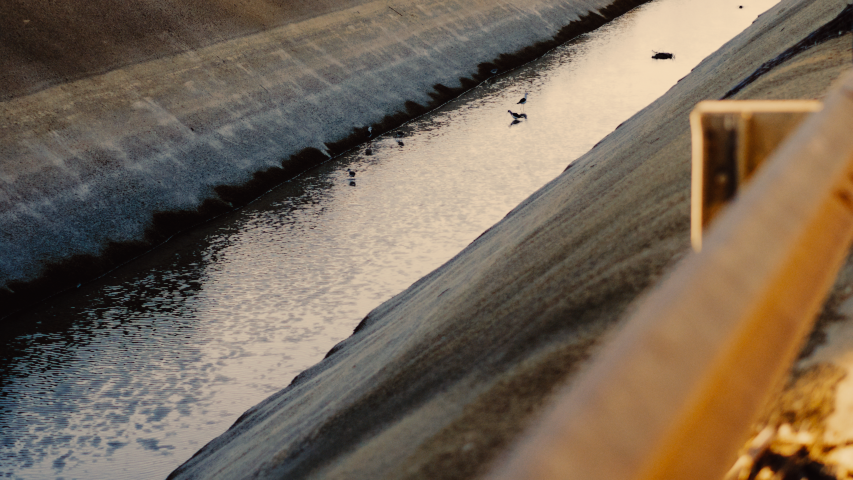
An Eastern-bloc home movie on a lamp-lit reversal film, neutral under tungsten lamps, with a weaving 16 mm frame. A surrogate built on Agfa RSX II 100 for an assumed 3400 K lamp. Original vs Ashigrain.
At a glance
- Exposure index
- 20
- Tungsten
- Introduced
- by 1964
- Process
- ORWO 9160
- Prints on
- Reversal, viewed directly
About the film
ORWOCOLOR UK 14 was a colour reversal film for artificial light from VEB Filmfabrik Wolfen in the German Democratic Republic: UK stands for Umkehr-Kunstlicht, reversal for artificial light, and 14 for its speed of 14 DIN. The 1964 ORWO general catalogue lists it for colour slides taken under special incandescent photographic lamps, exposed like a 14 DIN black-and-white negative, with duplicates possible from the slides.
It came in 135 cassettes of 36 and 20 exposures, a 12-exposure cassette for the Penti camera and roll films, and for cine in 16 mm, double-8 and 8 mm. In the cine sizes it was processed to a single projection-ready positive, an original rather than a print. ORWO's processing manual assigns it to reversal process 9160, with a first development, a second exposure and colour development. The Wolfen industrial and film museum holds a UK 14 box it dates to 1964, stamped to be exposed by July 1966, with an aluminium can holding a 36-exposure cassette, an instruction leaflet and an envelope for mailing the film to a laboratory. Its label, in German, English and French, marks it for slides at 14 DIN, 20 ASA. Its daylight sister in the same catalogue entry was ORWOCOLOR UT 16.
Sources for this history
- Gesamtkatalog Fotochemische Erzeugnisse (1964), VEB Filmfabrik Wolfen, Internet Archive
- Verarbeitung von ORWOCOLOR-Materialien – Rezepte, VEB Filmfabrik Wolfen, Internet Archive
- Kleinbildfilm Orwocolor UK 14 (21 February 2025 capture), Industrie- und Filmmuseum Wolfen, museum-digital
The look
ORWOCOLOR UK 14 was a 1960s colour reversal film from VEB Filmfabrik Wolfen for slides and home movies under photographic lamps, rated 14 DIN. Ashigrain's version is a labelled surrogate, a model inspired by the film rather than a reproduction, built on Agfa Agfachrome RSX II 100.


Best for
- Eastern-bloc 1960s home movies
- Lamp-lit family slides
- Standard 8 and double-8 pastiche
Compare camera films
Science & sources

A labelled surrogate inspired by the film, not a reproduction of UK 14. No measurement of it is published, so its curves, spectral sensitivity, dyes, MTF and grain are those of Agfa Agfachrome RSX II 100, with the curves moved for 14 DIN and the sensitivity rebalanced for an assumed 3400 K lamp. Its positive image is shown directly, without a print stage.
Response curves and the evidence behind the model
Compare manufacturer data with Ashigrain’s response on the same axes. These curves show how the model is calibrated to its sources; they do not establish a match to photographed film.
Characteristic response
RMS granularity
Density variation (σD). Where the datasheet gives a single grain value, the response away from that point is an approximation.
| Channel | Density | Datasheet-based σD | Model σD |
|---|---|---|---|
| R | 0.3 | 0.005479 | 0.005432 |
| G | 0.3 | 0.003551 | 0.003517 |
| B | 0.3 | 0.006656 | 0.006584 |
| R | 0.6 | 0.010865 | 0.010771 |
| G | 0.6 | 0.007092 | 0.007024 |
| B | 0.6 | 0.016018 | 0.015846 |
| R | 1 | 0.016794 | 0.016649 |
| G | 1 | 0.011294 | 0.011186 |
| B | 1 | 0.026698 | 0.026411 |
| R | 1.5 | 0.024479 | 0.024269 |
| G | 1.5 | 0.01798 | 0.017807 |
| B | 1.5 | 0.041597 | 0.04115 |
| R | 2 | 0.029164 | 0.028913 |
| G | 2 | 0.025078 | 0.024837 |
| B | 2 | 0.059021 | 0.058387 |
Model limits
These images show the film model in use. Spectral response, lighting and viewing conditions include approximations. Halation, bloom, grain size, weave and flicker are not fully measured for each film. The look of real film also depends on development and print timing.
- This is a labelled surrogate inspired by ORWOCOLOR UK 14, rather than a reproduction of it. No characteristic curve, spectral sensitivity, dye spectrum, MTF or grain measurement of the film is published.
- The characteristic curves, spectral sensitivity, dyes, MTF and grain are the named proxy Agfa Agfachrome RSX II 100, a later E-6-compatible film, not ORWO's 1960s dyes and reversal process 9160.
- The 14 DIN rating is taken as an ISO speed: the proxy's curves are moved 0.70 log H slower, an assumption.
- The catalogue names only photographic lamps. A 3400 K photoflood is assumed, and the proxy's sensitivity is offset per layer so that this lamp exposes each layer as daylight exposes the proxy.
- The model renders tungsten films under its 3200 K design light, so a grey exposed under the assumed 3400 K lamp renders slightly blue.
- The antihalation layer is not described; the proxy's undercoat is assumed.
- Custom lighting spectra, camera metering and the spectral reflectance inferred from fixed-white-balance footage are assumptions used by the model, not measurements of this film.
- Push and pull have no published curves for this film and use a generic model.
- Characteristic response outside the published exposure range is an extrapolation, not measured film data.
- The available sources do not measure veiling flare during projection. The model approximates its contribution to lifted blacks on screen, so the result is not a measured projection contrast.
Reciprocity: not modelled. Exposure time has no effect on this film.
Film guide: assumptions and practical choices
Sources
- Characteristic curves: Agfa Professional Films, Technical Data PF, Technical Data PF, 09/1998, 1st edition, p. 9
- Exposure index: Kleinbildfilm Orwocolor UK 14 (Industrie- und Filmmuseum Wolfen, museum-digital:sachsen-anhalt object 15220), Wayback Machine capture 20250221163924 of st.museum-digital.de/object/15220, p. 1
- Process: ORWOCOLOR Rezepte (1960s, archive.org OCR text), 1966 edition, p. 13