 Ashigrain
Colour reversal · 1990s
Kodak Ektachrome E200
Daylight slides with moderate contrast at 200.
Kodak Ektachrome E200 in Reversal mode. Original vs Ashigrain.
At a glance
- Exposure index
- 200
- Daylight
- Introduced
- c. 1997
- Discontinued
- Process
- E-6
- Prints on
- Reversal, viewed directly
About the film
Kodak Professional Ektachrome E200 is a daylight-balanced colour transparency film rated EI 200 and processed in E-6.
The Timeline of Historical Film Colors dates it to about 1997, as a distinct Ektachrome product rather than the beginning of the wider family. Kodak designed it for daylight or electronic flash, with conversion-filter guidance for other lighting. Kodak described its T-Grain emulsions as giving moderate contrast and allowing push processing to EI 800 with limited changes in contrast and colour balance. Its September 2005 technical sheet lists E200 in 135, 120 and 220, with E200 and SP404 codes for long rolls. The listed roll formats use acetate supports of different thicknesses. It was documented by Eastman Kodak Company and is discontinued, but the sources read do not establish an independently verified final production year.
Sources for this history
- KODAK PROFESSIONAL EKTACHROME Film E200 Technical Data, Eastman Kodak Company
- Kodak Professional Ektachrome Film E200, Timeline of Historical Film Colors, University of Zurich
The look
Kodak Ektachrome E200 is a daylight-balanced colour slide film rated EI 200, also intended for electronic flash. Kodak described moderate contrast and the ability to push to EI 800 with limited colour changes. Ashigrain uses Reversal mode by default; push processing uses a generic model.






Best for
- Daylight scenes needing 200-speed film
- Electronic-flash portraits
- Slides with moderate contrast
Compare camera films
Science & sources

Its tone, spectral sensitivity, individual dyes and per-layer MTF come from Kodak's September 2005 E-28 sheet. Grain is modelled from its own RMS 12 headline at gross density, with a gross-to-net conversion and a square-root density law. The published push table does not supply pushed curves.
Response curves and the evidence behind the model
Compare manufacturer data with Ashigrain’s response on the same axes. These curves show how the model is calibrated to its sources; they do not establish a match to photographed film.
Characteristic response
RMS granularity
Density variation (σD) measured through a 48 µm aperture. Where the datasheet gives a single grain value, the response away from that point is an approximation.
| Channel | Density | Datasheet-based σD | Model σD |
|---|---|---|---|
| R | 0.3 | 0.007868 | 0.007802 |
| G | 0.3 | 0.005335 | 0.005251 |
| B | 0.3 | 0.008008 | 0.00793 |
| R | 0.6 | 0.015526 | 0.015395 |
| G | 0.6 | 0.010753 | 0.010583 |
| B | 0.6 | 0.019806 | 0.019613 |
| R | 1 | 0.023375 | 0.023178 |
| G | 1 | 0.017794 | 0.017512 |
| B | 1 | 0.034136 | 0.033803 |
| R | 1.5 | 0.034756 | 0.034463 |
| G | 1.5 | 0.027797 | 0.027357 |
| B | 1.5 | 0.051177 | 0.050677 |
| R | 2 | 0.040057 | 0.03972 |
| G | 2 | 0.037493 | 0.0369 |
| B | 2 | 0.077374 | 0.076618 |
Model limits
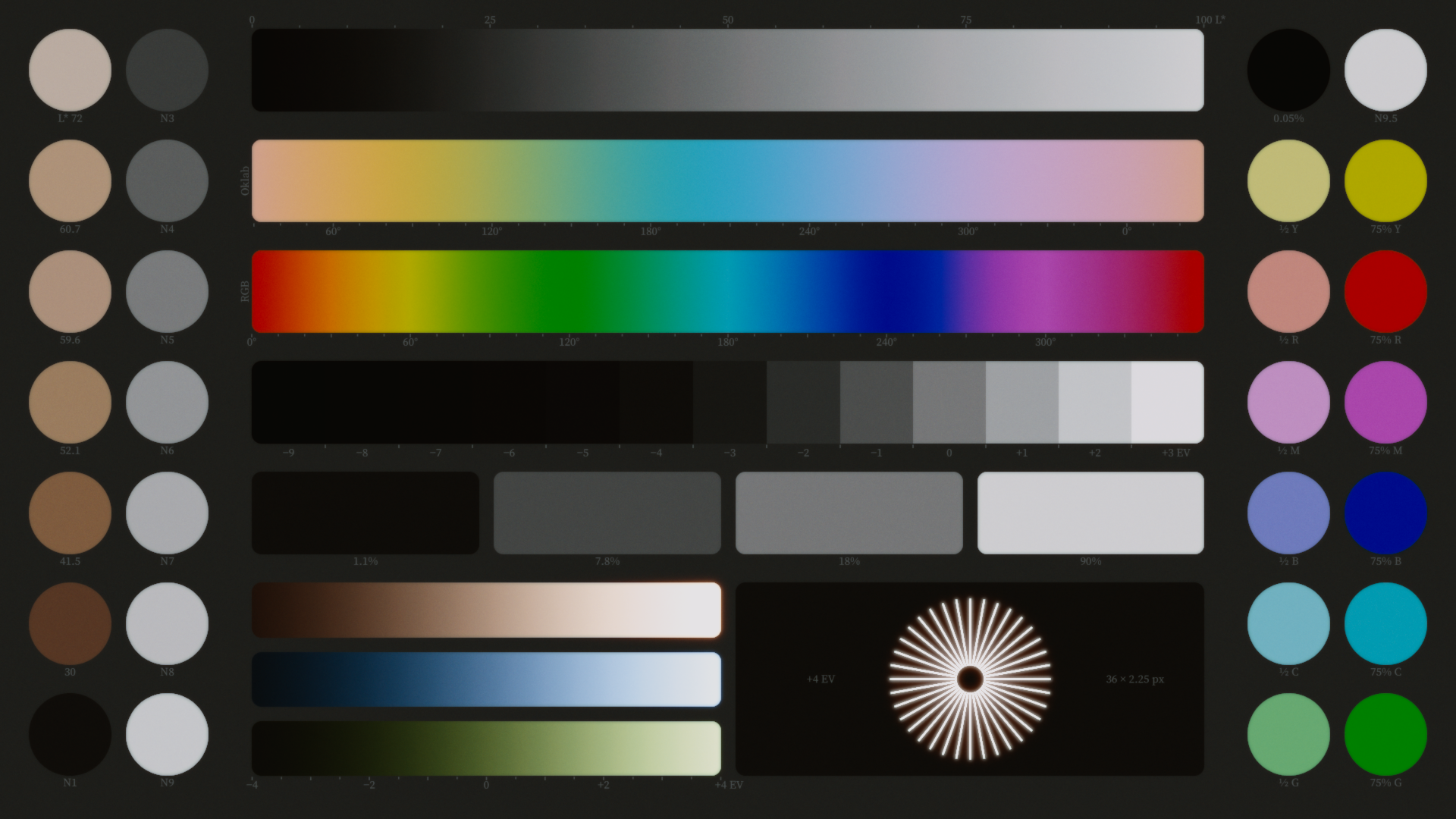
These images show the film model in use. Spectral response, lighting and viewing conditions include approximations. Halation, bloom, grain size, weave and flicker are not fully measured for each film. The look of real film also depends on development and print timing.
- Custom lighting spectra, camera metering and the spectral reflectance inferred from fixed-white-balance footage are assumptions used by the model, not measurements of this film.
- Conversion-filter spectra (80A for daylight films under tungsten, 85 for tungsten films in daylight) come from separate measured filter data, not from this film’s source. Applying those filters to this film remains modelled.
- The only grain datum is RMS granularity 12 × 10⁻³ at gross diffuse visual density 1.0, measured with a 48 µm aperture. Conversion to net density and extension with a square-root density law are modelled.
- Kodak publishes first-developer guidance for EI 320, EI 640 and EI 800 but no pushed curves. Push and pull use a generic model.
- The source does not state the MTF densitometry. Its individual red, green and blue MTF curves are used without a measured grain-versus-density curve.
- The yellow dye has no 700 nm grid value, and red sensitivity starts at 570.3 nm, leaving its 570 nm grid value missing. These missing samples are not measurements.
- The 2002 and 2005 editions print the same chart artwork. Their close agreement bounds extraction and edition differences, not independent film accuracy.
- The source records no reciprocity correction from 1/10000 s to 10 s. Reciprocity is not modelled for this film, and longer exposures receive no stock-specific correction.
- The physical dye-cloud or grain-clump size is inferred from the film's speed class, not measured for this film.
- Individual dye amounts, layer interactions and push/pull behaviour are approximated where the datasheet provides no calibration. Grain size is assumed; published RMS granularity does not specify dye-cloud size.
- The source names no antihalation layer; an undercoat is inferred rather than documented.
- Characteristic response outside the published exposure range is an extrapolation, not measured film data.
- Halation strength, radius and layer weights are not quantified by the datasheet. The effect of removing antihalation and the bloom response are also approximations.
- The available sources do not measure veiling flare during projection. The model approximates its contribution to lifted blacks on screen, so the result is not a measured projection contrast.
Reciprocity: not modelled. Exposure time has no effect on this film.
Film guide: assumptions and practical choices
Sources
- Exposure index: KODAK PROFESSIONAL EKTACHROME Film E200 Technical Data, E-28, September 2005, p. 2
- Process: KODAK PROFESSIONAL EKTACHROME Film E200 Technical Data, E-28, September 2005, p. 3
- Characteristic curves: KODAK PROFESSIONAL EKTACHROME Film E200 Technical Data, E-28, September 2005, p. 5
- Diffuse RMS granularity: KODAK PROFESSIONAL EKTACHROME Film E200 Technical Data, E-28, September 2005, p. 5