 Ashigrain
Colour negative · Vintage
Eastman EXR 500T
Kodak's fast EXR tungsten negative from 1989.
Eastman EXR 500T printed on its default EXR 5386: the 1990s fast tungsten chain. Original vs Ashigrain.
At a glance
- Exposure index
- 500
- Tungsten
- Introduced
- 1989
- Discontinued 1995
- Process
- ECN-2
About the film
Eastman EXR 500T 5296 is a high-speed, tungsten-balanced colour camera negative with a coloured-coupler mask, rated EI 500 in tungsten light and 320 in daylight.
Kodak's chronology lists it under 1989, the year Kodak marked the centenary of motion pictures by introducing its EXR colour negatives, and the Timeline of Historical Film Colors, independent of Kodak, also dates it from 1989. Kodak describes T-Grain emulsions in every layer except the fast yellow, and blue and green separation similar to that of 5295. The 16 mm version, 7296, cut from 5296, appears in Kodak's chronology under 1990. It is coated on a clear acetate safety base with a rem-jet backing, and Kodak's TI1664 sheet for it was reissued in 1992. Later Kodak 500T camera negatives carry their own codes, among them EXR 500T 5298, listed under 1994, and Vision 500T 5279, listed under 1996, and are different emulsions. Both Kodak's chronology and the Timeline end 5296 in 1995.
Sources for this history
- EASTMAN EXR 500T Film 5296, 7296 Technical Information (TI1664, reissued June 1992), Eastman Kodak Company
- Chronology of Film, Eastman Kodak Company
- Eastman EXR 500T Color Negative Film 5296, Timeline of Historical Film Colors, University of Zurich
The look
Eastman EXR 500T is a tungsten-balanced colour negative rated EI 500, or EI 320 in daylight with an 85 filter, with T-Grain emulsions in most of its layers. It belongs to the EXR family Kodak introduced in 1989. It prints on Eastman EXR 5386 by default.






Best for
- Late-1980s night interiors
- Tungsten-lit sets at 500 speed
- Early-1990s release-print looks
Compare camera films
Science & sources

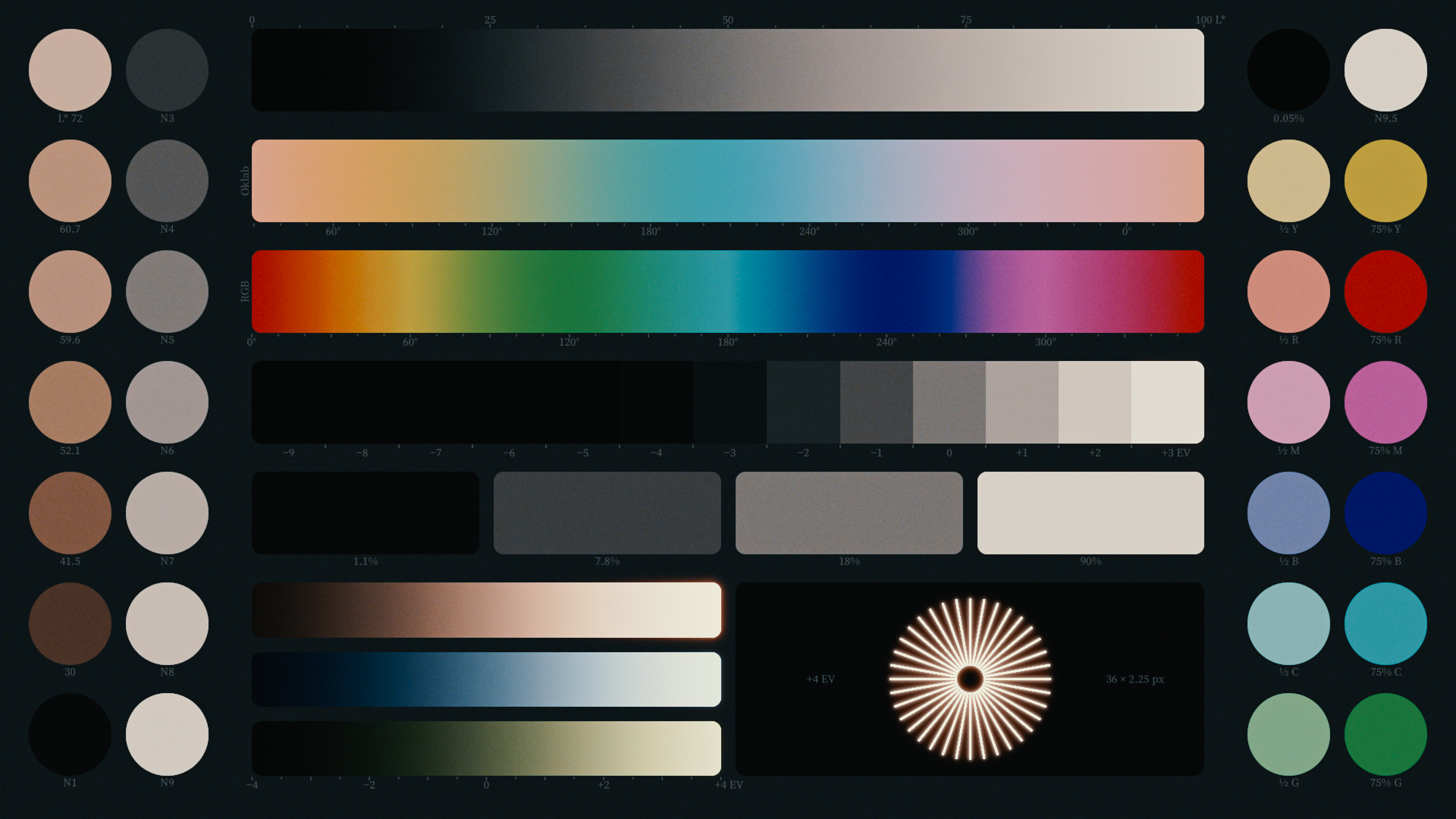
A tungsten-balanced colour negative with an exposure index of 500. Its individual dye shapes are borrowed from Kodak Vision3 200T and its grain from Kodak Vision3 500T, because its sheet prints only neutral dyes and its printed granularity scale reads far coarser than its EXR sibling's. It prints on Eastman EXR 5386 by default.
Response curves and the evidence behind the model
Compare manufacturer data with Ashigrain’s response on the same axes. These curves show how the model is calibrated to its sources; they do not establish a match to photographed film.
Characteristic response
RMS granularity
Density variation (σD) measured through a 48 µm aperture. Where the datasheet gives a single grain value, the response away from that point is an approximation.
| Channel | Density | Datasheet-based σD | Model σD |
|---|---|---|---|
| R | 0.3 | 0.007586 | 0.007468 |
| G | 0.3 | 0.009936 | 0.009694 |
| B | 0.3 | 0.027336 | 0.026738 |
| R | 0.6 | 0.005999 | 0.005905 |
| G | 0.6 | 0.007371 | 0.007192 |
| B | 0.6 | 0.019213 | 0.018793 |
| R | 1 | 0.005998 | 0.005904 |
| G | 1 | 0.008216 | 0.008016 |
| B | 1 | 0.020003 | 0.019565 |
Model limits
These images show the film model in use. Spectral response, lighting and viewing conditions include approximations. Halation, bloom, grain size, weave and flicker are not fully measured for each film. The look of real film also depends on development and print timing.
- Custom lighting spectra, camera metering and the spectral reflectance inferred from fixed-white-balance footage are assumptions used by the model, not measurements of this film.
- Colour-print timing and scan balance under arbitrary lighting are modelled. Scanner colour balance has no standard physical unit.
- The source specifies a 3200 K tungsten design light, not its spectrum. The design-light spectrum is an approximation.
- Conversion-filter spectra (80A for daylight films under tungsten, 85 for tungsten films in daylight) come from separate measured filter data, not from this film’s source. Applying those filters to this film remains modelled.
- Only a midscale neutral and a minimum-density spectrum are printed, not separate cyan, magenta and yellow dye spectra. The individual dye shapes are borrowed from Kodak Vision3 200T (5213), a proxy rather than this film's dyes.
- The sheet's printed granularity scale reads about 4 to 9.5 times that of its EXR 200T sibling and may be mislabelled. Grain is proxied from Kodak Vision3 500T (5219), not taken from this film's chart.
- The printed MTF rises above 100 %, which the model renders as a development adjacency effect. Its width, amplitude and dependence on density and development are not published and are approximated.
- The characteristic curves are printed only from log H −3.43 to −0.58; the response outside that range is extrapolated.
- The sheet states only that no reciprocity correction is needed from 1/1000 s to 1 s. Longer exposures get no correction.
- Individual dye amounts, layer interactions and push/pull behaviour are approximated where the datasheet provides no calibration. Grain size is assumed; published RMS granularity does not specify dye-cloud size.
- Halation strength, radius and layer weights are not quantified by the datasheet. The effect of removing antihalation and the bloom response are also approximations.
- The printer lamp and filter spectra and the Status A grey aim used in this preview are approximated; the source does not publish the required spectral or laboratory aim data.
Reciprocity: not modelled. Exposure time has no effect on this film.
Film guide: assumptions and practical choices
Sources
- Exposure index: EASTMAN EXR 500T Color Negative Film 5296 / 7296 Technical Information (TI1664), TI1664, Reissued 6-92, p. 1
- Process: EASTMAN EXR 500T Color Negative Film 5296 / 7296 Technical Information (TI1664), TI1664, Reissued 6-92, p. 3
- Diffuse RMS granularity: EASTMAN EXR 500T Color Negative Film 5296 / 7296 Technical Information (TI1664), TI1664, Reissued 6-92, p. 4
- Characteristic curves: EASTMAN EXR 500T Color Negative Film 5296 curve file ti1664b.pdf, Kodak curve file ti1664b.pdf for TI1664 (PDF created 2002-05-14), p. 1
- Diffuse RMS granularity: EASTMAN EXR 500T Color Negative Film 5296 curve file ti1664e.pdf, Kodak curve file ti1664e.pdf for TI1664 (PDF created 2002-05-07), p. 1
- Granularity density: EASTMAN EXR 500T Color Negative Film 5296 curve file ti1664e.pdf, Kodak curve file ti1664e.pdf for TI1664 (PDF created 2002-05-07), p. 1