 Ashigrain
Black-and-white negative · Black & white
Kodak Technical Pan
Extended-red black-and-white with development-dependent contrast.
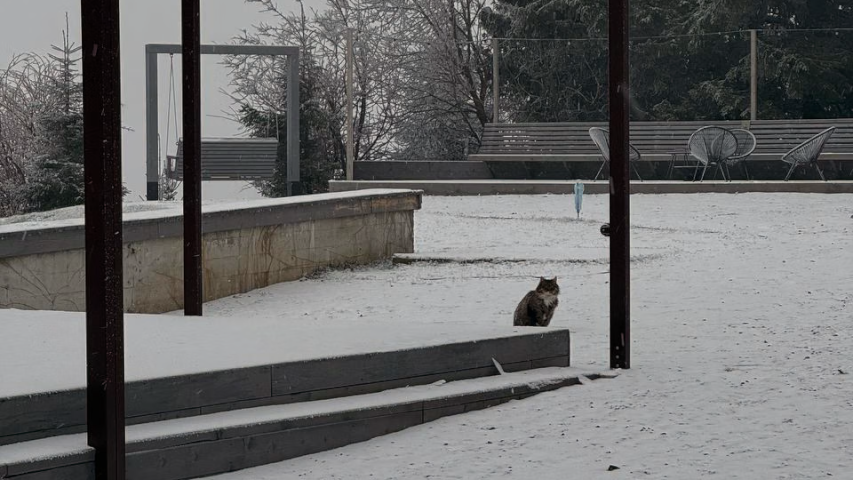
Kodak Technical Pan printed on Kodak B&W Print Film 2302. Original vs Ashigrain.
At a glance
- Exposure index
- 125
- Introduced
- c. 1977
- Discontinued
- Process
- KODAK HC-110 Developer (Dilution D), small tank, 20 C (68 F), 8 min
About the film
Kodak Professional Technical Pan was a variable-contrast panchromatic black-and-white film with extended red sensitivity.
Jürgen Linder's history of comet photography dates Technical Pan 2415 to about 1977 and describes its place in comet photography. Kodak listed pictorial photography, photomicrography, microfilming, solar photography, electrophoretic gels and laser recording among its applications. The maker explained that development controlled contrast, with TECHNIDOL giving a low-contrast pictorial result and other treatments producing higher contrast. Its product codes were 2415 for 135, 6415 for 120 and 4415 for sheets, with different supports for those formats. Kodak's June 2003 sheet carried a discontinuance notice, saying that the final coating had already taken place years earlier and sales would continue only while inventory remained. It was documented by Eastman Kodak Company and is discontinued, but neither the sheet's header date nor the single historical account independently establishes its final production year.
Sources for this history
- KODAK PROFESSIONAL Technical Pan Film Technical Data, Eastman Kodak Company
- interstellarum THEMA 1/2014: Astrofotografie, Jürgen Linder / Oculum-Verlag
The look
Kodak Technical Pan is a panchromatic black-and-white film with extended red response and developer-dependent contrast. This model uses HC-110 Dilution D for 8 minutes at 20 °C, at EI 125, rather than the low-contrast TECHNIDOL treatment. It prints on Kodak 2302 by default.





Best for
- High-contrast technical subjects
- Photomicrography and microfilm looks
- Exploring extended-red tonal response
Compare camera films
Science & sources


The curve represents HC-110 Dilution D, small tank, 8 minutes at 20 °C, with the sheet's EI 125 and gamma 2.00. It is not the low-contrast TECHNIDOL treatment. MTF, spectral sensitivity and the RMS 8 grain headline use the HC-110 condition; grain away from that headline is modelled. It prints on Kodak 2302 by default.
Response curves and the evidence behind the model
Compare manufacturer data with Ashigrain’s response on the same axes. These curves show how the model is calibrated to its sources; they do not establish a match to photographed film.
Characteristic response
RMS granularity
Density variation (σD) measured through a 48 µm aperture. Where the datasheet gives a single grain value, the response away from that point is an approximation.
| Channel | Density | Datasheet-based σD | Model σD |
|---|---|---|---|
| N | 0.3 | 0.004382 | 0.004297 |
| N | 0.6 | 0.006197 | 0.006076 |
| N | 1 | 0.008 | 0.007845 |
| N | 1.5 | 0.009798 | 0.009608 |
| N | 2 | 0.011314 | 0.011094 |
Model limits
These images show the film model in use. Spectral response, lighting and viewing conditions include approximations. Halation, bloom, grain size, weave and flicker are not fully measured for each film. The look of real film also depends on development and print timing.
- Custom lighting spectra, camera metering and the spectral reflectance inferred from fixed-white-balance footage are assumptions used by the model, not measurements of this film.
- The source gives no colour balance. Daylight calibration and spectrally neutral silver density are assumptions.
- The model uses the HC-110 Dilution D small-tank curve developed for 8 minutes at 20 °C, at EI 125 and printed gamma 2.00. This does not model the low-contrast TECHNIDOL treatment or establish a universal ISO speed for Technical Pan.
- The density curve was exposed under tungsten for 1/25 s and is used as printed, without a measured conversion to a daylight-exposed curve. Diffuse densitometry is inferred from the sheet's image-structure data rather than stated on that chart.
- Only RMS granularity 8 × 10⁻³ at net diffuse density 1.0 with a 48 µm aperture is used, under HC-110 development. Its response at other densities uses a square-root density law; the TECHNIDOL value of 5 is not this model's grain condition.
- The physical silver-clump diameter is assumed to be 4.5 µm from the speed class; it is not measured by the RMS granularity value.
- Other developers and times are recorded but are not calibrated whole-stop push sets. Push and pull use a generic model.
- The toe below log H −2.0 and the response beyond 0.8 are extrapolated. The unprinted toe prevents the Kodak contrast-index arc construction from being determined.
- The processed sensitivity ends at 695 nm; no measured 700 nm grid value is available.
- The printed MTF rises above 100 %, which the model renders as a development adjacency effect. Its width, amplitude and dependence on density and development are not published and are approximated.
- The adjacency fit uses two parameters per layer and cannot follow every printed MTF sample. Its dependence on local density differences is also assumed.
- For 135 film, the sheet's 100 µm ESTAR-AH support and built-in 0.1 neutral density inform the grey-base interpretation of halation. The stated base density is informational, not added again to the measured tone curve; other formats do not have separately measured halation geometry.
- The default halation-radius scale is referenced to Kodak Vision3 500T (5219), whose base thickness is not published. The thickness scaling is therefore an assumption.
- The sheet prints reciprocity corrections at a few exposure times; the correction between them is interpolated.
- The exposure correction is modelled, but the source's development-time adjustments for short and long exposures are not. Their associated contrast and speed changes are not calibrated.
- Only one vector edition is available, so there is no independent digitisation-error measurement.
- In the print branch it prints on Kodak B&W Print Film 2302 by default. Black-and-white print timing is modelled.
- Halation strength, radius and layer weights are not quantified by the datasheet. The effect of removing antihalation and the bloom response are also approximations.
- The available sources do not measure veiling flare during projection. The model approximates its contribution to lifted blacks on screen, so the result is not a measured projection contrast.
Reciprocity: modelled from 1/10000 s to 100 s, following the datasheet's corrections for long and short exposures. Exposure time stops at the ends of that range.
Film guide: assumptions and practical choices
Sources
- Exposure index: KODAK PROFESSIONAL Technical Pan Film Technical Data, P-255, June 2003, p. 4
- Diffuse RMS granularity: KODAK PROFESSIONAL Technical Pan Film Technical Data, P-255, June 2003, p. 9
- Characteristic curves: KODAK PROFESSIONAL Technical Pan Film Technical Data, P-255, June 2003, p. 10
- Process: KODAK PROFESSIONAL Technical Pan Film Technical Data, P-255, June 2003, p. 10