 Ashigrain
Colour negative · 2006 onward
Kodak Verita 200D
The daylight negative Kodak made for Euphoria.
Saturated daylight colour and warm skin, the classic look Kodak describes for the stock it made for Euphoria. Original vs Ashigrain.
At a glance
- Exposure index
- 200
- Daylight
- Introduced
- 2026
- In production
- Process
- ECN-2
About the film
Kodak dates Verita 200D to April 2026, when it announced the film as a new addition to its motion-picture range.
Kodak developed it with writer-director Sam Levinson and cinematographer Marcell Rév for the look of the third season of HBO's Euphoria, and American Cinematographer gives the same account of its origin. According to the magazine, Kodak first said it lacked the staff to bring out a new stock, so its Rochester engineers had Rév shoot existing still-photography films, process them by motion-picture methods and report which came closest to what he wanted. Kodak's own account describes the film as a pilot stock at first, made with its film design team for that season's look. Kodak describes a medium-speed daylight film with saturated colour, warm skin tones and a shorter dynamic range than its Vision3 films. Rév describes it as having a steeper curve, more contrast and colour separation and less sensitivity than Vision3, and says it copes better with overexposure than with underexposure, which turns it milky. Kodak's Vanessa Bendetti told the magazine that it carries more silver than Vision3 and is made in smaller batches, which is why it costs more. Coded 5206 in 35 mm and 65 mm and 7206 in 16 mm, it is in production, sold through Kodak's sales representatives with prices on application.
Sources for this history
- KODAK VERITA 200D Color Negative Film 5206 / 7206 Technical Data (H-1-5206, April 2026), Eastman Kodak Company
- Kodak expands motion picture portfolio with KODAK VERITA 200D Color Negative Film, Eastman Kodak Company
- Kodak News: KODAK VERITA 200D Color Negative Film 5206 / 7206, Eastman Kodak Company
- KODAK Motion Picture Products Price Catalog for the United States (effective 28 August 2026), Eastman Kodak Company
- VERITA 200D Color Negative Film 5206/7206, Eastman Kodak Company
- KODAK VERITA 200D Color Negative Film, Newsshooter
- KODAK VERITA 200D Film Stock Announced: A New Color Negative Born From Euphoria Season 3, CineD
- Kodak's Verita 200D: How It Was Born, and How It Changed the Look of Euphoria, American Society of Cinematographers
- How DP Marcell Rév embraced 65mm for 'Euphoria' Season 3 with a lush 'pilot stock' that became Kodak's innovative VERITA 200D, Eastman Kodak Company
The look
Kodak Verita 200D is a daylight colour negative rated EI 200, with saturated colour, warm skin tones and a shorter dynamic range than Vision3. Kodak notes that scans of its highlights lean towards magenta, which grading can correct. It prints on Kodak 2393 by default.






Best for
- Daylight portraits and warm skin tones
- Saturated exteriors in bright sun
- Contrasty drama with a classic look
Compare camera films
Science & sources

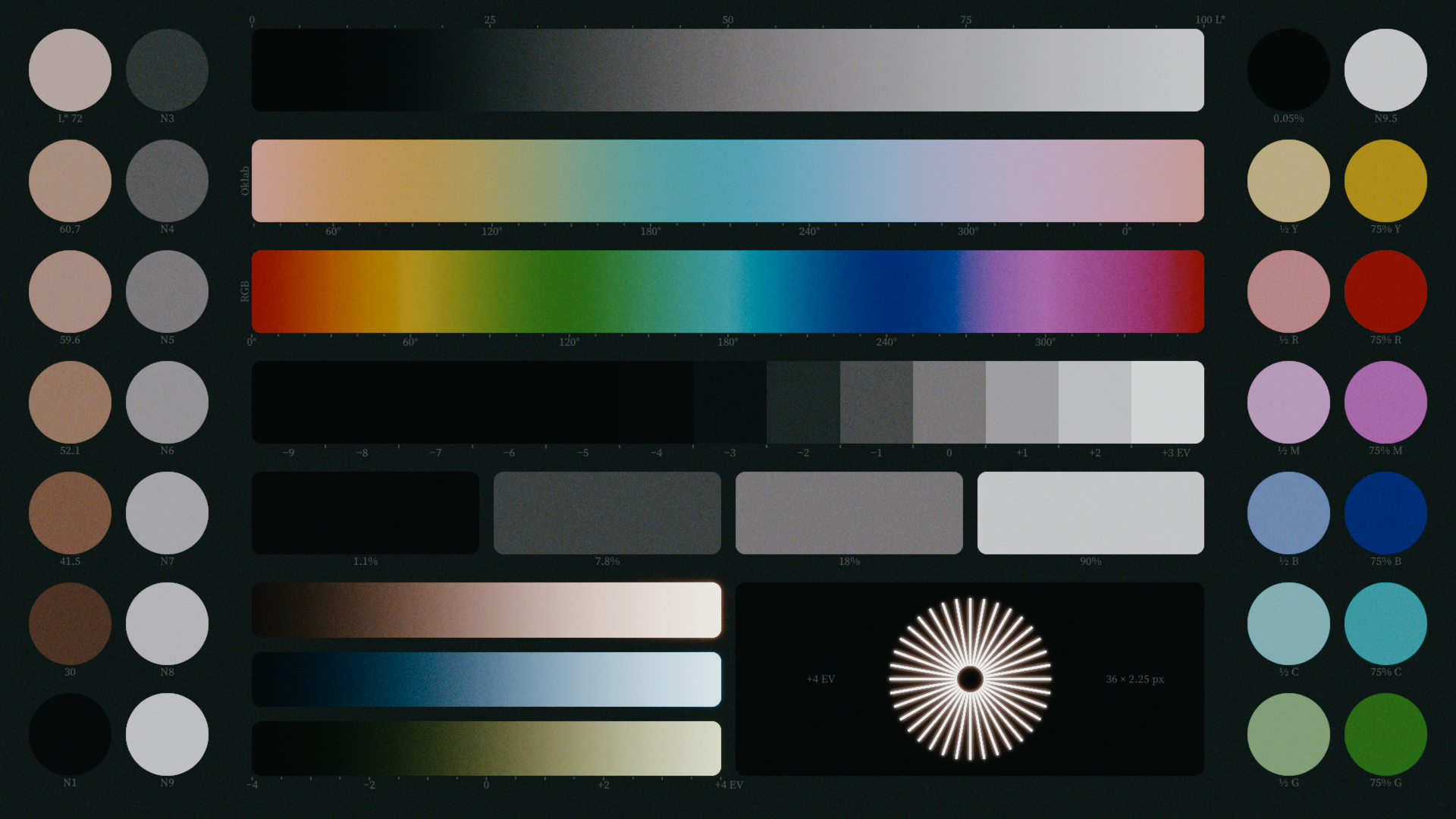
A daylight-balanced colour negative with an exposure index of 200. Compare its response through the Kodak 2393 print stage. Its individual dye shapes are borrowed from Kodak Vision3 250D, because the datasheet does not publish them, and the magenta lean Kodak describes in scanned highlights is rendered only through the printed curves.
Response curves and the evidence behind the model
Compare manufacturer data with Ashigrain’s response on the same axes. These curves show how the model is calibrated to its sources; they do not establish a match to photographed film.
Characteristic response
RMS granularity
Density variation (σD) measured through a 48 µm aperture. Where the datasheet gives a single grain value, the response away from that point is an approximation.
| Channel | Density | Datasheet-based σD | Model σD |
|---|---|---|---|
| R | 0.3 | 0.014094 | 0.013958 |
| G | 0.3 | 0.00905 | 0.008827 |
| B | 0.3 | 0.019664 | 0.019448 |
| R | 0.6 | 0.009292 | 0.009203 |
| G | 0.6 | 0.00737 | 0.007188 |
| B | 0.6 | 0.019139 | 0.018929 |
| R | 1 | 0.00745 | 0.007379 |
| G | 1 | 0.006659 | 0.006494 |
| B | 1 | 0.01825 | 0.018049 |
| R | 1.5 | 0.007644 | 0.007571 |
| G | 1.5 | 0.00661 | 0.006447 |
| B | 1.5 | 0.015378 | 0.015209 |
| R | 2 | 0.006726 | 0.006661 |
| B | 2 | 0.01322 | 0.013074 |
Model limits
These images show the film model in use. Spectral response, lighting and viewing conditions include approximations. Halation, bloom, grain size, weave and flicker are not fully measured for each film. The look of real film also depends on development and print timing.
- Custom lighting spectra, camera metering and the spectral reflectance inferred from fixed-white-balance footage are assumptions used by the model, not measurements of this film.
- Colour-print timing and scan balance under arbitrary lighting are modelled. Scanner colour balance has no standard physical unit.
- The datasheet rates the film for daylight only and gives no tungsten exposure index. The optional conversion filters use separate measured spectra; the source does not calibrate their effect on this film.
- Only a midscale neutral and a minimum-density spectrum are printed, not separate cyan, magenta and yellow dye spectra. The individual dye shapes are borrowed from Kodak Vision3 250D (5207), a proxy rather than this film's dyes.
- Individual dye amounts, layer interactions and push/pull behaviour are approximated where the datasheet provides no calibration. Grain size is assumed; published RMS granularity does not specify dye-cloud size.
- The granularity chart uses its own relative exposure axis, measured on different equipment from the characteristic curves. Grain is matched to density on that chart's axis; no link to the curves' exposure scale is assumed.
- Characteristic response outside the published exposure range is an extrapolation, not measured film data.
- Halation strength, radius and layer weights are not quantified by the datasheet. The effect of removing antihalation and the bloom response are also approximations.
- The printer lamp and filter spectra and the Status A grey aim used in this preview are approximated; the source does not publish the required spectral or laboratory aim data.
Reciprocity: not modelled. Exposure time has no effect on this film.
Film guide: assumptions and practical choices
Sources
- Exposure index: KODAK VERITA 200D Color Negative Film 5206 / 7206 Technical Data, H-1-5206, p. 1
- Process: KODAK VERITA 200D Color Negative Film 5206 / 7206 Technical Data, H-1-5206, p. 2
- Diffuse RMS granularity: KODAK VERITA 200D Color Negative Film 5206 / 7206 Technical Data, H-1-5206, p. 3
- Granularity density: KODAK VERITA 200D Color Negative Film 5206 / 7206 Technical Data, H-1-5206, p. 3
- Characteristic curves: KODAK VERITA 200D Color Negative Film 5206 / 7206 Technical Data, H-1-5206, p. 4