 Ashigrain
Colour screen reversal · Experimental
Dufaycolor
Additive colour through a visible red-green-blue mosaic.
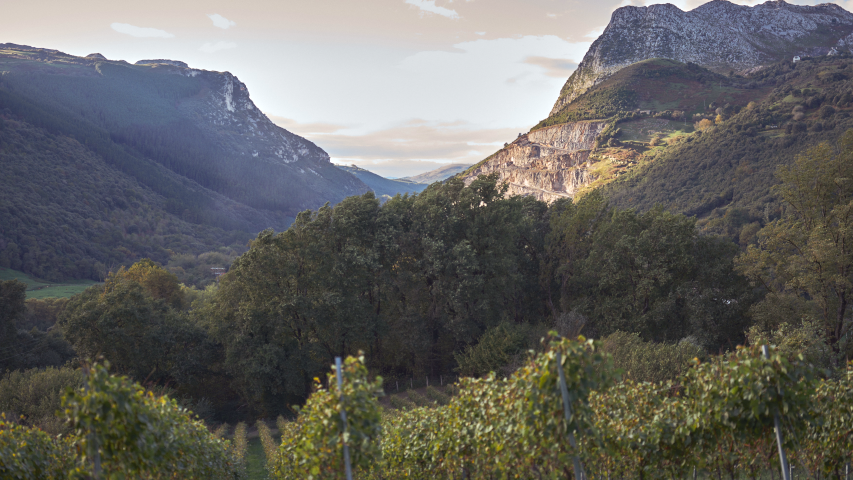
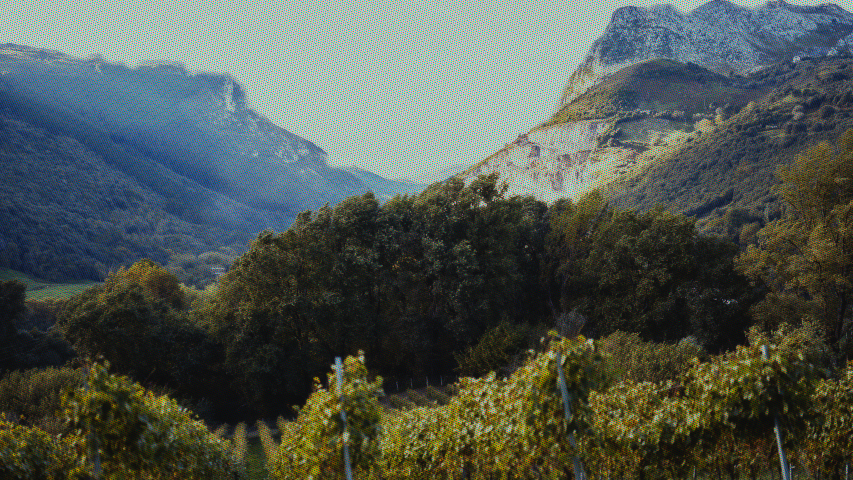
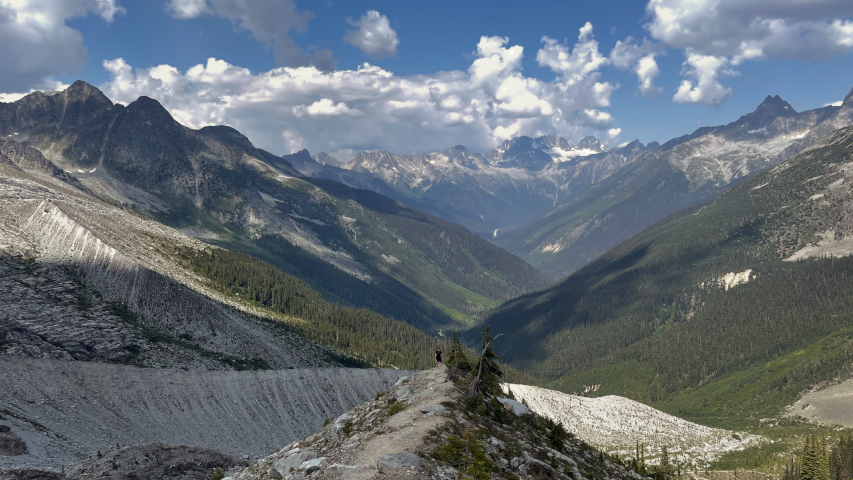
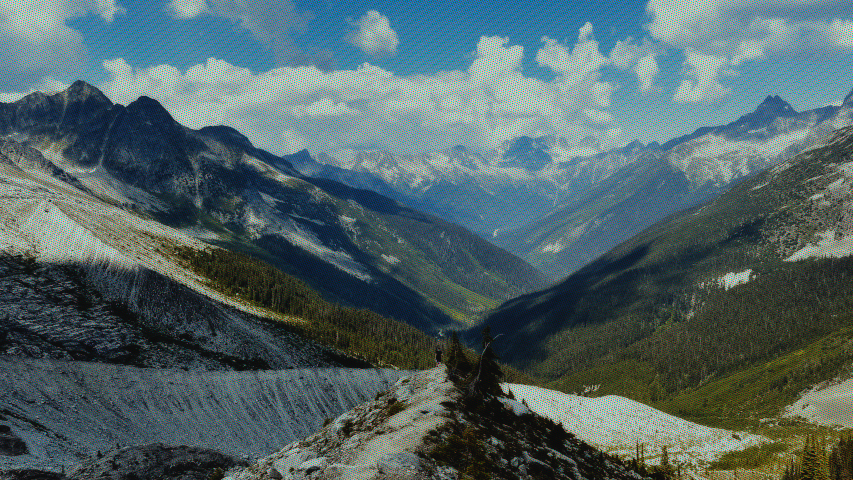
Muted 1930s documentary colour seen through a visible red-green-blue mosaic. A model inspired by the additive screen process, not a reproduction. Original vs Ashigrain.
At a glance
- Exposure index
- 50
- Daylight
- Introduced
- 1930s
- Discontinued
- Process
- black-and-white reversal to a high-contrast monochrome transparency
- Prints on
- Reversal, viewed directly
About the film
Louis Dufay devised the mosaic colour screen behind Dufaycolor for still photography in 1908.
The film itself appeared in the 1930s from Dufaycolor Ltd., later Dufay-Chromex, and the Timeline of Historical Film Colors credits Dufay together with Thomas Thorne Baker and Charles Bonamico. Its base carried a réseau of red lines and alternating green and blue squares, separated by a varnish layer from a single panchromatic emulsion, and the film was loaded with the base towards the lens. After exposure it was reversed to a positive and viewed in daylight through the same mosaic. Because it ran in ordinary black-and-white cameras, it was a cheaper alternative to Technicolor, made in 35 mm and 16 mm and used for documentaries, experimental films and home movies. Its filters absorbed up to 80 % of the light, so it needed strong light and gave muted colours, and printing from negatives caused moiré. The films the Timeline lists run from Hans Richter's Wir leben in einer neuen Zeit! (1938) to Giorgio Ferroni's L'ebbrezza del cielo (1940). It came late among the additive screen processes but was among the most refined and best documented, and it was produced until the late 1950s.
Sources for this history
- Understanding colors of Dufaycolor: Can we recover them using historical colorimetric and spectral data? (arXiv:2501.06216), Jan Hubička, Linda Kimrová, Melichar Konečný
- Dufaycolor, Timeline of Historical Film Colors
The look
Dufaycolor was an additive colour-screen film of the 1930s to 1950s: one panchromatic emulsion behind a fine mosaic of red lines and green and blue squares. Ashigrain's version is a labelled surrogate, a model inspired by the process rather than a reproduction, and the mosaic stays visible in the image.


Best for
- Muted 1930s documentary looks
- Home-movie and amateur colour pastiche
- Textured, screen-patterned art films
Compare camera films
Science & sources

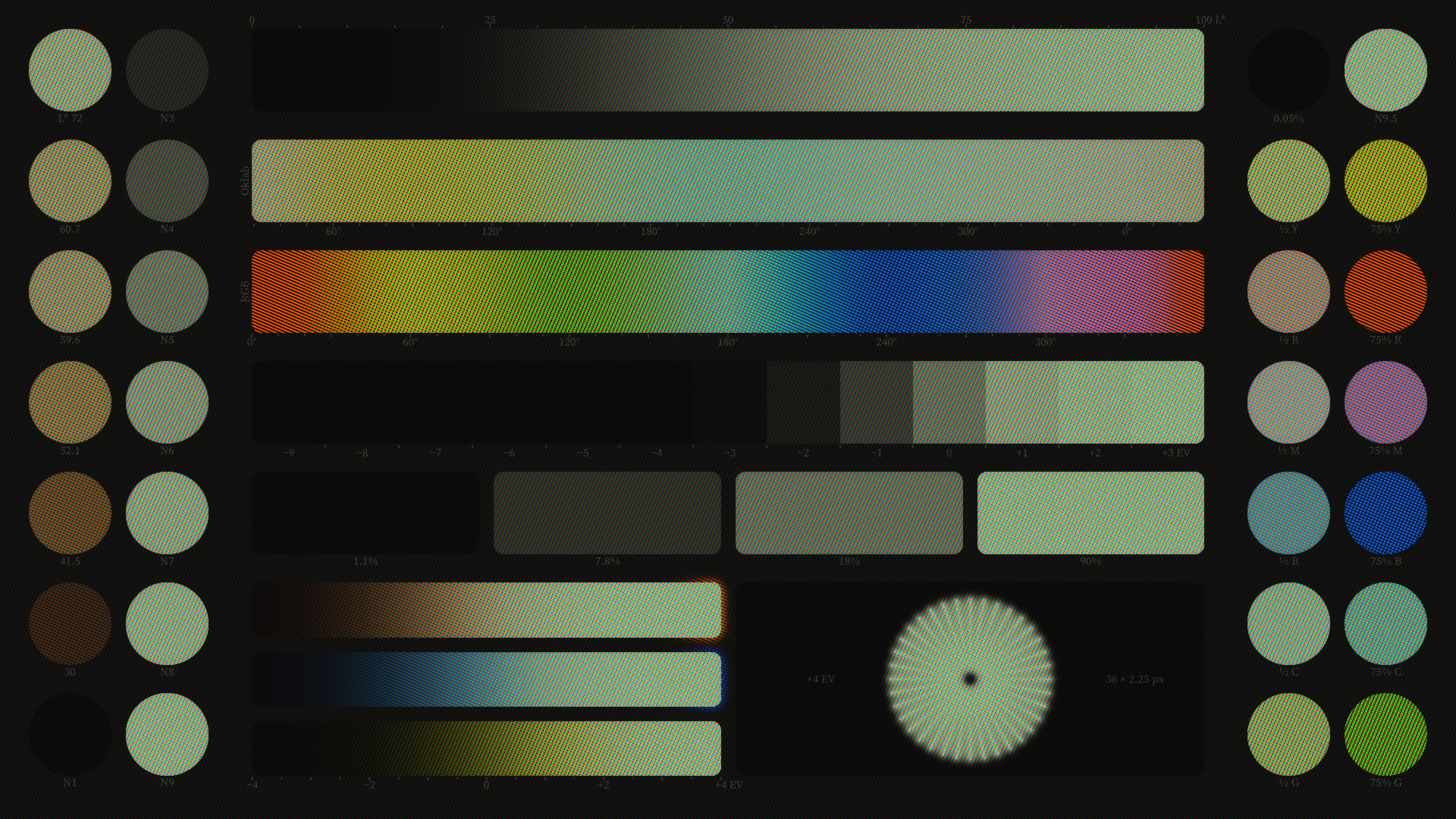
A model inspired by the additive screen process, not a reproduction of Dufaycolor. No sensitometric data of the film exists, so its silver record is borrowed from Kodak Tri-X Reversal 7266, with that film's curve, sensitivity and MTF, and its grain from Kodak Double-X 5222, while the mosaic's geometry and colours follow published measurements.
Response curves and the evidence behind the model
Compare manufacturer data with Ashigrain’s response on the same axes. These curves show how the model is calibrated to its sources; they do not establish a match to photographed film.
Characteristic response
RMS granularity
Density variation (σD). Where the datasheet gives a single grain value, the response away from that point is an approximation.
| Channel | Density | Datasheet-based σD | Model σD |
|---|---|---|---|
| R | 0.3 | 0.009426 | 0.009293 |
| G | 0.3 | 0.009426 | 0.00926 |
| B | 0.3 | 0.009426 | 0.009267 |
| R | 0.6 | 0.010914 | 0.01076 |
| G | 0.6 | 0.010914 | 0.010722 |
| B | 0.6 | 0.010914 | 0.01073 |
| R | 1 | 0.012308 | 0.012135 |
| G | 1 | 0.012308 | 0.012091 |
| B | 1 | 0.012308 | 0.012101 |
| R | 1.5 | 0.012607 | 0.012429 |
| G | 1.5 | 0.012607 | 0.012385 |
| B | 1.5 | 0.012607 | 0.012395 |
| R | 2 | 0.013571 | 0.01338 |
| G | 2 | 0.013571 | 0.013332 |
| B | 2 | 0.013571 | 0.013343 |
Model limits
These images show the film model in use. Spectral response, lighting and viewing conditions include approximations. Halation, bloom, grain size, weave and flicker are not fully measured for each film. The look of real film also depends on development and print timing.
- This is a model inspired by the Dufaycolor screen process, rather than a reproduction of the original film.
- No characteristic curve, spectral sensitivity, MTF or grain measurement of Dufaycolor exists in the sources. The silver record is the named proxy Kodak Tri-X Reversal 7266, with its curve, panchromatic sensitivity and MTF, and grain is proxied from Kodak Double-X 5222.
- The réseau is drawn as a visible mosaic of red lines and green and blue squares at 20 lines per millimetre, within the published range; its angle and element areas are estimates.
- The element colours are period spectra corrected to the published colorimetry. How projection blurred and mixed the mosaic, and how a display pixel samples it, are approximated.
- The proxy's sensitivity is printed only to 640 nm, so the red elements record light from 590 to 640 nm only.
- The exposure index of 50 is an assumption: the proxy's EI 200 reduced by the screen's light loss.
- Under custom lights the fast rendering path follows the full spectral calculation less closely for this film than for most others.
- Custom lighting spectra, camera metering and the spectral reflectance inferred from fixed-white-balance footage are assumptions used by the model, not measurements of this film.
- Push and pull have no published curves for this film and use a generic model.
- Characteristic response outside the published exposure range is an extrapolation, not measured film data.
- The available sources do not measure veiling flare during projection. The model approximates its contribution to lifted blacks on screen, so the result is not a measured projection contrast.
Reciprocity: not modelled. Exposure time has no effect on this film.
Film guide: assumptions and practical choices
Sources
- Process: J. Hubicka, L. Kimrova, M. Konecny: Understanding colors of Dufaycolor: Can we recover them using historical colorimetric and spectral data? (arXiv:2501.06216v1), arXiv 2501.06216v1, submitted 2025-01-05 (9 pp), p. 2
- Characteristic curves: KODAK TRI-X Reversal Film 7266 Technical Data, H-1-7266t, Revised 7-15, p. 3