 Ashigrain
Barwny film pozytywowy · Film pozytywowy
Trucolor Print (two-colour)
Dwubarwna kopia Trucolor, barwiona na niebiesko i czerwono.
A labelled surrogate of Trucolor's two-colour print, a blue dye on one side and a red dye on the other: a two-record image with a narrow gamut. Original vs Ashigrain.
W skrócie
- Wprowadzenie
- połowa lat 1940.
- Wycofany
- Proces
- Trucolor double-coated coupler print (one colour developer forms a blue dye on one side and a red dye on the other; silver bleached and fixed out; silver-compound sound track)
- Gęstość maksymalna
- ≈ 2,6
O filmie
Trucolor był dwubarwnym procesem kopiowania prowadzonym przez Consolidated Film Industries, laboratorium Republic Pictures.
Brian Coe, cytowany przez Timeline of Historical Film Colors, podaje, że użyto go w 1946 roku przy Out California Way. Coe nazywa go jedynym znaczącym nowym procesem dwubarwnym po II wojnie światowej, gdy większość metod dwubarwnych poza Cinecolor była przestarzała, a American WideScreen Museum opisuje go jako odpowiedź Republic na Cinecolor. Kopie wykonywano z negatywów bipack, głównie dla filmów klasy B. Raport Society of Motion Picture Engineers z 1948 roku opisuje taśmę kopiową jako podłoże bezpieczne polewane z obu stron emulsjami pozytywowymi zawierającymi sprzęgacze barwne, z których jeden tworzył niebieski barwnik, a drugi czerwony w tym samym wywoływaczu. Wybielanie i utrwalanie usuwały następnie srebro, pozostawiając dwa obrazy barwnikowe, a ścieżka dźwiękowa pozostawała związkiem srebra. Coe pisze, że po 1950 roku Trucolor używał nowoczesnych taśm barwnych, a do 1954 roku proces dwubarwny był przestarzały i jego ostatnia usługa kopiowania została zamknięta.
Źródła tej historii
- Trucolor 2 color, Timeline of Historical Film Colors
- Report of SMPE Progress Committee (Journal of the SMPE 50, June 1948, pp. 523–542), Society of Motion Picture Engineers, Internet Archive
- Cinecolor, American WideScreen Museum
Charakter obrazu
Trucolor był dwubarwnym procesem kopiowania Consolidated Film Industries, laboratorium Republic Pictures, używanym już w 1946 roku. Jego taśma była polewana z obu stron, tworząc niebieski barwnik po jednej i czerwony po drugiej. Wersja Ashigrain to oznaczony zamiennik, model inspirowany kopią, a nie jej reprodukcja.

Najlepsze zastosowania
- Filmy klasy B wytwórni Republic z końca lat 40.
- Porównanie Trucolor z Cinecolor
- Dwubarwna stylizacja epoki
Porównaj filmy pozytywowe
The same Vision3 500T night frame on each print film: how deep the blacks go, how the highlights roll off and how the colour separates.
The same Vision3 500T night frame on each print film: how deep the blacks go, how the highlights roll off and how the colour separates.
The same Vision3 500T night frame on each print film: how deep the blacks go, how the highlights roll off and how the colour separates.
The same Vision3 500T night frame on each print film: how deep the blacks go, how the highlights roll off and how the colour separates.
The same Vision3 500T night frame on each print film: how deep the blacks go, how the highlights roll off and how the colour separates.
The same Vision3 500T night frame on each print film: how deep the blacks go, how the highlights roll off and how the colour separates.
The same Vision3 500T night frame on each print film: how deep the blacks go, how the highlights roll off and how the colour separates.
The same Vision3 500T night frame on each print film: how deep the blacks go, how the highlights roll off and how the colour separates.
The same Vision3 500T night frame on each print film: how deep the blacks go, how the highlights roll off and how the colour separates.
The same Vision3 500T night frame on each print film: how deep the blacks go, how the highlights roll off and how the colour separates.
The same Vision3 500T night frame on each print film: how deep the blacks go, how the highlights roll off and how the colour separates.
The same Vision3 500T night frame on each print film: how deep the blacks go, how the highlights roll off and how the colour separates.
The same Vision3 500T night frame on each print film: how deep the blacks go, how the highlights roll off and how the colour separates.
The same Vision3 500T night frame on each print film. On this two-colour print (a labelled surrogate) every colour falls between blue-green and red-orange: how deep the blacks go, how the highlights roll off and which lights keep their hue.
The same Vision3 500T night frame on each print film: how deep the blacks go, how the highlights roll off and how the colour separates.
The same Vision3 500T night frame on each print film: how deep the blacks go, how the highlights roll off and how the colour separates.
The same Vision3 500T night frame on each print film: how deep the blacks go, how the highlights roll off and how the colour separates.
The same Vision3 500T night frame on each print film: how deep the blacks go, how the highlights roll off and how the colour separates.
The same Vision3 500T night frame on each print film: how deep the blacks go, how the highlights roll off and how the colour separates.
The same Vision3 500T night frame on each print film: how deep the blacks go, how the highlights roll off and how the colour separates.
The same Vision3 500T night frame on each print film: how deep the blacks go, how the highlights roll off and how the colour separates.
The same Vision3 500T night frame on each print film: how deep the blacks go, how the highlights roll off and how the colour separates.
The same Vision3 500T night frame on each print film: how deep the blacks go, how the highlights roll off and how the colour separates.
The same Vision3 500T night frame on each print film: how deep the blacks go, how the highlights roll off and how the colour separates.
The same Vision3 500T night frame on each print film. On this blue-sensitive black-and-white print the colour negative turns grey: how deep the blacks go, how the highlights roll off and how dark the reds and greens print.
The same Vision3 500T night frame on each print film: how deep the blacks go, how the highlights roll off and how the colour separates.
The same Vision3 500T night frame on each print film. On this blue-sensitive black-and-white print the colour negative turns grey: how deep the blacks go, how the highlights roll off and how dark the red neon and skin print.
The same Vision3 500T night frame on each print film: how deep the blacks go, how the highlights roll off and how the colour separates.
The same Vision3 500T night frame on each print film. On this black-and-white print the colour negative turns grey: how deep the blacks go, how the highlights roll off and how the coloured lights and skin translate to grey.
The same Vision3 500T night frame on each print film. On this blue-sensitive black-and-white print the colour negative turns grey: how deep the blacks go, how the highlights roll off and how the coloured lights and skin translate to grey.
The same Vision3 500T night frame on each print film: how deep the blacks go, how the highlights roll off and how the colour separates.
The same Vision3 500T night frame on each print film: how deep the blacks go, how the highlights roll off and how the colour separates.
The same Vision3 500T night frame on each print film: how deep the blacks go, how the highlights roll off and how the colour separates.
The same Vision3 500T night frame on each print film: how deep the blacks go, how the highlights roll off and how the colour separates.
The same Vision3 500T night frame on each print film: how deep the blacks go, how the highlights roll off and how the colour separates.
The same Vision3 500T night frame on each print film. On this two-colour print (a labelled surrogate) every colour falls between a blue and a red dye: how deep the blacks go, how the highlights roll off and which lights keep their hue.
The same Vision3 500T night frame on each print film: how deep the blacks go, how the highlights roll off and how the colour separates.
Ta sama nocna klatka z filmu Kodak Vision3 500T, skopiowana na każdy pozytyw.
- Kodak Vision Premier Color Print Film 2393
- Eastman Color SP Print Film 5383
- Eastman Color Print Film 5384
- Fujifilm Eterna-CP 3521XD
- Du Pont Color Release Positive Type 275
- Fujifilm Eterna-CP 3523XD
- Kodak Vision Color Print Film 2383
- Fujifilm Eterna-CP 3513DI
- Eastman EXR Color Print Film 5386
- Eastman Color Print Film 5381 (1972)
- Eastman Color Print Film 5385
- Agfa CP30 Colour Print Film
- SuperCinecolor
- Cinecolor (two-colour)
- Gevacolor Positive 953
- Gevacolor Print 9.85
- Gevacolor Print 986
- Gevacolor Print 982
- Ferraniacolor Positive
- 3M Color Positive 650
- Fujicolor Positive F-CP 3510
- Fujicolor Positive F-CP 3519
- Fujifilm Eterna-CP 3512
- Eastman Color Print 5381 (1950)
- Eastman Fine Grain Release Positive 5302
- Ansco Color Print 848
- Kodak B&W Print Film 2302
- Svema TsP-11
- Svema MZ-3
- ORWO PF 2 Positive Print Film
- Technicolor Dye Transfer (1997 revival)
- Svema TsP-8R
- Shostka Colour Positive (1950s)
- Technicolor Dye Transfer (Process IV)
- Gasparcolor Print
- Trucolor Print (two-colour)
- Kodak Vision Color Teleprint Film 2395
Nauka i źródła

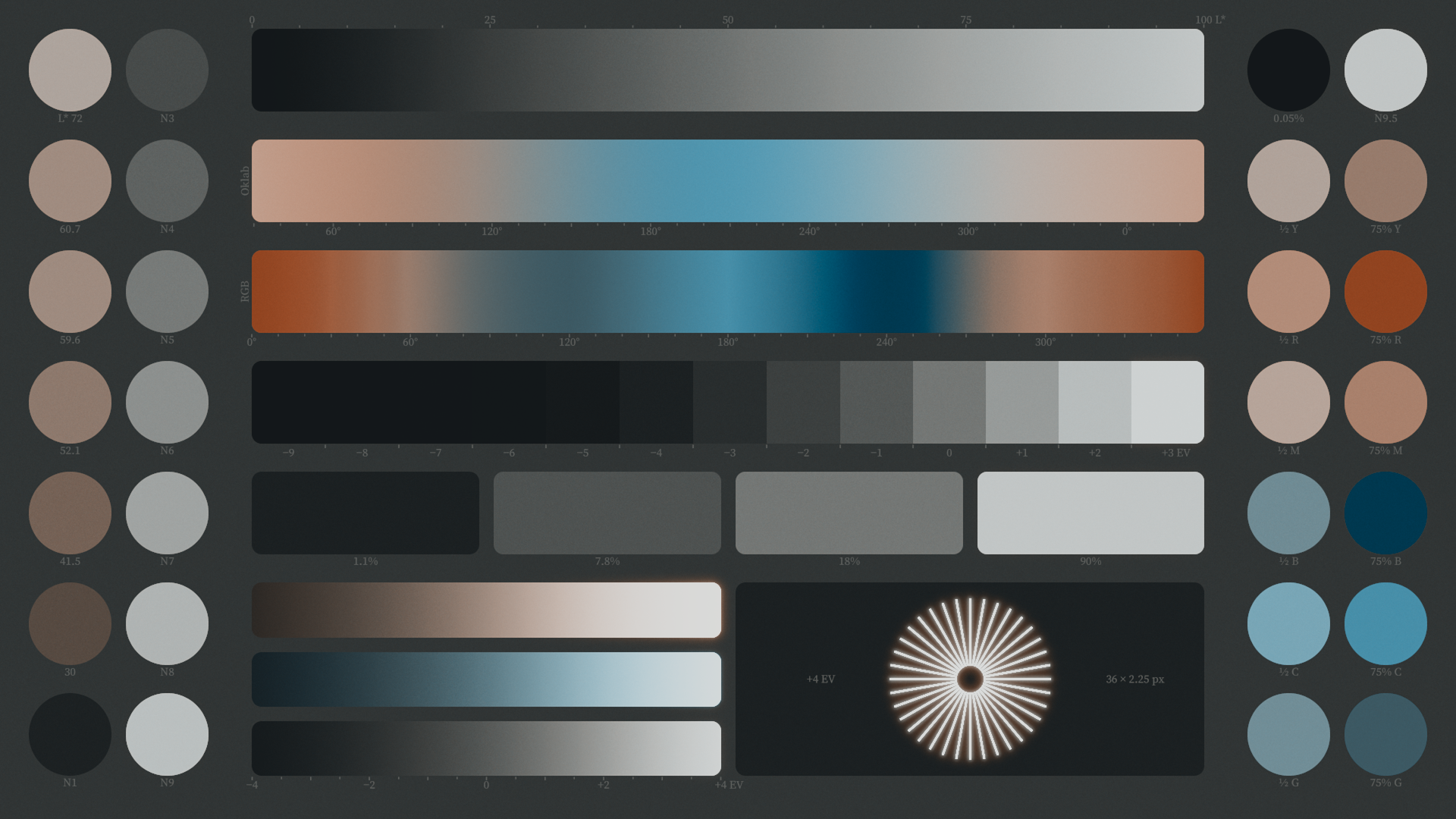
Dwubarwny model inspirowany kopią, a nie reprodukcja Trucolor, pokazany po Ansco Color Negative 843. Dzieli barwniki i czułości rekordów z modelem procesu Trucolor w Ashigrain, które same wynikają z nazwanych założeń, a jego dwie krzywe kopiowania są założeniami dostrojonymi do najbardziej neutralnej szarości. Nie opublikowano dla niego MTF ani ziarnistości.
Krzywe odpowiedzi i podstawy modelu
Porównaj dane producenta z odpowiedzią Ashigrain na tych samych osiach. Krzywe pokazują kalibrację modelu do źródeł; nie potwierdzają zgodności z obrazem zarejestrowanym na filmie.
Odpowiedź charakterystyczna
Ograniczenia modelu
Te obrazy pokazują działanie modelu filmu. Odpowiedź widmowa, oświetlenie i warunki oglądania zawierają przybliżenia, a halacja, poświata, rozmiar ziarna, niestabilność i migotanie nie są w pełni zmierzone dla każdego filmu. Rzeczywiste ujęcie zależy też od wywołania i ustawień kopiowania.
- To dwubarwny model inspirowany kopią Trucolor, a nie jej reprodukcja. W źródłach nie istnieje krzywa charakterystyczna, czułość widmowa, widmo barwnika, MTF ani pomiar ziarna kopii Trucolor.
- Barwniki i czułości rekordów pochodzą z modelu procesu Trucolor w Ashigrain, który sam wynika z nazwanych założeń opartych na raporcie SMPE z 1948 roku.
- Dwie krzywe kopiowania (gamma 2.6 dla rekordu czerwono-pomarańczowego i 2.0 dla niebieskozielonego) są założeniami wybranymi dla najbardziej neutralnej szarości; dwa barwniki nie mogą dać dokładnej neutralności.
- Model prowadzi oba wyciągi w ścieżce trójwarstwowej: warstwa niebieska kopiuje wyciąg zielony i nie ma barwnika żółtego.
- Srebrowa ścieżka dźwiękowa i dwustronne polewanie są odnotowane, ale nie są modelowane. Nie opublikowano dla niego MTF ani ziarnistości.
- Źródło nie podaje widm lampy ani filtrów kopiarki. Ich odpowiedź spektralna jest przybliżona.
- Modelowane światło rozproszone projekcji podnosi czerń na ekranie. Jego siła jest założeniem, bo dostępne źródła jej nie mierzą, więc nie określa zmierzonego kontrastu projekcji.
Efekt Schwarzschilda: niemodelowany. Czas naświetlania nie wpływa na ten film.
Przewodnik po filmach: założenia i praktyczne wybory
Ten podgląd łączy pozytyw ze wskazanym negatywem kamerowym. W tym porównaniu pozytyw nie ma osobnego wskaźnika ekspozycji ani własnej zmierzonej odpowiedzi ziarna.
Źródła
- Process: Journal of the SMPE vol. 50 (Jan-Jun 1948), incl. Report of SMPE Progress Committee (June 1948), pp.523-542, archive.org item journalofsociety50socirich (Prelinger Library scan), file journalofsociety50socirich.pdf (derivative, 47493669 bytes), s. 550
- Reconstructed: Journal of the SMPE vol. 50 (Jan-Jun 1948), incl. Report of SMPE Progress Committee (June 1948), pp.523-542, archive.org item journalofsociety50socirich (Prelinger Library scan), file journalofsociety50socirich.pdf (derivative, 47493669 bytes), s. 550
Wprowadź ten film do swojej korekcji barwnej.
Wszystkie filmy w jednym zakupie, bez abonamentu.
€199 + VAT