Barwny film pozytywowy · Film pozytywowy

Cinecolor (two-colour)

Dwubarwne kopie Cinecolor do krótkich metraży i kreskówek.

Planowany materiał

A labelled surrogate of two-colour Cinecolor: only a blue-green and an orange-red image, so blues reproduce as blue-greens. Original vs Ashigrain.

Ansco Color Negative 843, Cinecolor (two-colour)

stock
Ansco Color Negative 843
mode
Print
print_film
Cinecolor (two-colour)
film_format
Super 35 (4-perf)

W skrócie

Wprowadzenie
1932
Wycofany
Proces
Cinecolor two-colour processing (develop, fix and wash the duplitized positive, then colour each record by toning and dyeing)
Gęstość maksymalna
≈ 4,0

O filmie

Cinecolor był dwubarwnym subtraktywnym procesem kopiowania na taśmie polewanej emulsją z obu stron.

American WideScreen Museum podaje, że Cinecolor Corporation powstała w 1932 roku, a Timeline of Historical Film Colors przypisuje proces Williamowi Crespinelowi, którego zgłoszenie patentowe z 1932 roku przeniesiono na Cinecolor. Według Museum Cinecolor przejął system Multicolor po finansowym upadku Multicolor i używał go niemal bez zmian do końca lat 40. Dwa negatywy naświetlane w bipacku rejestrowały czerwono-pomarańczowe i niebieskozielone składowe sceny, a kopiarka krokowa drukowała po jednym rekordzie na każdej stronie pozytywu. Rekord czerwony tonowano żelazem na niebieskozielono jako błękit pruski, a rekord zielony barwiono na czerwono-pomarańczowo barwnikiem zaprawowym. W latach 1932–1940 służył głównie krótkim metrażom i kreskówkom mniejszych wytwórni, a jego pierwszym filmem fabularnym był The Gentleman from Arizona wytwórni Monogram. Późniejszymi klientami byli Monogram, PRC, Screen Guild i Eagle-Lion, a Warner Bros. wydało w 1948 roku kilka kreskówek w Cinecolor. Museum wskazuje jego ograniczenia, miękki obraz projekcyjny, bo dwa rekordy leżały po przeciwnych stronach taśmy, oraz ścieżkę dźwiękową tonowaną na cyjan, a następcą był trójbarwny SuperCinecolor.

Źródła tej historii
  1. Cinecolor (subtractive 2 color), Timeline of Historical Film Colors, University of Zurich
  2. Cinecolor, American WideScreen Museum
  3. US Patent 2,016,666: Colored photograph and method of making same (1935), W. T. Crespinel
  4. Cinecolor Three-Color Process (Alan M. Gundelfinger, Journal of the SMPTE 54, January 1950), Society of Motion Picture and Television Engineers

Charakter obrazu

Cinecolor był dwubarwnym procesem kopiowania z 1932 roku, który drukował obraz niebieskozielony i czerwono-pomarańczowy po obu stronach taśmy dwustronnie polewanej. Służył krótkim metrażom, kreskówkom i filmom fabularnym mniejszych wytwórni do końca lat 40. Wersja Ashigrain to oznaczony zamiennik, model inspirowany kopią, a nie jej reprodukcja.


Cinecolor (two-colour): przykładowa klatka: OryginałCinecolor (two-colour): przykładowa klatka: Ashigrain

Najlepsze zastosowania

  1. Kreskówki i krótkie metraże lat 40.
  2. Niskobudżetowe filmy fabularne lat 40.
  3. Porównanie dwubarwnego Cinecolor z SuperCinecolor

Porównaj filmy pozytywowe

Planowany materiał

The same Vision3 500T night frame on each print film: how deep the blacks go, how the highlights roll off and how the colour separates.

Kodak Vision3 500T, Kodak Vision Premier Color Print Film 2393

stock
Kodak Vision3 500T
mode
Print
print_film
Kodak Vision Premier Color Print Film 2393
film_format
Super 35 (4-perf)
Kodak Vision3 500T → Kodak Vision Premier Color Print Film 2393

Planowany materiał

The same Vision3 500T night frame on each print film: how deep the blacks go, how the highlights roll off and how the colour separates.

Kodak Vision3 500T, Eastman Color SP Print Film 5383

stock
Kodak Vision3 500T
mode
Print
print_film
Eastman Color SP Print Film 5383
film_format
Super 35 (4-perf)
Kodak Vision3 500T → Eastman Color SP Print Film 5383

Planowany materiał

The same Vision3 500T night frame on each print film: how deep the blacks go, how the highlights roll off and how the colour separates.

Kodak Vision3 500T, Eastman Color Print Film 5384

stock
Kodak Vision3 500T
mode
Print
print_film
Eastman Color Print Film 5384
film_format
Super 35 (4-perf)
Kodak Vision3 500T → Eastman Color Print Film 5384

Planowany materiał

The same Vision3 500T night frame on each print film: how deep the blacks go, how the highlights roll off and how the colour separates.

Kodak Vision3 500T, Fujifilm Eterna-CP 3521XD

stock
Kodak Vision3 500T
mode
Print
print_film
Fujifilm Eterna-CP 3521XD
film_format
Super 35 (4-perf)
Kodak Vision3 500T → Fujifilm Eterna-CP 3521XD

Planowany materiał

The same Vision3 500T night frame on each print film: how deep the blacks go, how the highlights roll off and how the colour separates.

Kodak Vision3 500T, Du Pont Color Release Positive Type 275

stock
Kodak Vision3 500T
mode
Print
print_film
Du Pont Color Release Positive Type 275
film_format
Super 35 (4-perf)
Kodak Vision3 500T → Du Pont Color Release Positive Type 275

Planowany materiał

The same Vision3 500T night frame on each print film: how deep the blacks go, how the highlights roll off and how the colour separates.

Kodak Vision3 500T, Fujifilm Eterna-CP 3523XD

stock
Kodak Vision3 500T
mode
Print
print_film
Fujifilm Eterna-CP 3523XD
film_format
Super 35 (4-perf)
Kodak Vision3 500T → Fujifilm Eterna-CP 3523XD

Planowany materiał

The same Vision3 500T night frame on each print film: how deep the blacks go, how the highlights roll off and how the colour separates.

Kodak Vision3 500T, Kodak Vision Color Print Film 2383

stock
Kodak Vision3 500T
mode
Print
print_film
Kodak Vision Color Print Film 2383
film_format
Super 35 (4-perf)
Kodak Vision3 500T → Kodak Vision Color Print Film 2383

Planowany materiał

The same Vision3 500T night frame on each print film: how deep the blacks go, how the highlights roll off and how the colour separates.

Kodak Vision3 500T, Fujifilm Eterna-CP 3513DI

stock
Kodak Vision3 500T
mode
Print
print_film
Fujifilm Eterna-CP 3513DI
film_format
Super 35 (4-perf)
Kodak Vision3 500T → Fujifilm Eterna-CP 3513DI

Planowany materiał

The same Vision3 500T night frame on each print film: how deep the blacks go, how the highlights roll off and how the colour separates.

Kodak Vision3 500T, Eastman EXR Color Print Film 5386

stock
Kodak Vision3 500T
mode
Print
print_film
Eastman EXR Color Print Film 5386
film_format
Super 35 (4-perf)
Kodak Vision3 500T → Eastman EXR Color Print Film 5386

Planowany materiał

The same Vision3 500T night frame on each print film: how deep the blacks go, how the highlights roll off and how the colour separates.

Kodak Vision3 500T, Eastman Color Print Film 5381 (1972)

stock
Kodak Vision3 500T
mode
Print
print_film
Eastman Color Print Film 5381 (1972)
film_format
Super 35 (4-perf)
Kodak Vision3 500T → Eastman Color Print Film 5381 (1972)

Planowany materiał

The same Vision3 500T night frame on each print film: how deep the blacks go, how the highlights roll off and how the colour separates.

Kodak Vision3 500T, Eastman Color Print Film 5385

stock
Kodak Vision3 500T
mode
Print
print_film
Eastman Color Print Film 5385
film_format
Super 35 (4-perf)
Kodak Vision3 500T → Eastman Color Print Film 5385

Planowany materiał

The same Vision3 500T night frame on each print film: how deep the blacks go, how the highlights roll off and how the colour separates.

Kodak Vision3 500T, Agfa CP30 Colour Print Film

stock
Kodak Vision3 500T
mode
Print
print_film
Agfa CP30 Colour Print Film
film_format
Super 35 (4-perf)
Kodak Vision3 500T → Agfa CP30 Colour Print Film

Planowany materiał

The same Vision3 500T night frame on each print film: how deep the blacks go, how the highlights roll off and how the colour separates.

Kodak Vision3 500T, SuperCinecolor

stock
Kodak Vision3 500T
mode
Print
print_film
SuperCinecolor
film_format
Super 35 (4-perf)
Kodak Vision3 500T → SuperCinecolor

Planowany materiał

The same Vision3 500T night frame on each print film. On this two-colour print (a labelled surrogate) every colour falls between blue-green and red-orange: how deep the blacks go, how the highlights roll off and which lights keep their hue.

Kodak Vision3 500T, Cinecolor (two-colour)

stock
Kodak Vision3 500T
mode
Print
print_film
Cinecolor (two-colour)
film_format
Super 35 (4-perf)
Kodak Vision3 500T → Cinecolor (two-colour)

Planowany materiał

The same Vision3 500T night frame on each print film: how deep the blacks go, how the highlights roll off and how the colour separates.

Kodak Vision3 500T, Gevacolor Positive 953

stock
Kodak Vision3 500T
mode
Print
print_film
Gevacolor Positive 953
film_format
Super 35 (4-perf)
Kodak Vision3 500T → Gevacolor Positive 953

Planowany materiał

The same Vision3 500T night frame on each print film: how deep the blacks go, how the highlights roll off and how the colour separates.

Kodak Vision3 500T, Gevacolor Print 9.85

stock
Kodak Vision3 500T
mode
Print
print_film
Gevacolor Print 9.85
film_format
Super 35 (4-perf)
Kodak Vision3 500T → Gevacolor Print 9.85

Planowany materiał

The same Vision3 500T night frame on each print film: how deep the blacks go, how the highlights roll off and how the colour separates.

Kodak Vision3 500T, Gevacolor Print 986

stock
Kodak Vision3 500T
mode
Print
print_film
Gevacolor Print 986
film_format
Super 35 (4-perf)
Kodak Vision3 500T → Gevacolor Print 986

Planowany materiał

The same Vision3 500T night frame on each print film: how deep the blacks go, how the highlights roll off and how the colour separates.

Kodak Vision3 500T, Gevacolor Print 982

stock
Kodak Vision3 500T
mode
Print
print_film
Gevacolor Print 982
film_format
Super 35 (4-perf)
Kodak Vision3 500T → Gevacolor Print 982

Planowany materiał

The same Vision3 500T night frame on each print film: how deep the blacks go, how the highlights roll off and how the colour separates.

Kodak Vision3 500T, Ferraniacolor Positive

stock
Kodak Vision3 500T
mode
Print
print_film
Ferraniacolor Positive
film_format
Super 35 (4-perf)
Kodak Vision3 500T → Ferraniacolor Positive

Planowany materiał

The same Vision3 500T night frame on each print film: how deep the blacks go, how the highlights roll off and how the colour separates.

Kodak Vision3 500T, 3M Color Positive 650

stock
Kodak Vision3 500T
mode
Print
print_film
3M Color Positive 650
film_format
Super 35 (4-perf)
Kodak Vision3 500T → 3M Color Positive 650

Planowany materiał

The same Vision3 500T night frame on each print film: how deep the blacks go, how the highlights roll off and how the colour separates.

Kodak Vision3 500T, Fujicolor Positive F-CP 3510

stock
Kodak Vision3 500T
mode
Print
print_film
Fujicolor Positive F-CP 3510
film_format
Super 35 (4-perf)
Kodak Vision3 500T → Fujicolor Positive F-CP 3510

Planowany materiał

The same Vision3 500T night frame on each print film: how deep the blacks go, how the highlights roll off and how the colour separates.

Kodak Vision3 500T, Fujicolor Positive F-CP 3519

stock
Kodak Vision3 500T
mode
Print
print_film
Fujicolor Positive F-CP 3519
film_format
Super 35 (4-perf)
Kodak Vision3 500T → Fujicolor Positive F-CP 3519

Planowany materiał

The same Vision3 500T night frame on each print film: how deep the blacks go, how the highlights roll off and how the colour separates.

Kodak Vision3 500T, Fujifilm Eterna-CP 3512

stock
Kodak Vision3 500T
mode
Print
print_film
Fujifilm Eterna-CP 3512
film_format
Super 35 (4-perf)
Kodak Vision3 500T → Fujifilm Eterna-CP 3512

Planowany materiał

The same Vision3 500T night frame on each print film: how deep the blacks go, how the highlights roll off and how the colour separates.

Kodak Vision3 500T, Eastman Color Print 5381 (1950)

stock
Kodak Vision3 500T
mode
Print
print_film
Eastman Color Print 5381 (1950)
film_format
Super 35 (4-perf)
Kodak Vision3 500T → Eastman Color Print 5381 (1950)

Planowany materiał

The same Vision3 500T night frame on each print film. On this blue-sensitive black-and-white print the colour negative turns grey: how deep the blacks go, how the highlights roll off and how dark the reds and greens print.

Kodak Vision3 500T, Eastman Fine Grain Release Positive 5302

stock
Kodak Vision3 500T
mode
Print
print_film
Eastman Fine Grain Release Positive 5302
film_format
Super 35 (4-perf)
Kodak Vision3 500T → Eastman Fine Grain Release Positive 5302

Planowany materiał

The same Vision3 500T night frame on each print film: how deep the blacks go, how the highlights roll off and how the colour separates.

Kodak Vision3 500T, Ansco Color Print 848

stock
Kodak Vision3 500T
mode
Print
print_film
Ansco Color Print 848
film_format
Super 35 (4-perf)
Kodak Vision3 500T → Ansco Color Print 848

Planowany materiał

The same Vision3 500T night frame on each print film. On this blue-sensitive black-and-white print the colour negative turns grey: how deep the blacks go, how the highlights roll off and how dark the red neon and skin print.

Kodak Vision3 500T, Kodak B&W Print Film 2302

stock
Kodak Vision3 500T
mode
Print
print_film
Kodak B&W Print Film 2302
film_format
Super 35 (4-perf)
Kodak Vision3 500T → Kodak B&W Print Film 2302

Planowany materiał

The same Vision3 500T night frame on each print film: how deep the blacks go, how the highlights roll off and how the colour separates.

Kodak Vision3 500T, Svema TsP-11

stock
Kodak Vision3 500T
mode
Print
print_film
Svema TsP-11
film_format
Super 35 (4-perf)
Kodak Vision3 500T → Svema TsP-11

Planowany materiał

The same Vision3 500T night frame on each print film. On this black-and-white print the colour negative turns grey: how deep the blacks go, how the highlights roll off and how the coloured lights and skin translate to grey.

Kodak Vision3 500T, Svema MZ-3

stock
Kodak Vision3 500T
mode
Print
print_film
Svema MZ-3
film_format
Super 35 (4-perf)
Kodak Vision3 500T → Svema MZ-3

Planowany materiał

The same Vision3 500T night frame on each print film. On this blue-sensitive black-and-white print the colour negative turns grey: how deep the blacks go, how the highlights roll off and how the coloured lights and skin translate to grey.

Kodak Vision3 500T, ORWO PF 2 Positive Print Film

stock
Kodak Vision3 500T
mode
Print
print_film
ORWO PF 2 Positive Print Film
film_format
Super 35 (4-perf)
Kodak Vision3 500T → ORWO PF 2 Positive Print Film

Planowany materiał

The same Vision3 500T night frame on each print film: how deep the blacks go, how the highlights roll off and how the colour separates.

Kodak Vision3 500T, Technicolor Dye Transfer (1997 revival)

stock
Kodak Vision3 500T
mode
Print
print_film
Technicolor Dye Transfer (1997 revival)
film_format
Super 35 (4-perf)
Kodak Vision3 500T → Technicolor Dye Transfer (1997 revival)

Planowany materiał

The same Vision3 500T night frame on each print film: how deep the blacks go, how the highlights roll off and how the colour separates.

Kodak Vision3 500T, Svema TsP-8R

stock
Kodak Vision3 500T
mode
Print
print_film
Svema TsP-8R
film_format
Super 35 (4-perf)
Kodak Vision3 500T → Svema TsP-8R

Planowany materiał

The same Vision3 500T night frame on each print film: how deep the blacks go, how the highlights roll off and how the colour separates.

Kodak Vision3 500T, Shostka Colour Positive (1950s)

stock
Kodak Vision3 500T
mode
Print
print_film
Shostka Colour Positive (1950s)
film_format
Super 35 (4-perf)
Kodak Vision3 500T → Shostka Colour Positive (1950s)

Planowany materiał

The same Vision3 500T night frame on each print film: how deep the blacks go, how the highlights roll off and how the colour separates.

Kodak Vision3 500T, Technicolor Dye Transfer (Process IV)

stock
Kodak Vision3 500T
mode
Print
print_film
Technicolor Dye Transfer (Process IV)
film_format
Super 35 (4-perf)
Kodak Vision3 500T → Technicolor Dye Transfer (Process IV)

Planowany materiał

The same Vision3 500T night frame on each print film: how deep the blacks go, how the highlights roll off and how the colour separates.

Kodak Vision3 500T, Gasparcolor Print

stock
Kodak Vision3 500T
mode
Print
print_film
Gasparcolor Print
film_format
Super 35 (4-perf)
Kodak Vision3 500T → Gasparcolor Print

Planowany materiał

The same Vision3 500T night frame on each print film. On this two-colour print (a labelled surrogate) every colour falls between a blue and a red dye: how deep the blacks go, how the highlights roll off and which lights keep their hue.

Kodak Vision3 500T, Trucolor Print (two-colour)

stock
Kodak Vision3 500T
mode
Print
print_film
Trucolor Print (two-colour)
film_format
Super 35 (4-perf)
Kodak Vision3 500T → Trucolor Print (two-colour)

Planowany materiał

The same Vision3 500T night frame on each print film: how deep the blacks go, how the highlights roll off and how the colour separates.

Kodak Vision3 500T, Kodak Vision Color Teleprint Film 2395

stock
Kodak Vision3 500T
mode
Print
print_film
Kodak Vision Color Teleprint Film 2395
film_format
Super 35 (4-perf)
Kodak Vision3 500T → Kodak Vision Color Teleprint Film 2395

Ta sama nocna klatka z filmu Kodak Vision3 500T, skopiowana na każdy pozytyw.

Pozytyw · najpierw najgłębsza czerńRodzajGęstość maksymalna, Status A · wyżej znaczy głębsza czerńLata produkcji
Kodak Vision Premier Color Print Film 2393Kodak Vision Premier Color Print Film 2393+1.5 głębsza niż Cinecolor (two-colour)Kolor5.51998
Eastman Color SP Print Film 5383Eastman Color SP Print Film 5383Produkowany w latach 1974–1983 · +1.0 głębsza niż Cinecolor (two-colour)Kolor5.01974–83
Eastman Color Print Film 5384Eastman Color Print Film 5384+0.9 głębsza niż Cinecolor (two-colour)Kolor4.91981
Fujifilm Eterna-CP 3521XDFujifilm Eterna-CP 3521XD+0.8 głębsza niż Cinecolor (two-colour)Kolor4.82007
Du Pont Color Release Positive Type 275Du Pont Color Release Positive Type 275+0.7 głębsza niż Cinecolor (two-colour)Kolor4.71949
Fujifilm Eterna-CP 3523XDFujifilm Eterna-CP 3523XD+0.5 głębsza niż Cinecolor (two-colour)Kolor4.52010
Kodak Vision Color Print Film 2383Kodak Vision Color Print Film 2383Produkowany od 1998, nadal w produkcji · +0.1 głębsza niż Cinecolor (two-colour)Kolor4.11998–
Fujifilm Eterna-CP 3513DIFujifilm Eterna-CP 3513DItaka sama jak Cinecolor (two-colour)Kolor4.02005
Eastman EXR Color Print Film 5386Eastman EXR Color Print Film 5386taka sama jak Cinecolor (two-colour)Kolor4.01993
Eastman Color Print Film 5381 (1972)Eastman Color Print Film 5381 (1972)taka sama jak Cinecolor (two-colour)Kolor4.01972
Eastman Color Print Film 5385Eastman Color Print Film 5385taka sama jak Cinecolor (two-colour)Kolor4.01962
Agfa CP30 Colour Print FilmAgfa CP30 Colour Print Filmtaka sama jak Cinecolor (two-colour)Kolor4.02003
SuperCinecolorSuperCinecolortaka sama jak Cinecolor (two-colour)Kolor4.01948
Cinecolor (two-colour)Cinecolor (two-colour)ten pozytywKolor4.01932
Gevacolor Positive 953Gevacolor Positive 953taka sama jak Cinecolor (two-colour)Kolor4.01958
Gevacolor Print 9.85Gevacolor Print 9.85taka sama jak Cinecolor (two-colour)Kolor4.01971
Gevacolor Print 986Gevacolor Print 986taka sama jak Cinecolor (two-colour)Kolor4.01975
Gevacolor Print 982Gevacolor Print 982taka sama jak Cinecolor (two-colour)Kolor4.01980
Ferraniacolor PositiveFerraniacolor Positivetaka sama jak Cinecolor (two-colour)Kolor4.01949
3M Color Positive 6503M Color Positive 650taka sama jak Cinecolor (two-colour)Kolor4.01970
Fujicolor Positive F-CP 3510Fujicolor Positive F-CP 3510−0.2 jaśniejsza niż Cinecolor (two-colour)Kolor3.82003
Fujicolor Positive F-CP 3519Fujicolor Positive F-CP 3519−0.2 jaśniejsza niż Cinecolor (two-colour)Kolor3.82001
Fujifilm Eterna-CP 3512Fujifilm Eterna-CP 3512Produkowany w latach 2010–2013 · −0.3 jaśniejsza niż Cinecolor (two-colour)Kolor3.72010–13
Eastman Color Print 5381 (1950)Eastman Color Print 5381 (1950)Produkowany w latach 1950–1953 · −0.5 jaśniejsza niż Cinecolor (two-colour)Kolor3.51950–53
Eastman Fine Grain Release Positive 5302Eastman Fine Grain Release Positive 5302−0.6 jaśniejsza niż Cinecolor (two-colour)Cz.-b.3.41950
Ansco Color Print 848Ansco Color Print 848−0.7 jaśniejsza niż Cinecolor (two-colour)Kolor3.31951
Kodak B&W Print Film 2302Kodak B&W Print Film 2302Produkowany od 2000, nadal w produkcji · −0.8 jaśniejsza niż Cinecolor (two-colour)Cz.-b.3.22000–
Svema TsP-11Svema TsP-11−1.0 jaśniejsza niż Cinecolor (two-colour)Kolor3.01979
Svema MZ-3Svema MZ-3−1.0 jaśniejsza niż Cinecolor (two-colour)Cz.-b.3.01979
ORWO PF 2 Positive Print FilmORWO PF 2 Positive Print Film−1.0 jaśniejsza niż Cinecolor (two-colour)Cz.-b.3.02014
Technicolor Dye Transfer (1997 revival)Technicolor Dye Transfer (1997 revival)−1.2 jaśniejsza niż Cinecolor (two-colour)Kolor2.81997
Svema TsP-8RSvema TsP-8R−1.2 jaśniejsza niż Cinecolor (two-colour)Kolor2.81969
Shostka Colour Positive (1950s)Shostka Colour Positive (1950s)−1.2 jaśniejsza niż Cinecolor (two-colour)Kolor2.81948
Technicolor Dye Transfer (Process IV)Technicolor Dye Transfer (Process IV)−1.2 jaśniejsza niż Cinecolor (two-colour)Kolor2.81932
Gasparcolor PrintGasparcolor Print−1.3 jaśniejsza niż Cinecolor (two-colour)Kolor2.71932
Trucolor Print (two-colour)Trucolor Print (two-colour)−1.4 jaśniejsza niż Cinecolor (two-colour)Kolor2.61945
Kodak Vision Color Teleprint Film 2395Kodak Vision Color Teleprint Film 2395−1.6 jaśniejsza niż Cinecolor (two-colour)Kolor2.41999

Nauka i źródła

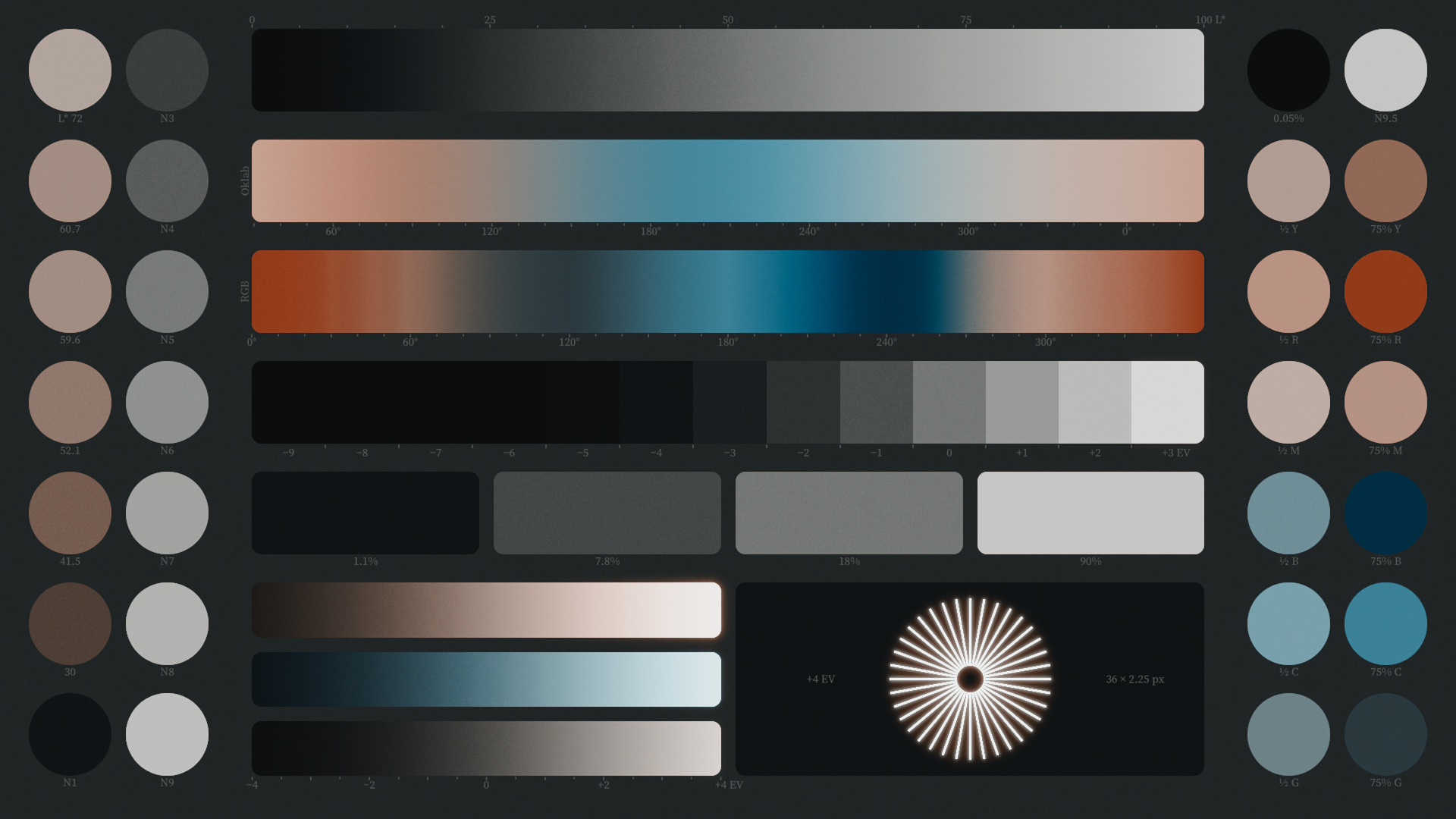
Cinecolor (two-colour): tablica kalibracyjna: OryginałCinecolor (two-colour): tablica kalibracyjna: Przetworzony
Syntetyczna tablica testowa (odcienie skóry, szarości Munsell, paski kolorów, rampy szarości i odcieni, klin schodkowy, przejście świateł barw pamięciowych, gwiazda halacji) przed i po przejściu przez pełny potok Ashigrain: Kodak Vision3 50D skopiowany na Cinecolor (two-colour), Super 35 4-perf, domyślne parametry, ekspozycja +0.65 stopnia dla dopasowania średniej szarości oryginału, klatka 0.

Dwubarwny model inspirowany kopią, a nie reprodukcja Cinecolor, pokazany po Ansco Color Negative 843. Jego czułości tonalne i rekordów pochodzą z Agfa Print CP30, użytego jako zastępstwo; jego barwnik błękitu pruskiego odwzorowano z artykułu Gundelfingera z 1950 roku o procesie trójbarwnym, a barwnik pomarańczowoczerwony jest nazwanym założeniem. Nie opublikowano dla niego MTF ani ziarnistości.

Krzywe odpowiedzi i podstawy modelu

Porównaj dane producenta z odpowiedzią Ashigrain na tych samych osiach. Krzywe pokazują kalibrację modelu do źródeł; nie potwierdzają zgodności z obrazem zarejestrowanym na filmie.

Odpowiedź charakterystyczna

Gęstość względem log H (luksosekundy) dla kanałów R, G, B. R – kółka, G – kwadraty, B – trójkąty, N – romby; wypełnione znaczniki i linie ciągłe oznaczają wartości zdigitalizowane, a puste znaczniki i linie przerywane – wartości symulowane: zdigitalizowane i symulowane.0.00.51.01.52.0log H (luksosekundy)0.01.02.03.04.0Gęstość

Ograniczenia modelu

Te obrazy pokazują działanie modelu filmu. Odpowiedź widmowa, oświetlenie i warunki oglądania zawierają przybliżenia, a halacja, poświata, rozmiar ziarna, niestabilność i migotanie nie są w pełni zmierzone dla każdego filmu. Rzeczywiste ujęcie zależy też od wywołania i ustawień kopiowania.

  • To dwubarwny model inspirowany kopią Cinecolor, a nie jej reprodukcja. Nie zarejestrowano żadnej krzywej charakterystycznej kopii dwubarwnej.
  • Czułości tonalne i rekordów pochodzą z Agfa Print CP30, użytego jako zastępstwo; czułość rekordu zielonego jest sumą zieleni i błękitu zastępstwa.
  • Barwnik błękitu pruskiego to cyjan odwzorowany z artykułu Gundelfingera z 1950 roku o procesie trójbarwnym. Barwnik pomarańczowoczerwony to założona krzywa Gaussa (szczyt 480 nm, szerokość 70 nm), wybrana dla najbardziej neutralnej szarości.
  • Model prowadzi oba wyciągi w ścieżce trójwarstwowej: warstwa niebieska kopiuje wyciąg zielony i nie ma barwnika żółtego.
  • Dwustronne polewanie i wynikający z niego miękki obraz projekcyjny nie są modelowane. Nie opublikowano dla niego MTF ani ziarnistości.
  • Źródło nie podaje widm lampy ani filtrów kopiarki. Ich odpowiedź spektralna jest przybliżona.
  • Modelowane światło rozproszone projekcji podnosi czerń na ekranie. Jego siła jest założeniem, bo dostępne źródła jej nie mierzą, więc nie określa zmierzonego kontrastu projekcji.

Efekt Schwarzschilda: niemodelowany. Czas naświetlania nie wpływa na ten film.

Przewodnik po filmach: założenia i praktyczne wybory

Ten podgląd łączy pozytyw ze wskazanym negatywem kamerowym. W tym porównaniu pozytyw nie ma osobnego wskaźnika ekspozycji ani własnej zmierzonej odpowiedzi ziarna.

Źródła

  1. Characteristic curves: AGFA PRINT CP30 colour print film product info / technical data, 17/10/2011, s. 5
  2. Process: US Patent 2,016,666: Colored photograph and method of making same (W. T. Crespinel, assigned to Cinecolor Inc.), US 2,016,666 A, filed 1932-12-02, granted 1935-10-08; Google Patents image PDF (5 pages), s. 3

Wprowadź ten film do swojej korekcji barwnej.

Wszystkie filmy w jednym zakupie, bez abonamentu.