 Ashigrain
Barwny film pozytywowy · Film pozytywowy
Du Pont Color Release Positive Type 275
Bezżelatynowa kopia barwna z trzech wyciągów.
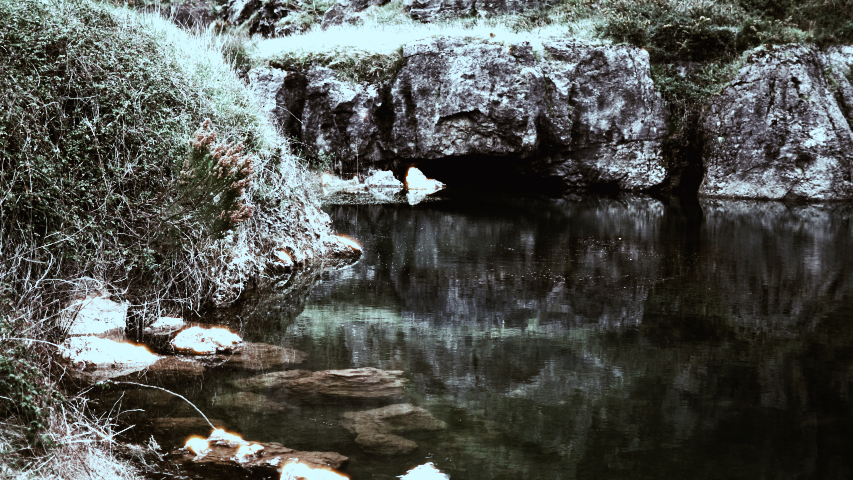
Du Pont Type 275, a gelatin-free separation release print reconstructed from its 1950 paper: the model derives three separation records from the negative and prints each at a contrast of 2.5. Original vs Ashigrain.
W skrócie
- Wprowadzenie
- ok. 1949
- Proces
- Du Pont Type 275 coupling colour development (p-aminodiethylaniline developer; develop, wash, first fix, bleach, second fix)
- Gęstość maksymalna
- ≈ 4,7
O filmie
Du Pont Type 275 był barwnym pozytywem eksploatacyjnym, którego nigdy nie naświetlano w kamerze: kopiowano go w kopiarce z pasowaniem z trzech czarno-białych negatywów wyciągowych, każdy przez wąskopasmowy filtr.
Inżynierowie Photo Products Department firmy Du Pont z Parlin w stanie New Jersey przedstawili go na zjeździe SMPE w Hollywood 11 października 1949, a ich artykuł ukazał się w listopadzie 1950. Wywoływanie barwne przez sprzęganie sięgało patentu Rudolpha Fischera z 1912, ale Du Pont całkowicie zastąpił żelatynę: spoiwem każdej warstwy był syntetyczny polimer, acetal alkoholu poliwinylowego, który sam niósł grupy barwotwórcze, więc sprzęgacz nie mógł wędrować. Artykuł przedstawiał to jako usunięcie żelatyny z komercyjnego produktu fotograficznego, a potrzebne były trzy różne spoiwa, po jednym na każdy barwnik subtraktywny. Od góry warstwa czuła na niebieski tworzyła purpurę z wyciągu zielonego, warstwa uczulona na czerwony niebieskozielony z wyciągu czerwonego, a warstwa czuła na zielony żółty z wyciągu niebieskiego, przy czym żółty barwnik chronił dolne warstwy przed światłem niebieskim. Warstwy zaprojektowano na kontrast kopii 2.5 z wyciągów o równym kontraście, a przeciwodblaskowa warstwa tylna odbarwiała się w wywoływaniu i rozpuszczała w płukaniach. Dźwięk mógł być zapisany jako purpurowa ścieżka barwnikowa lub ścieżka z siarczku srebra, a artykuł podawał nieco lepszy stosunek sygnału do szumu niż w czarno-białym pozytywie eksploatacyjnym. Timeline of Historical Film Colors datuje DuPont Color Film Type 275 na lata 1949–1953, a artykuł wymienia Type 875 jako wersję na podłożu bezpiecznym.
Źródła tej historii
- Synthetic Color-Forming Binders for Photographic Emulsions (Journal of the SMPTE 55, November 1950, pp. 455–476), A. B. Jennings, W. A. Stanton and J. P. Weiss (Du Pont), Internet Archive
- DuPont Color Film Type 275, Timeline of Historical Film Colors, University of Zurich
Charakter obrazu
Du Pont Color Release Positive Type 275 był barwną taśmą do kopii eksploatacyjnych z około 1949, kopiowaną w pasowaniu z trzech czarno-białych negatywów wyciągowych zamiast z negatywu barwnego. Jej trzy warstwy używały syntetycznych spoiw barwotwórczych zamiast żelatyny. Wersja Ashigrain jest zrekonstruowana i pokazana po Ansco Color Negative 843.





Najlepsze zastosowania
- Kolor kopii eksploatacyjnych końca lat 1940
- Kopiowanie z negatywów wyciągowych
- Porównanie kopii z wyciągów i z negatywu
Porównaj filmy pozytywowe
The same Vision3 500T night frame on each print film: how deep the blacks go, how the highlights roll off and how the colour separates.
The same Vision3 500T night frame on each print film: how deep the blacks go, how the highlights roll off and how the colour separates.
The same Vision3 500T night frame on each print film: how deep the blacks go, how the highlights roll off and how the colour separates.
The same Vision3 500T night frame on each print film: how deep the blacks go, how the highlights roll off and how the colour separates.
The same Vision3 500T night frame on each print film: how deep the blacks go, how the highlights roll off and how the colour separates.
The same Vision3 500T night frame on each print film: how deep the blacks go, how the highlights roll off and how the colour separates.
The same Vision3 500T night frame on each print film: how deep the blacks go, how the highlights roll off and how the colour separates.
The same Vision3 500T night frame on each print film: how deep the blacks go, how the highlights roll off and how the colour separates.
The same Vision3 500T night frame on each print film: how deep the blacks go, how the highlights roll off and how the colour separates.
The same Vision3 500T night frame on each print film: how deep the blacks go, how the highlights roll off and how the colour separates.
The same Vision3 500T night frame on each print film: how deep the blacks go, how the highlights roll off and how the colour separates.
The same Vision3 500T night frame on each print film: how deep the blacks go, how the highlights roll off and how the colour separates.
The same Vision3 500T night frame on each print film: how deep the blacks go, how the highlights roll off and how the colour separates.
The same Vision3 500T night frame on each print film. On this two-colour print (a labelled surrogate) every colour falls between blue-green and red-orange: how deep the blacks go, how the highlights roll off and which lights keep their hue.
The same Vision3 500T night frame on each print film: how deep the blacks go, how the highlights roll off and how the colour separates.
The same Vision3 500T night frame on each print film: how deep the blacks go, how the highlights roll off and how the colour separates.
The same Vision3 500T night frame on each print film: how deep the blacks go, how the highlights roll off and how the colour separates.
The same Vision3 500T night frame on each print film: how deep the blacks go, how the highlights roll off and how the colour separates.
The same Vision3 500T night frame on each print film: how deep the blacks go, how the highlights roll off and how the colour separates.
The same Vision3 500T night frame on each print film: how deep the blacks go, how the highlights roll off and how the colour separates.
The same Vision3 500T night frame on each print film: how deep the blacks go, how the highlights roll off and how the colour separates.
The same Vision3 500T night frame on each print film: how deep the blacks go, how the highlights roll off and how the colour separates.
The same Vision3 500T night frame on each print film: how deep the blacks go, how the highlights roll off and how the colour separates.
The same Vision3 500T night frame on each print film: how deep the blacks go, how the highlights roll off and how the colour separates.
The same Vision3 500T night frame on each print film. On this blue-sensitive black-and-white print the colour negative turns grey: how deep the blacks go, how the highlights roll off and how dark the reds and greens print.
The same Vision3 500T night frame on each print film: how deep the blacks go, how the highlights roll off and how the colour separates.
The same Vision3 500T night frame on each print film. On this blue-sensitive black-and-white print the colour negative turns grey: how deep the blacks go, how the highlights roll off and how dark the red neon and skin print.
The same Vision3 500T night frame on each print film: how deep the blacks go, how the highlights roll off and how the colour separates.
The same Vision3 500T night frame on each print film. On this black-and-white print the colour negative turns grey: how deep the blacks go, how the highlights roll off and how the coloured lights and skin translate to grey.
The same Vision3 500T night frame on each print film. On this blue-sensitive black-and-white print the colour negative turns grey: how deep the blacks go, how the highlights roll off and how the coloured lights and skin translate to grey.
The same Vision3 500T night frame on each print film: how deep the blacks go, how the highlights roll off and how the colour separates.
The same Vision3 500T night frame on each print film: how deep the blacks go, how the highlights roll off and how the colour separates.
The same Vision3 500T night frame on each print film: how deep the blacks go, how the highlights roll off and how the colour separates.
The same Vision3 500T night frame on each print film: how deep the blacks go, how the highlights roll off and how the colour separates.
The same Vision3 500T night frame on each print film: how deep the blacks go, how the highlights roll off and how the colour separates.
The same Vision3 500T night frame on each print film. On this two-colour print (a labelled surrogate) every colour falls between a blue and a red dye: how deep the blacks go, how the highlights roll off and which lights keep their hue.
The same Vision3 500T night frame on each print film: how deep the blacks go, how the highlights roll off and how the colour separates.
Ta sama nocna klatka z filmu Kodak Vision3 500T, skopiowana na każdy pozytyw.
- Kodak Vision Premier Color Print Film 2393
- Eastman Color SP Print Film 5383
- Eastman Color Print Film 5384
- Fujifilm Eterna-CP 3521XD
- Du Pont Color Release Positive Type 275
- Fujifilm Eterna-CP 3523XD
- Kodak Vision Color Print Film 2383
- Fujifilm Eterna-CP 3513DI
- Eastman EXR Color Print Film 5386
- Eastman Color Print Film 5381 (1972)
- Eastman Color Print Film 5385
- Agfa CP30 Colour Print Film
- SuperCinecolor
- Cinecolor (two-colour)
- Gevacolor Positive 953
- Gevacolor Print 9.85
- Gevacolor Print 986
- Gevacolor Print 982
- Ferraniacolor Positive
- 3M Color Positive 650
- Fujicolor Positive F-CP 3510
- Fujicolor Positive F-CP 3519
- Fujifilm Eterna-CP 3512
- Eastman Color Print 5381 (1950)
- Eastman Fine Grain Release Positive 5302
- Ansco Color Print 848
- Kodak B&W Print Film 2302
- Svema TsP-11
- Svema MZ-3
- ORWO PF 2 Positive Print Film
- Technicolor Dye Transfer (1997 revival)
- Svema TsP-8R
- Shostka Colour Positive (1950s)
- Technicolor Dye Transfer (Process IV)
- Gasparcolor Print
- Trucolor Print (two-colour)
- Kodak Vision Color Teleprint Film 2395
Nauka i źródła

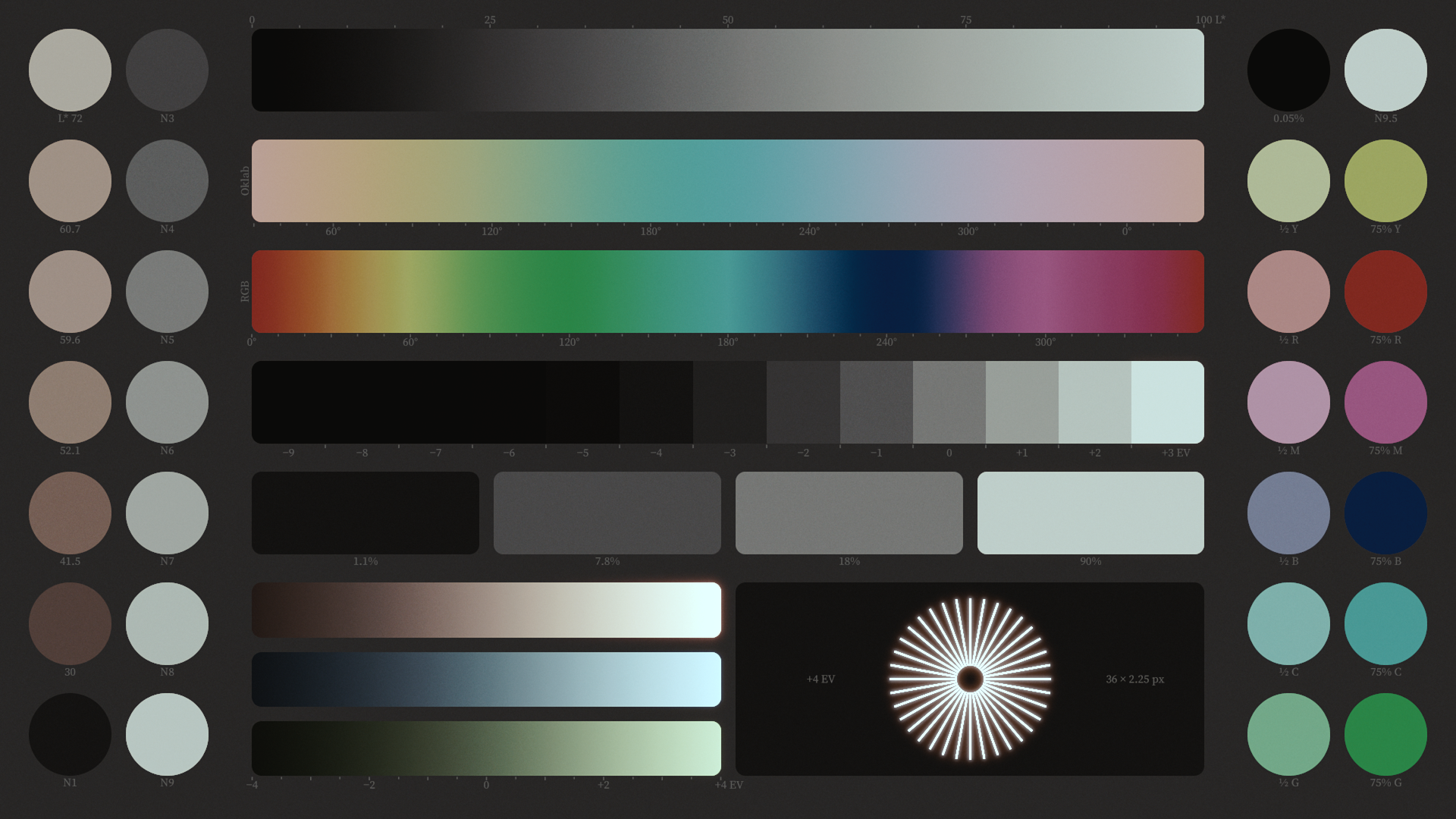
Kopia z wyciągów, zrekonstruowana, a nie zmierzona, pokazana po Ansco Color Negative 843. Jej krzywe i barwniki odrysowano z artykułu SMPTE Du Ponta z 1950, a czułości widmowe to nazwane kształty na spektrogramie z artykułu. Model wyprowadza z negatywu trzy czarno-białe wyciągi i kopiuje każdy z projektowym kontrastem z artykułu, 2.5.
Krzywe odpowiedzi i podstawy modelu
Porównaj dane producenta z odpowiedzią Ashigrain na tych samych osiach. Krzywe pokazują kalibrację modelu do źródeł; nie potwierdzają zgodności z obrazem zarejestrowanym na filmie.
Odpowiedź charakterystyczna
Ograniczenia modelu
Te obrazy pokazują działanie modelu filmu. Odpowiedź widmowa, oświetlenie i warunki oglądania zawierają przybliżenia, a halacja, poświata, rozmiar ziarna, niestabilność i migotanie nie są w pełni zmierzone dla każdego filmu. Rzeczywiste ujęcie zależy też od wywołania i ustawień kopiowania.
- To zrekonstruowany model Du Pont Type 275. Jego krzywe warstw i barwniki odrysowano z artykułu z 1950, który podaje gęstości przy długości fali maksymalnej absorpcji każdego barwnika, a nie gęstości Status A; odczytywanie ich jako równoważnych gęstości neutralnych jest przybliżeniem.
- Spektrogram z artykułu nie ma osi czułości, więc trzy czułości widmowe to nazwane kształty na wydrukowanych maksimach (440, 550 i 710 nm), z założonymi zboczami przy 360 i 760 nm.
- Model kopiuje Type 275 z negatywu barwnego: wyprowadza z negatywu trzy wyciągi i kopiuje każdy z projektowym kontrastem z artykułu, 2.5. Skala neutralna narysowana w artykule ma gradient około 2.24.
- Odrysowane stopy krzywych warstw rozchodzą się poniżej równoważnej gęstości około 0.55, więc neutralny zestaw wyciągów daje zielononiebieskie światła.
- Barwniki wydrukowano tylko od około 415 do 680 nm; poza tym zakresem model utrzymuje wartości brzegowe.
- Kolejność warstw, syntetyczne spoiwa, wąskopasmowe filtry kopiowe, tylna warstwa przeciwodblaskowa i ścieżki dźwiękowe są zapisane, ale nie modelowane. Nie podano dla niej MTF ani ziarnistości.
- Źródło nie podaje widm lampy ani filtrów kopiarki. Ich odpowiedź spektralna jest przybliżona.
- Modelowane światło rozproszone projekcji podnosi czerń na ekranie. Jego siła jest założeniem, bo dostępne źródła jej nie mierzą, więc nie określa zmierzonego kontrastu projekcji.
Efekt Schwarzschilda: niemodelowany. Czas naświetlania nie wpływa na ten film.
Przewodnik po filmach: założenia i praktyczne wybory
Ten podgląd łączy pozytyw ze wskazanym negatywem kamerowym. W tym porównaniu pozytyw nie ma osobnego wskaźnika ekspozycji ani własnej zmierzonej odpowiedzi ziarna.
Źródła
- Characteristic curves: Jennings, Stanton and Weiss: Synthetic Color-Forming Binders for Photographic Emulsions (J. SMPTE 55, Nov. 1950) in Journal of the Society of Motion Picture Engineers vol. 55 (Jul-Dec 1950), archive.org item journalofsociety55socirich, file journalofsociety55socirich.pdf (Prelinger Library scan, 680 pages), s. 470
- Process: Jennings, Stanton and Weiss: Synthetic Color-Forming Binders for Photographic Emulsions (J. SMPTE 55, Nov. 1950) in Journal of the Society of Motion Picture Engineers vol. 55 (Jul-Dec 1950), archive.org item journalofsociety55socirich, file journalofsociety55socirich.pdf (Prelinger Library scan, 680 pages), s. 470
Wprowadź ten film do swojej korekcji barwnej.
Wszystkie filmy w jednym zakupie, bez abonamentu.
€199 + VAT