 Ashigrain
Copie couleur · Pellicule de copie
Fujifilm Eterna-CP 3523XD
Le positif Fujifilm à fort contraste pour des noirs profonds.
Fujifilm Eterna-CP 3523XD, printed from Fujifilm Eterna Vivid 500. Original vs Ashigrain.
En bref
- Lancement
- dès 2010
- Arrêté
- Procédé
- ECP-2B
- Densité maximale
- ≈ 4,5
- Support
- Polyester
À propos du film
Fujicolor Positive Film Eterna-CP 3523XD est un positif couleur à fort contraste, fabriqué en 35 mm sous Type 3523XD par FUJIFILM Corporation.
Fujifilm soulignait ses noirs profonds et ses détails dans les ombres. Sa fiche compare ses courbes caractéristiques à celles d'Eterna-CP 3514DI. Le film existait en 2010 : aucune source consultée ne date son lancement, et la preuve datée la plus ancienne est cette fiche imprimée en 2010. En septembre 2012, Fujifilm annonçait que le positif couleur faisait partie des produits cinéma dont la vente cesserait. Film and Digital Times rapportait que Fujifilm prévoyait d'arrêter toute fabrication de film cinéma sauf le film de séparation d'archives avant fin mars 2013. La liste archivée des films arrêtés de Fujifilm comprend Eterna-CP 3523XD et date sa fin de production au 31 mars 2013.
Sources de cet historique
- FUJICOLOR POSITIVE FILM ETERNA-CP 3523XD data sheet (KB-1004E), FUJIFILM Corporation
- Discontinued Films, FUJIFILM Corporation
- Fujifilm, Film and Digital Times
- Announcement on Motion Picture Film Business of Fujifilm, FUJIFILM Corporation
Le rendu
Fujifilm Eterna-CP 3523XD est un positif couleur à fort contraste sur support polyester, traité en ECP-2B sans rem-jet. Ses noirs atteignent environ 4.4 à 4.5 de densité Status A, plus que le 3514DI qu'il remplace, tandis que pied et valeurs moyennes coïncident.






Idéale pour
- Rendus de copie d'exploitation aux noirs profonds
- Tirage Fuji sur Fuji
- Scènes nocturnes à fort contraste
Comparer les films de copie
The same Vision3 500T night frame on each print film: how deep the blacks go, how the highlights roll off and how the colour separates.
The same Vision3 500T night frame on each print film: how deep the blacks go, how the highlights roll off and how the colour separates.
The same Vision3 500T night frame on each print film: how deep the blacks go, how the highlights roll off and how the colour separates.
The same Vision3 500T night frame on each print film: how deep the blacks go, how the highlights roll off and how the colour separates.
The same Vision3 500T night frame on each print film: how deep the blacks go, how the highlights roll off and how the colour separates.
The same Vision3 500T night frame on each print film: how deep the blacks go, how the highlights roll off and how the colour separates.
The same Vision3 500T night frame on each print film: how deep the blacks go, how the highlights roll off and how the colour separates.
The same Vision3 500T night frame on each print film: how deep the blacks go, how the highlights roll off and how the colour separates.
The same Vision3 500T night frame on each print film: how deep the blacks go, how the highlights roll off and how the colour separates.
The same Vision3 500T night frame on each print film: how deep the blacks go, how the highlights roll off and how the colour separates.
The same Vision3 500T night frame on each print film: how deep the blacks go, how the highlights roll off and how the colour separates.
The same Vision3 500T night frame on each print film: how deep the blacks go, how the highlights roll off and how the colour separates.
The same Vision3 500T night frame on each print film: how deep the blacks go, how the highlights roll off and how the colour separates.
The same Vision3 500T night frame on each print film. On this two-colour print (a labelled surrogate) every colour falls between blue-green and red-orange: how deep the blacks go, how the highlights roll off and which lights keep their hue.
The same Vision3 500T night frame on each print film: how deep the blacks go, how the highlights roll off and how the colour separates.
The same Vision3 500T night frame on each print film: how deep the blacks go, how the highlights roll off and how the colour separates.
The same Vision3 500T night frame on each print film: how deep the blacks go, how the highlights roll off and how the colour separates.
The same Vision3 500T night frame on each print film: how deep the blacks go, how the highlights roll off and how the colour separates.
The same Vision3 500T night frame on each print film: how deep the blacks go, how the highlights roll off and how the colour separates.
The same Vision3 500T night frame on each print film: how deep the blacks go, how the highlights roll off and how the colour separates.
The same Vision3 500T night frame on each print film: how deep the blacks go, how the highlights roll off and how the colour separates.
The same Vision3 500T night frame on each print film: how deep the blacks go, how the highlights roll off and how the colour separates.
The same Vision3 500T night frame on each print film: how deep the blacks go, how the highlights roll off and how the colour separates.
The same Vision3 500T night frame on each print film: how deep the blacks go, how the highlights roll off and how the colour separates.
The same Vision3 500T night frame on each print film. On this blue-sensitive black-and-white print the colour negative turns grey: how deep the blacks go, how the highlights roll off and how dark the reds and greens print.
The same Vision3 500T night frame on each print film: how deep the blacks go, how the highlights roll off and how the colour separates.
The same Vision3 500T night frame on each print film. On this blue-sensitive black-and-white print the colour negative turns grey: how deep the blacks go, how the highlights roll off and how dark the red neon and skin print.
The same Vision3 500T night frame on each print film: how deep the blacks go, how the highlights roll off and how the colour separates.
The same Vision3 500T night frame on each print film. On this black-and-white print the colour negative turns grey: how deep the blacks go, how the highlights roll off and how the coloured lights and skin translate to grey.
The same Vision3 500T night frame on each print film. On this blue-sensitive black-and-white print the colour negative turns grey: how deep the blacks go, how the highlights roll off and how the coloured lights and skin translate to grey.
The same Vision3 500T night frame on each print film: how deep the blacks go, how the highlights roll off and how the colour separates.
The same Vision3 500T night frame on each print film: how deep the blacks go, how the highlights roll off and how the colour separates.
The same Vision3 500T night frame on each print film: how deep the blacks go, how the highlights roll off and how the colour separates.
The same Vision3 500T night frame on each print film: how deep the blacks go, how the highlights roll off and how the colour separates.
The same Vision3 500T night frame on each print film: how deep the blacks go, how the highlights roll off and how the colour separates.
The same Vision3 500T night frame on each print film. On this two-colour print (a labelled surrogate) every colour falls between a blue and a red dye: how deep the blacks go, how the highlights roll off and which lights keep their hue.
The same Vision3 500T night frame on each print film: how deep the blacks go, how the highlights roll off and how the colour separates.
La même image de nuit sur Kodak Vision3 500T, tirée sur chaque positif.
- Kodak Vision Premier Color Print Film 2393
- Eastman Color SP Print Film 5383
- Eastman Color Print Film 5384
- Fujifilm Eterna-CP 3521XD
- Du Pont Color Release Positive Type 275
- Fujifilm Eterna-CP 3523XD
- Kodak Vision Color Print Film 2383
- Fujifilm Eterna-CP 3513DI
- Eastman EXR Color Print Film 5386
- Eastman Color Print Film 5381 (1972)
- Eastman Color Print Film 5385
- Agfa CP30 Colour Print Film
- SuperCinecolor
- Cinecolor (two-colour)
- Gevacolor Positive 953
- Gevacolor Print 9.85
- Gevacolor Print 986
- Gevacolor Print 982
- Ferraniacolor Positive
- 3M Color Positive 650
- Fujicolor Positive F-CP 3510
- Fujicolor Positive F-CP 3519
- Fujifilm Eterna-CP 3512
- Eastman Color Print 5381 (1950)
- Eastman Fine Grain Release Positive 5302
- Ansco Color Print 848
- Kodak B&W Print Film 2302
- Svema TsP-11
- Svema MZ-3
- ORWO PF 2 Positive Print Film
- Technicolor Dye Transfer (1997 revival)
- Svema TsP-8R
- Shostka Colour Positive (1950s)
- Technicolor Dye Transfer (Process IV)
- Gasparcolor Print
- Trucolor Print (two-colour)
- Kodak Vision Color Teleprint Film 2395
Science et sources

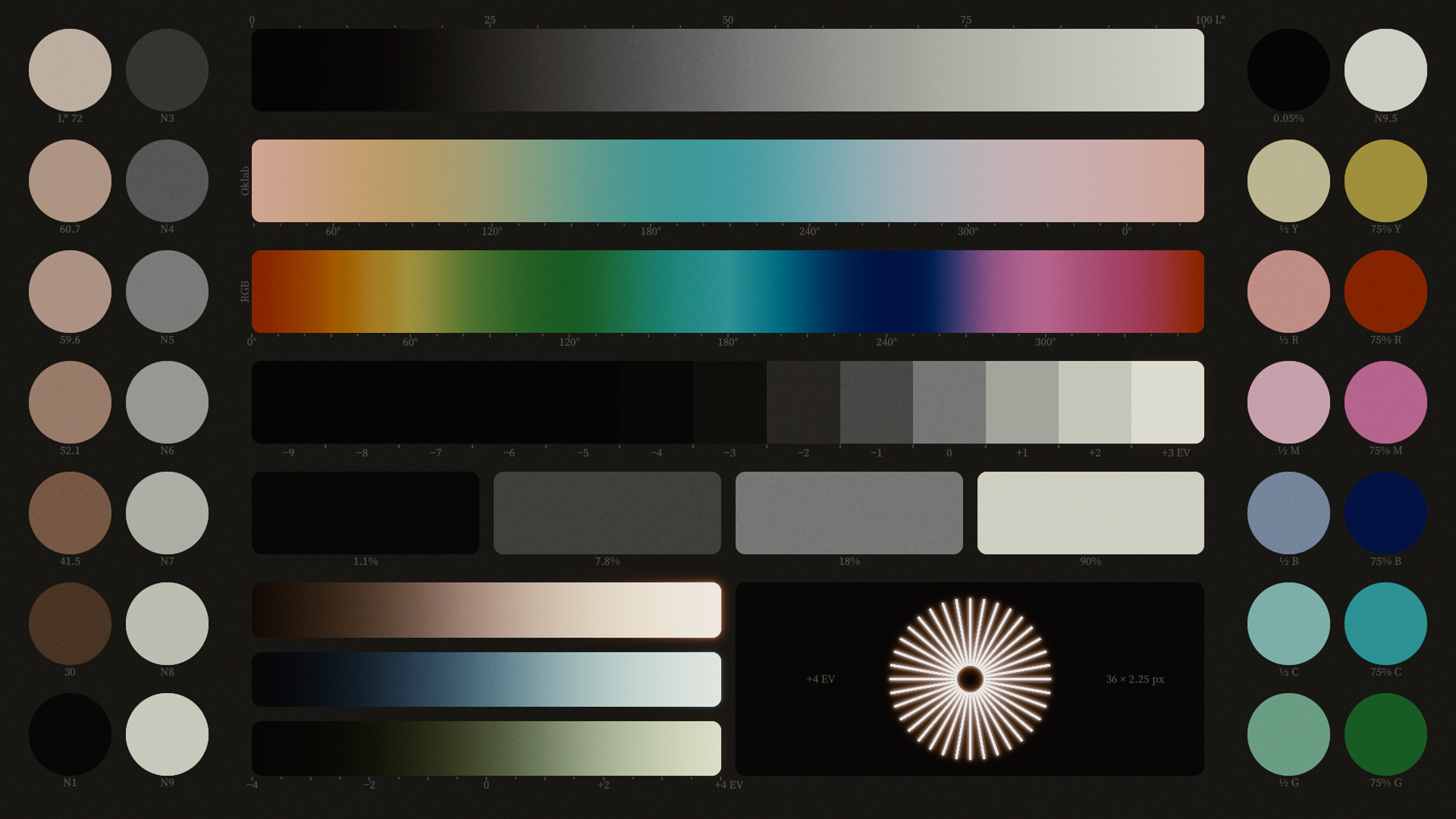
Un positif couleur à fort contraste pour tirage Fuji sur Fuji, présenté après Fujifilm Eterna Vivid 500. Le résultat combine les réponses du négatif et du positif.
Courbes de réponse et fondements du modèle
Comparez les données du fabricant à la réponse d’Ashigrain sur les mêmes axes. Ces courbes montrent comment le modèle est calibré sur ses sources ; elles ne prouvent pas qu’il reproduit une prise de vue argentique.
Réponse caractéristique
Limites du modèle
Ces images présentent le modèle de pellicule en action. La réponse spectrale, l’éclairage et les conditions de visionnage comportent des approximations ; les halos, la diffusion, la taille du grain, l’instabilité et le scintillement ne sont pas entièrement mesurés pour chaque pellicule. Une prise de vue réelle dépend aussi du développement et du calage du tirage.
- La cible de gris Status A est supposée : la cible de tirage de la fiche (1.10, 1.05, 1.05) est consignée, mais les colorants n'ont aucune normalisation indiquée ; le modèle tire donc le gris de scène à une densité moyenne neutre.
- Les courbes caractéristiques utilisent un axe d’exposition relatif : la fiche n’imprime qu’une barre d’échelle de 0.5 log H, et les courbes verte et bleue sont imprimées décalées de 1.0 log H. Leur exposition absolue n’est pas spécifiée.
- La source publie une seule fonction de transfert de contraste en onde carrée, à une densité diffuse visuelle de 1.2, et non des mesures MTF sinusoïdales distinctes pour le rouge, le vert et le bleu.
- Le voile de projection modélisé relève les noirs à l’écran. Son intensité est supposée, faute de mesure dans les sources disponibles ; il ne permet donc pas d’établir un contraste de projection mesuré.
Réciprocité : non modélisée. Le temps de pose n’a aucun effet sur cette pellicule.
Guide des pellicules : hypothèses et choix pratiques
Cet aperçu associe le positif au négatif de prise de vue indiqué. Dans cette comparaison, le positif n’a ni indice d’exposition distinct ni réponse de grain mesurée propre.
Sources
- Characteristic curves: FUJIFILM ETERNA-CP 3523XD color positive film data sheet, Ref. No. KB-1004E (SK·10·05·F1079), p. 1
- Process: FUJIFILM ETERNA-CP 3523XD color positive film data sheet, Ref. No. KB-1004E (SK·10·05·F1079), p. 2
Intégrez cette pellicule à votre étalonnage.
Toutes les pellicules en un seul achat, sans abonnement.
€199 + VAT