 Ashigrain
Copie couleur · Pellicule de copie
Fujicolor Positive F-CP 3510
Le tirage SUPER F de Fujifilm pour négatifs Fujicolor.
Fujifilm's SUPER F print, modelled from its own data sheet: rich gradation, natural skin tones and neutral blacks. Original vs Ashigrain.
En bref
- Lancement
- dès 2003
- Arrêté
- Procédé
- ECP-2B
- Densité maximale
- ≈ 3,8
- Support
- Polyester
À propos du film
Fujicolor Positive F-CP 3510 était un film de tirage couleur de la série SUPER F de Fujifilm, référencé 3510 en 35 mm et 3610 en 16 mm, le 70 mm figurant aussi sur sa fiche.
Sa fiche technique est datée de 2003, et la page japonaise de la gamme Fujifilm, qui avait présenté le film de tirage F-CP sous le numéro 3519 en 2001 et 2002, le donnait comme 3510 en juin 2004. En octobre 2006, la page produit mondiale de Fujifilm le présentait avec une gradation riche, des tons chair naturels et des noirs plus neutres. Il était couché sur polyester et traité en ECP-2B, et Fujifilm donnait des réglages de tirage pour négatifs Fujicolor sur tireuses additives comme la Bell & Howell Model C. Pour une charte grise à 18 pour cent, Fujifilm visait des densités Status A de 1.10 en rouge, 1.05 en vert et 1.05 en bleu. Ses courbes caractéristiques étaient exposées à une lampe tungstène de 2854 K à travers des filtres de correction couleur et anti-ultraviolets, et lues en Status A ; la fiche n’indique aucune granularité RMS. Dans la dernière gamme de tirage de Fujifilm, présentée dans son manuel de 2011, les films Eterna-CP 3512, 3514DI et 3523XD l’avaient remplacé. Fujifilm a cessé toute production de film cinéma le 31 mars 2013.
Sources de cet historique
- FUJICOLOR POSITIVE FILM F-CP 35mm Type 3510 / 16mm Type 3610 (KB-301E), FUJIFILM Corporation
- 映画用フィルム 製品一覧 (archived June 2004), FUJIFILM Corporation
- F-CP TYPE3510, FUJIFILM Corporation
- Motion Picture Film Manual (KB-0707E), FUJIFILM Corporation
- Announcement on Motion Picture Film Business of Fujifilm, FUJIFILM Corporation
- Discontinued Films, FUJIFILM Corporation
- Motion Picture Film Manual KB-1101E, FUJIFILM Corporation
Le rendu
Fujicolor Positive F-CP 3510 est un film de tirage couleur pour copies d’exploitation de la série SUPER F de Fujifilm, sur support polyester et traité en ECP-2B. Fujifilm évoquait une gradation riche, des tons chair naturels et des noirs plus neutres. Ses courbes, ses colorants et sa sensibilité proviennent de la propre fiche technique de Fujifilm.






Idéale pour
- Tirer des négatifs Fujifilm Eterna
- Tons chair naturels dans un rendu de copie d’exploitation
- Comparer Fuji F-CP avec Kodak 2383
Comparer les films de copie
The same Vision3 500T night frame on each print film: how deep the blacks go, how the highlights roll off and how the colour separates.
The same Vision3 500T night frame on each print film: how deep the blacks go, how the highlights roll off and how the colour separates.
The same Vision3 500T night frame on each print film: how deep the blacks go, how the highlights roll off and how the colour separates.
The same Vision3 500T night frame on each print film: how deep the blacks go, how the highlights roll off and how the colour separates.
The same Vision3 500T night frame on each print film: how deep the blacks go, how the highlights roll off and how the colour separates.
The same Vision3 500T night frame on each print film: how deep the blacks go, how the highlights roll off and how the colour separates.
The same Vision3 500T night frame on each print film: how deep the blacks go, how the highlights roll off and how the colour separates.
The same Vision3 500T night frame on each print film: how deep the blacks go, how the highlights roll off and how the colour separates.
The same Vision3 500T night frame on each print film: how deep the blacks go, how the highlights roll off and how the colour separates.
The same Vision3 500T night frame on each print film: how deep the blacks go, how the highlights roll off and how the colour separates.
The same Vision3 500T night frame on each print film: how deep the blacks go, how the highlights roll off and how the colour separates.
The same Vision3 500T night frame on each print film: how deep the blacks go, how the highlights roll off and how the colour separates.
The same Vision3 500T night frame on each print film: how deep the blacks go, how the highlights roll off and how the colour separates.
The same Vision3 500T night frame on each print film. On this two-colour print (a labelled surrogate) every colour falls between blue-green and red-orange: how deep the blacks go, how the highlights roll off and which lights keep their hue.
The same Vision3 500T night frame on each print film: how deep the blacks go, how the highlights roll off and how the colour separates.
The same Vision3 500T night frame on each print film: how deep the blacks go, how the highlights roll off and how the colour separates.
The same Vision3 500T night frame on each print film: how deep the blacks go, how the highlights roll off and how the colour separates.
The same Vision3 500T night frame on each print film: how deep the blacks go, how the highlights roll off and how the colour separates.
The same Vision3 500T night frame on each print film: how deep the blacks go, how the highlights roll off and how the colour separates.
The same Vision3 500T night frame on each print film: how deep the blacks go, how the highlights roll off and how the colour separates.
The same Vision3 500T night frame on each print film: how deep the blacks go, how the highlights roll off and how the colour separates.
The same Vision3 500T night frame on each print film: how deep the blacks go, how the highlights roll off and how the colour separates.
The same Vision3 500T night frame on each print film: how deep the blacks go, how the highlights roll off and how the colour separates.
The same Vision3 500T night frame on each print film: how deep the blacks go, how the highlights roll off and how the colour separates.
The same Vision3 500T night frame on each print film. On this blue-sensitive black-and-white print the colour negative turns grey: how deep the blacks go, how the highlights roll off and how dark the reds and greens print.
The same Vision3 500T night frame on each print film: how deep the blacks go, how the highlights roll off and how the colour separates.
The same Vision3 500T night frame on each print film. On this blue-sensitive black-and-white print the colour negative turns grey: how deep the blacks go, how the highlights roll off and how dark the red neon and skin print.
The same Vision3 500T night frame on each print film: how deep the blacks go, how the highlights roll off and how the colour separates.
The same Vision3 500T night frame on each print film. On this black-and-white print the colour negative turns grey: how deep the blacks go, how the highlights roll off and how the coloured lights and skin translate to grey.
The same Vision3 500T night frame on each print film. On this blue-sensitive black-and-white print the colour negative turns grey: how deep the blacks go, how the highlights roll off and how the coloured lights and skin translate to grey.
The same Vision3 500T night frame on each print film: how deep the blacks go, how the highlights roll off and how the colour separates.
The same Vision3 500T night frame on each print film: how deep the blacks go, how the highlights roll off and how the colour separates.
The same Vision3 500T night frame on each print film: how deep the blacks go, how the highlights roll off and how the colour separates.
The same Vision3 500T night frame on each print film: how deep the blacks go, how the highlights roll off and how the colour separates.
The same Vision3 500T night frame on each print film: how deep the blacks go, how the highlights roll off and how the colour separates.
The same Vision3 500T night frame on each print film. On this two-colour print (a labelled surrogate) every colour falls between a blue and a red dye: how deep the blacks go, how the highlights roll off and which lights keep their hue.
The same Vision3 500T night frame on each print film: how deep the blacks go, how the highlights roll off and how the colour separates.
La même image de nuit sur Kodak Vision3 500T, tirée sur chaque positif.
- Kodak Vision Premier Color Print Film 2393
- Eastman Color SP Print Film 5383
- Eastman Color Print Film 5384
- Fujifilm Eterna-CP 3521XD
- Du Pont Color Release Positive Type 275
- Fujifilm Eterna-CP 3523XD
- Kodak Vision Color Print Film 2383
- Fujifilm Eterna-CP 3513DI
- Eastman EXR Color Print Film 5386
- Eastman Color Print Film 5381 (1972)
- Eastman Color Print Film 5385
- Agfa CP30 Colour Print Film
- SuperCinecolor
- Cinecolor (two-colour)
- Gevacolor Positive 953
- Gevacolor Print 9.85
- Gevacolor Print 986
- Gevacolor Print 982
- Ferraniacolor Positive
- 3M Color Positive 650
- Fujicolor Positive F-CP 3510
- Fujicolor Positive F-CP 3519
- Fujifilm Eterna-CP 3512
- Eastman Color Print 5381 (1950)
- Eastman Fine Grain Release Positive 5302
- Ansco Color Print 848
- Kodak B&W Print Film 2302
- Svema TsP-11
- Svema MZ-3
- ORWO PF 2 Positive Print Film
- Technicolor Dye Transfer (1997 revival)
- Svema TsP-8R
- Shostka Colour Positive (1950s)
- Technicolor Dye Transfer (Process IV)
- Gasparcolor Print
- Trucolor Print (two-colour)
- Kodak Vision Color Teleprint Film 2395
Science et sources

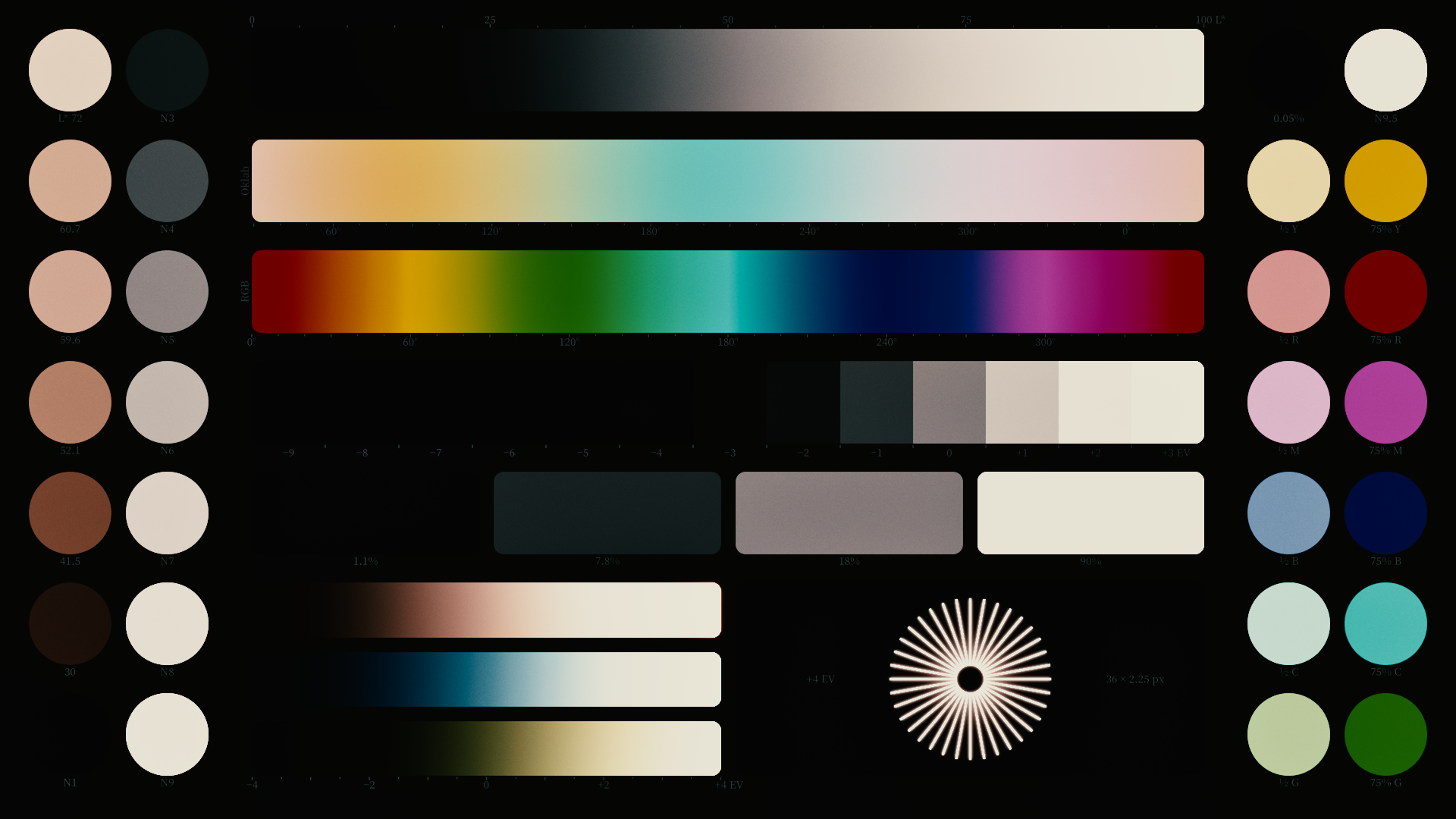
Un film de tirage couleur, montré après Fujifilm Eterna 500. Le résultat combine la réponse du négatif et celle de la copie. Ses courbes caractéristiques, sa sensibilité spectrale, ses densités de colorants et sa CTF sont numérisées depuis la propre fiche technique de Fujifilm ; aucune grandeur n’est empruntée à un autre film.
Courbes de réponse et fondements du modèle
Comparez les données du fabricant à la réponse d’Ashigrain sur les mêmes axes. Ces courbes montrent comment le modèle est calibré sur ses sources ; elles ne prouvent pas qu’il reproduit une prise de vue argentique.
Réponse caractéristique
Limites du modèle
Ces images présentent le modèle de pellicule en action. La réponse spectrale, l’éclairage et les conditions de visionnage comportent des approximations ; les halos, la diffusion, la taille du grain, l’instabilité et le scintillement ne sont pas entièrement mesurés pour chaque pellicule. Une prise de vue réelle dépend aussi du développement et du calage du tirage.
- Les courbes caractéristiques utilisent un axe d’exposition relatif : la fiche n’imprime qu’une barre d’échelle de 0.5 log H, et les courbes verte et bleue sont imprimées décalées de 1.0 log H. Leur exposition absolue n’est pas spécifiée.
- Aucune granularité RMS n’est publiée pour ce film.
- Les sensibilités spectrales laissent un trou entre 575 et 625 nm, et les courbes de colorants séparées s’arrêtent avant 700 nm ; seule la courbe grise couvre 400–700 nm.
- La source donne les conditions d’exposition de la tireuse, mais aucun spectre de lampe ou de filtre. Leur réponse spectrale est approximée.
- La fiche technique est lue depuis une copie archivée.
- Le voile de projection modélisé relève les noirs à l’écran. Son intensité est supposée, faute de mesure dans les sources disponibles ; il ne permet donc pas d’établir un contraste de projection mesuré.
Réciprocité : non modélisée. Le temps de pose n’a aucun effet sur cette pellicule.
Guide des pellicules : hypothèses et choix pratiques
Cet aperçu associe le positif au négatif de prise de vue indiqué. Dans cette comparaison, le positif n’a ni indice d’exposition distinct ni réponse de grain mesurée propre.
Sources
- Characteristic curves: FUJICOLOR POSITIVE FILM F-CP (35mm Type 3510 / 16mm Type 3610) data sheet, Ref. No. KB-301E, p. 1
- Process: FUJIFILM Motion Picture Film Manual, Ref.No.KB-0707E, p. 26
Intégrez cette pellicule à votre étalonnage.
Toutes les pellicules en un seul achat, sans abonnement.
€199 + VAT