 Ashigrain
Copie couleur · Pellicule de copie
Du Pont Color Release Positive Type 275
Une copie couleur sans gélatine issue de trois sélections.
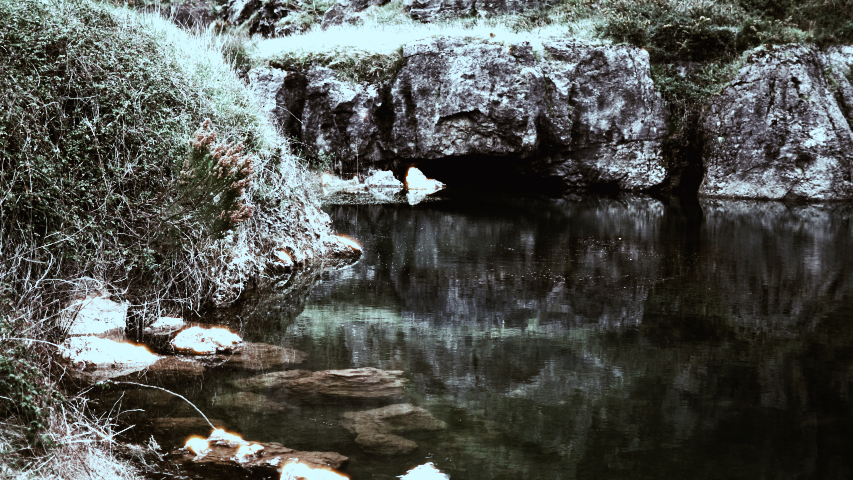
Du Pont Type 275, a gelatin-free separation release print reconstructed from its 1950 paper: the model derives three separation records from the negative and prints each at a contrast of 2.5. Original vs Ashigrain.
En bref
- Lancement
- vers 1949
- Procédé
- Du Pont Type 275 coupling colour development (p-aminodiethylaniline developer; develop, wash, first fix, bleach, second fix)
- Densité maximale
- ≈ 4,7
À propos du film
Du Pont Type 275 était un positif d'exploitation couleur jamais exposé dans une caméra : on le tirait sur une tireuse à repérage depuis trois négatifs de sélection noir et blanc, chacun à travers un filtre à bande étroite.
Des ingénieurs du Photo Products Department de Du Pont à Parlin, New Jersey, le présentèrent au congrès de la SMPE à Hollywood le 11 octobre 1949, et leur article parut en novembre 1950. Le développement chromogène par copulation remontait au brevet de Rudolph Fischer de 1912, mais Du Pont remplaça entièrement la gélatine : le liant de chaque couche était un polymère synthétique, un acétal d'alcool polyvinylique, qui portait lui-même les groupes chromogènes, si bien que le coupleur ne pouvait pas migrer. L'article présentait cela comme l'élimination de la gélatine d'un produit photographique commercial, et trois liants différents étaient nécessaires, un pour chaque colorant soustractif. De haut en bas, une couche sensible au bleu formait le magenta depuis la sélection verte, une couche sensibilisée au rouge le cyan depuis la sélection rouge et une couche sensible au vert le jaune depuis la sélection bleue, un colorant jaune empêchant la lumière bleue d'atteindre les couches inférieures. Les couches étaient conçues pour un contraste de tirage de 2.5 à partir de sélections de contraste égal, et une couche antihalo dorsale était décolorée au développement et se dissolvait aux lavages. Le son pouvait être porté par une piste de colorant magenta ou une piste de sulfure d'argent, et l'article signalait un rapport signal sur bruit un peu meilleur que celui du positif d'exploitation noir et blanc. La Timeline of Historical Film Colors date DuPont Color Film Type 275 de 1949 à 1953, et l'article nomme Type 875 la version sur support de sécurité.
Sources de cet historique
- Synthetic Color-Forming Binders for Photographic Emulsions (Journal of the SMPTE 55, November 1950, pp. 455–476), A. B. Jennings, W. A. Stanton and J. P. Weiss (Du Pont), Internet Archive
- DuPont Color Film Type 275, Timeline of Historical Film Colors, University of Zurich
Le rendu
Du Pont Color Release Positive Type 275 était un film de copie d'exploitation couleur d'environ 1949, tiré en repérage depuis trois négatifs de sélection noir et blanc plutôt que depuis un négatif couleur. Ses trois couches utilisaient des liants chromogènes synthétiques à la place de la gélatine. La version d'Ashigrain est reconstruite et affichée après Ansco Color Negative 843.





Idéale pour
- Couleur de copie d'exploitation de la fin des années 1940
- Tirage depuis des négatifs de sélection
- Comparer tirage par sélections et depuis un négatif
Comparer les films de copie
The same Vision3 500T night frame on each print film: how deep the blacks go, how the highlights roll off and how the colour separates.
The same Vision3 500T night frame on each print film: how deep the blacks go, how the highlights roll off and how the colour separates.
The same Vision3 500T night frame on each print film: how deep the blacks go, how the highlights roll off and how the colour separates.
The same Vision3 500T night frame on each print film: how deep the blacks go, how the highlights roll off and how the colour separates.
The same Vision3 500T night frame on each print film: how deep the blacks go, how the highlights roll off and how the colour separates.
The same Vision3 500T night frame on each print film: how deep the blacks go, how the highlights roll off and how the colour separates.
The same Vision3 500T night frame on each print film: how deep the blacks go, how the highlights roll off and how the colour separates.
The same Vision3 500T night frame on each print film: how deep the blacks go, how the highlights roll off and how the colour separates.
The same Vision3 500T night frame on each print film: how deep the blacks go, how the highlights roll off and how the colour separates.
The same Vision3 500T night frame on each print film: how deep the blacks go, how the highlights roll off and how the colour separates.
The same Vision3 500T night frame on each print film: how deep the blacks go, how the highlights roll off and how the colour separates.
The same Vision3 500T night frame on each print film: how deep the blacks go, how the highlights roll off and how the colour separates.
The same Vision3 500T night frame on each print film: how deep the blacks go, how the highlights roll off and how the colour separates.
The same Vision3 500T night frame on each print film. On this two-colour print (a labelled surrogate) every colour falls between blue-green and red-orange: how deep the blacks go, how the highlights roll off and which lights keep their hue.
The same Vision3 500T night frame on each print film: how deep the blacks go, how the highlights roll off and how the colour separates.
The same Vision3 500T night frame on each print film: how deep the blacks go, how the highlights roll off and how the colour separates.
The same Vision3 500T night frame on each print film: how deep the blacks go, how the highlights roll off and how the colour separates.
The same Vision3 500T night frame on each print film: how deep the blacks go, how the highlights roll off and how the colour separates.
The same Vision3 500T night frame on each print film: how deep the blacks go, how the highlights roll off and how the colour separates.
The same Vision3 500T night frame on each print film: how deep the blacks go, how the highlights roll off and how the colour separates.
The same Vision3 500T night frame on each print film: how deep the blacks go, how the highlights roll off and how the colour separates.
The same Vision3 500T night frame on each print film: how deep the blacks go, how the highlights roll off and how the colour separates.
The same Vision3 500T night frame on each print film: how deep the blacks go, how the highlights roll off and how the colour separates.
The same Vision3 500T night frame on each print film: how deep the blacks go, how the highlights roll off and how the colour separates.
The same Vision3 500T night frame on each print film. On this blue-sensitive black-and-white print the colour negative turns grey: how deep the blacks go, how the highlights roll off and how dark the reds and greens print.
The same Vision3 500T night frame on each print film: how deep the blacks go, how the highlights roll off and how the colour separates.
The same Vision3 500T night frame on each print film. On this blue-sensitive black-and-white print the colour negative turns grey: how deep the blacks go, how the highlights roll off and how dark the red neon and skin print.
The same Vision3 500T night frame on each print film: how deep the blacks go, how the highlights roll off and how the colour separates.
The same Vision3 500T night frame on each print film. On this black-and-white print the colour negative turns grey: how deep the blacks go, how the highlights roll off and how the coloured lights and skin translate to grey.
The same Vision3 500T night frame on each print film. On this blue-sensitive black-and-white print the colour negative turns grey: how deep the blacks go, how the highlights roll off and how the coloured lights and skin translate to grey.
The same Vision3 500T night frame on each print film: how deep the blacks go, how the highlights roll off and how the colour separates.
The same Vision3 500T night frame on each print film: how deep the blacks go, how the highlights roll off and how the colour separates.
The same Vision3 500T night frame on each print film: how deep the blacks go, how the highlights roll off and how the colour separates.
The same Vision3 500T night frame on each print film: how deep the blacks go, how the highlights roll off and how the colour separates.
The same Vision3 500T night frame on each print film: how deep the blacks go, how the highlights roll off and how the colour separates.
The same Vision3 500T night frame on each print film. On this two-colour print (a labelled surrogate) every colour falls between a blue and a red dye: how deep the blacks go, how the highlights roll off and which lights keep their hue.
The same Vision3 500T night frame on each print film: how deep the blacks go, how the highlights roll off and how the colour separates.
La même image de nuit sur Kodak Vision3 500T, tirée sur chaque positif.
- Kodak Vision Premier Color Print Film 2393
- Eastman Color SP Print Film 5383
- Eastman Color Print Film 5384
- Fujifilm Eterna-CP 3521XD
- Du Pont Color Release Positive Type 275
- Fujifilm Eterna-CP 3523XD
- Kodak Vision Color Print Film 2383
- Fujifilm Eterna-CP 3513DI
- Eastman EXR Color Print Film 5386
- Eastman Color Print Film 5381 (1972)
- Eastman Color Print Film 5385
- Agfa CP30 Colour Print Film
- SuperCinecolor
- Cinecolor (two-colour)
- Gevacolor Positive 953
- Gevacolor Print 9.85
- Gevacolor Print 986
- Gevacolor Print 982
- Ferraniacolor Positive
- 3M Color Positive 650
- Fujicolor Positive F-CP 3510
- Fujicolor Positive F-CP 3519
- Fujifilm Eterna-CP 3512
- Eastman Color Print 5381 (1950)
- Eastman Fine Grain Release Positive 5302
- Ansco Color Print 848
- Kodak B&W Print Film 2302
- Svema TsP-11
- Svema MZ-3
- ORWO PF 2 Positive Print Film
- Technicolor Dye Transfer (1997 revival)
- Svema TsP-8R
- Shostka Colour Positive (1950s)
- Technicolor Dye Transfer (Process IV)
- Gasparcolor Print
- Trucolor Print (two-colour)
- Kodak Vision Color Teleprint Film 2395
Science et sources

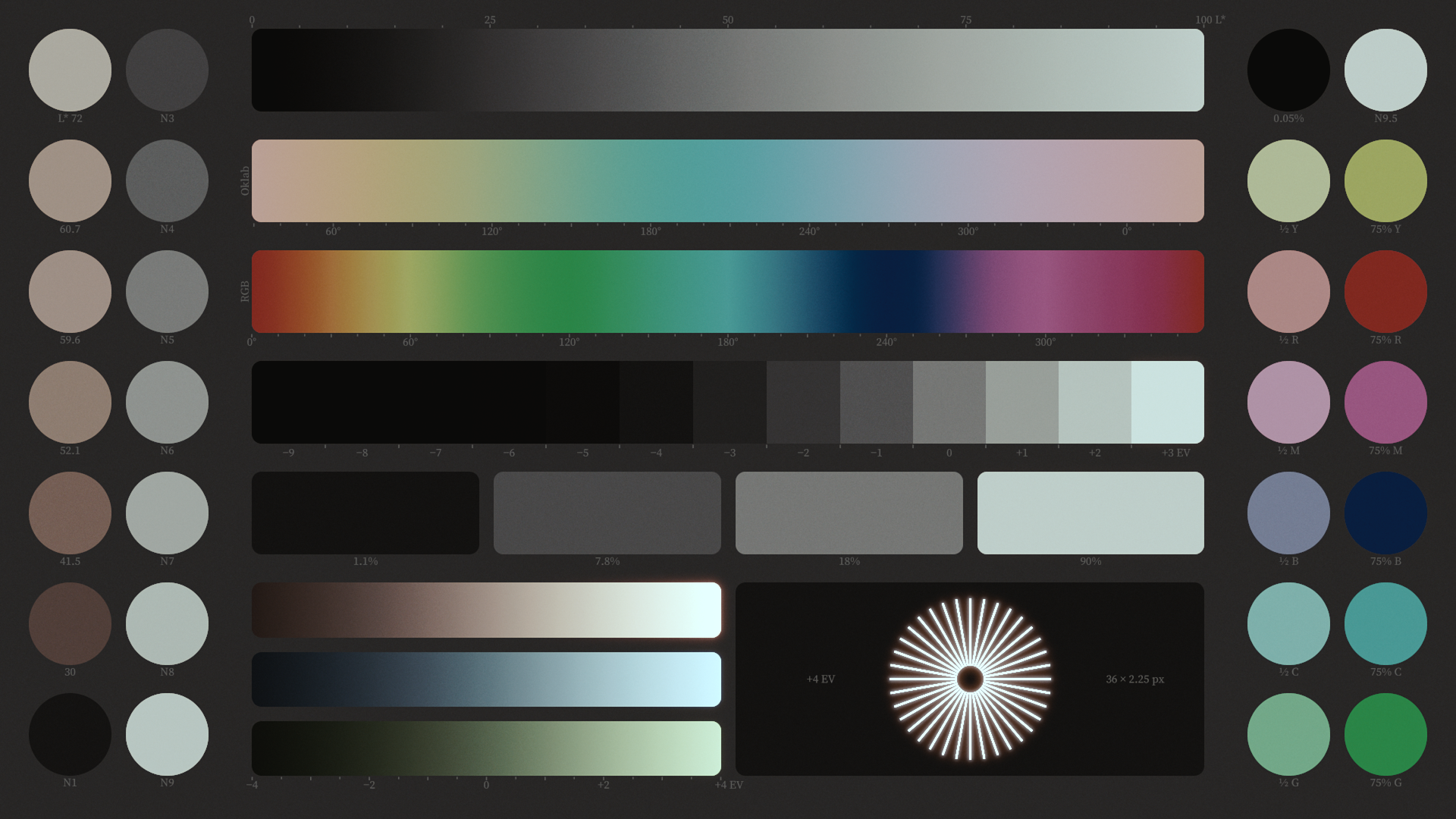
Une copie par sélections, reconstruite plutôt que mesurée, affichée après Ansco Color Negative 843. Ses courbes et ses colorants sont relevés dans l'article SMPTE de Du Pont de 1950 et ses sensibilités spectrales sont des formes nommées sur le spectrogramme de l'article. Le modèle dérive du négatif trois sélections noir et blanc et tire chacune au contraste nominal de l'article, 2.5.
Courbes de réponse et fondements du modèle
Comparez les données du fabricant à la réponse d’Ashigrain sur les mêmes axes. Ces courbes montrent comment le modèle est calibré sur ses sources ; elles ne prouvent pas qu’il reproduit une prise de vue argentique.
Réponse caractéristique
Limites du modèle
Ces images présentent le modèle de pellicule en action. La réponse spectrale, l’éclairage et les conditions de visionnage comportent des approximations ; les halos, la diffusion, la taille du grain, l’instabilité et le scintillement ne sont pas entièrement mesurés pour chaque pellicule. Une prise de vue réelle dépend aussi du développement et du calage du tirage.
- Ceci est un modèle reconstruit de Du Pont Type 275. Ses courbes de couche et ses colorants sont relevés dans l'article de 1950, qui imprime des densités à la longueur d'onde d'absorption maximale de chaque colorant, et non des densités Status A ; les lire comme des densités neutres équivalentes est une approximation.
- Le spectrogramme de l'article n'a pas d'axe de sensibilité ; les trois sensibilités spectrales sont donc des formes nommées sur ses pics imprimés (440, 550 et 710 nm), avec des flancs supposés à 360 et 760 nm.
- Le modèle tire le Type 275 depuis un négatif couleur : il en dérive trois sélections et tire chacune au contraste nominal de l'article, 2.5. L'échelle neutre telle que dessinée dans l'article a un gradient d'environ 2.24.
- Les pieds de courbe relevés se séparent sous une densité équivalente d'environ 0.55, si bien qu'un jeu de sélections neutre donne des hautes lumières vert-cyan.
- Les colorants ne sont imprimés que d'environ 415 à 680 nm ; le modèle conserve les valeurs des bords en dehors de cette plage.
- L'ordre des couches, les liants synthétiques, les filtres de tirage à bande étroite, la couche antihalo dorsale et les pistes son sont enregistrés mais non modélisés. Aucune FTM ni granularité n'est imprimée pour ce film.
- La source ne donne aucun spectre de lampe ni de filtre de tireuse. Leur réponse spectrale est approchée.
- Le voile de projection modélisé relève les noirs à l’écran. Son intensité est supposée, faute de mesure dans les sources disponibles ; il ne permet donc pas d’établir un contraste de projection mesuré.
Réciprocité : non modélisée. Le temps de pose n’a aucun effet sur cette pellicule.
Guide des pellicules : hypothèses et choix pratiques
Cet aperçu associe le positif au négatif de prise de vue indiqué. Dans cette comparaison, le positif n’a ni indice d’exposition distinct ni réponse de grain mesurée propre.
Sources
- Characteristic curves: Jennings, Stanton and Weiss: Synthetic Color-Forming Binders for Photographic Emulsions (J. SMPTE 55, Nov. 1950) in Journal of the Society of Motion Picture Engineers vol. 55 (Jul-Dec 1950), archive.org item journalofsociety55socirich, file journalofsociety55socirich.pdf (Prelinger Library scan, 680 pages), p. 470
- Process: Jennings, Stanton and Weiss: Synthetic Color-Forming Binders for Photographic Emulsions (J. SMPTE 55, Nov. 1950) in Journal of the Society of Motion Picture Engineers vol. 55 (Jul-Dec 1950), archive.org item journalofsociety55socirich, file journalofsociety55socirich.pdf (Prelinger Library scan, 680 pages), p. 470
Intégrez cette pellicule à votre étalonnage.
Toutes les pellicules en un seul achat, sans abonnement.
€199 + VAT