 Ashigrain
Farbkopie · Kopierfilm
Trucolor Print (two-colour)
Trucolors Zweifarbenkopie, blau und rot gefärbt.
A labelled surrogate of Trucolor's two-colour print, a blue dye on one side and a red dye on the other: a two-record image with a narrow gamut. Original vs Ashigrain.
Auf einen Blick
- Eingeführt
- Mitte der 1940er-Jahre
- Eingestellt
- Prozess
- Trucolor double-coated coupler print (one colour developer forms a blue dye on one side and a red dye on the other; silver bleached and fixed out; silver-compound sound track)
- Maximale Dichte
- ≈ 2,6
Über den Film
Trucolor war ein Zweifarben-Kopierverfahren von Consolidated Film Industries, dem Labor von Republic Pictures.
Brian Coe, zitiert von der Timeline of Historical Film Colors, schreibt, es sei 1946 für Out California Way verwendet worden. Coe nennt es das einzige bedeutende neue Zweifarbenverfahren nach dem Zweiten Weltkrieg, als die meisten Zweifarbenmethoden außer Cinecolor überholt waren, und das American WideScreen Museum beschreibt es als Republics Gegenstück zu Cinecolor. Die Kopien entstanden von Bipack-Negativen, meist für B-Filme. Ein Bericht der Society of Motion Picture Engineers von 1948 beschreibt den Kopierfilm als Sicherheitsunterlage, beidseitig mit Positivemulsionen mit Farbkupplern beschichtet, von denen einer im selben Entwickler einen blauen und der andere einen roten Farbstoff bildete. Bleiche und Fixierung entfernten dann das Silber und ließen zwei Farbstoffbilder zurück, während die Tonspur eine Silberverbindung blieb. Coe schreibt, Trucolor habe nach 1950 moderne Farbfilme verwendet, und 1954 sei das Zweifarbenverfahren überholt und sein letzter Kopierdienst geschlossen gewesen.
Quellen zu dieser Geschichte
- Trucolor 2 color, Timeline of Historical Film Colors
- Report of SMPE Progress Committee (Journal of the SMPE 50, June 1948, pp. 523–542), Society of Motion Picture Engineers, Internet Archive
- Cinecolor, American WideScreen Museum
Der Look
Trucolor war ein Zweifarben-Kopierverfahren von Consolidated Film Industries, dem Labor von Republic Pictures, ab spätestens 1946 im Einsatz. Sein Film war beidseitig beschichtet und bildete auf der einen Seite einen blauen, auf der anderen einen roten Farbstoff. Ashigrains Fassung ist ein gekennzeichnetes Surrogat, ein von der Kopie inspiriertes Modell statt einer Reproduktion.

Geeignet für
- Republic-B-Filme der späten 1940er
- Trucolor und Cinecolor im Vergleich
- Zweifarbiges Zeitkolorit
Kopierfilme vergleichen
The same Vision3 500T night frame on each print film: how deep the blacks go, how the highlights roll off and how the colour separates.
The same Vision3 500T night frame on each print film: how deep the blacks go, how the highlights roll off and how the colour separates.
The same Vision3 500T night frame on each print film: how deep the blacks go, how the highlights roll off and how the colour separates.
The same Vision3 500T night frame on each print film: how deep the blacks go, how the highlights roll off and how the colour separates.
The same Vision3 500T night frame on each print film: how deep the blacks go, how the highlights roll off and how the colour separates.
The same Vision3 500T night frame on each print film: how deep the blacks go, how the highlights roll off and how the colour separates.
The same Vision3 500T night frame on each print film: how deep the blacks go, how the highlights roll off and how the colour separates.
The same Vision3 500T night frame on each print film: how deep the blacks go, how the highlights roll off and how the colour separates.
The same Vision3 500T night frame on each print film: how deep the blacks go, how the highlights roll off and how the colour separates.
The same Vision3 500T night frame on each print film: how deep the blacks go, how the highlights roll off and how the colour separates.
The same Vision3 500T night frame on each print film: how deep the blacks go, how the highlights roll off and how the colour separates.
The same Vision3 500T night frame on each print film: how deep the blacks go, how the highlights roll off and how the colour separates.
The same Vision3 500T night frame on each print film: how deep the blacks go, how the highlights roll off and how the colour separates.
The same Vision3 500T night frame on each print film. On this two-colour print (a labelled surrogate) every colour falls between blue-green and red-orange: how deep the blacks go, how the highlights roll off and which lights keep their hue.
The same Vision3 500T night frame on each print film: how deep the blacks go, how the highlights roll off and how the colour separates.
The same Vision3 500T night frame on each print film: how deep the blacks go, how the highlights roll off and how the colour separates.
The same Vision3 500T night frame on each print film: how deep the blacks go, how the highlights roll off and how the colour separates.
The same Vision3 500T night frame on each print film: how deep the blacks go, how the highlights roll off and how the colour separates.
The same Vision3 500T night frame on each print film: how deep the blacks go, how the highlights roll off and how the colour separates.
The same Vision3 500T night frame on each print film: how deep the blacks go, how the highlights roll off and how the colour separates.
The same Vision3 500T night frame on each print film: how deep the blacks go, how the highlights roll off and how the colour separates.
The same Vision3 500T night frame on each print film: how deep the blacks go, how the highlights roll off and how the colour separates.
The same Vision3 500T night frame on each print film: how deep the blacks go, how the highlights roll off and how the colour separates.
The same Vision3 500T night frame on each print film: how deep the blacks go, how the highlights roll off and how the colour separates.
The same Vision3 500T night frame on each print film. On this blue-sensitive black-and-white print the colour negative turns grey: how deep the blacks go, how the highlights roll off and how dark the reds and greens print.
The same Vision3 500T night frame on each print film: how deep the blacks go, how the highlights roll off and how the colour separates.
The same Vision3 500T night frame on each print film. On this blue-sensitive black-and-white print the colour negative turns grey: how deep the blacks go, how the highlights roll off and how dark the red neon and skin print.
The same Vision3 500T night frame on each print film: how deep the blacks go, how the highlights roll off and how the colour separates.
The same Vision3 500T night frame on each print film. On this black-and-white print the colour negative turns grey: how deep the blacks go, how the highlights roll off and how the coloured lights and skin translate to grey.
The same Vision3 500T night frame on each print film. On this blue-sensitive black-and-white print the colour negative turns grey: how deep the blacks go, how the highlights roll off and how the coloured lights and skin translate to grey.
The same Vision3 500T night frame on each print film: how deep the blacks go, how the highlights roll off and how the colour separates.
The same Vision3 500T night frame on each print film: how deep the blacks go, how the highlights roll off and how the colour separates.
The same Vision3 500T night frame on each print film: how deep the blacks go, how the highlights roll off and how the colour separates.
The same Vision3 500T night frame on each print film: how deep the blacks go, how the highlights roll off and how the colour separates.
The same Vision3 500T night frame on each print film: how deep the blacks go, how the highlights roll off and how the colour separates.
The same Vision3 500T night frame on each print film. On this two-colour print (a labelled surrogate) every colour falls between a blue and a red dye: how deep the blacks go, how the highlights roll off and which lights keep their hue.
The same Vision3 500T night frame on each print film: how deep the blacks go, how the highlights roll off and how the colour separates.
Dasselbe Nachtbild auf Kodak Vision3 500T, auf jeden Printfilm kopiert.
- Kodak Vision Premier Color Print Film 2393
- Eastman Color SP Print Film 5383
- Eastman Color Print Film 5384
- Fujifilm Eterna-CP 3521XD
- Du Pont Color Release Positive Type 275
- Fujifilm Eterna-CP 3523XD
- Kodak Vision Color Print Film 2383
- Fujifilm Eterna-CP 3513DI
- Eastman EXR Color Print Film 5386
- Eastman Color Print Film 5381 (1972)
- Eastman Color Print Film 5385
- Agfa CP30 Colour Print Film
- SuperCinecolor
- Cinecolor (two-colour)
- Gevacolor Positive 953
- Gevacolor Print 9.85
- Gevacolor Print 986
- Gevacolor Print 982
- Ferraniacolor Positive
- 3M Color Positive 650
- Fujicolor Positive F-CP 3510
- Fujicolor Positive F-CP 3519
- Fujifilm Eterna-CP 3512
- Eastman Color Print 5381 (1950)
- Eastman Fine Grain Release Positive 5302
- Ansco Color Print 848
- Kodak B&W Print Film 2302
- Svema TsP-11
- Svema MZ-3
- ORWO PF 2 Positive Print Film
- Technicolor Dye Transfer (1997 revival)
- Svema TsP-8R
- Shostka Colour Positive (1950s)
- Technicolor Dye Transfer (Process IV)
- Gasparcolor Print
- Trucolor Print (two-colour)
- Kodak Vision Color Teleprint Film 2395
Wissenschaft und Quellen

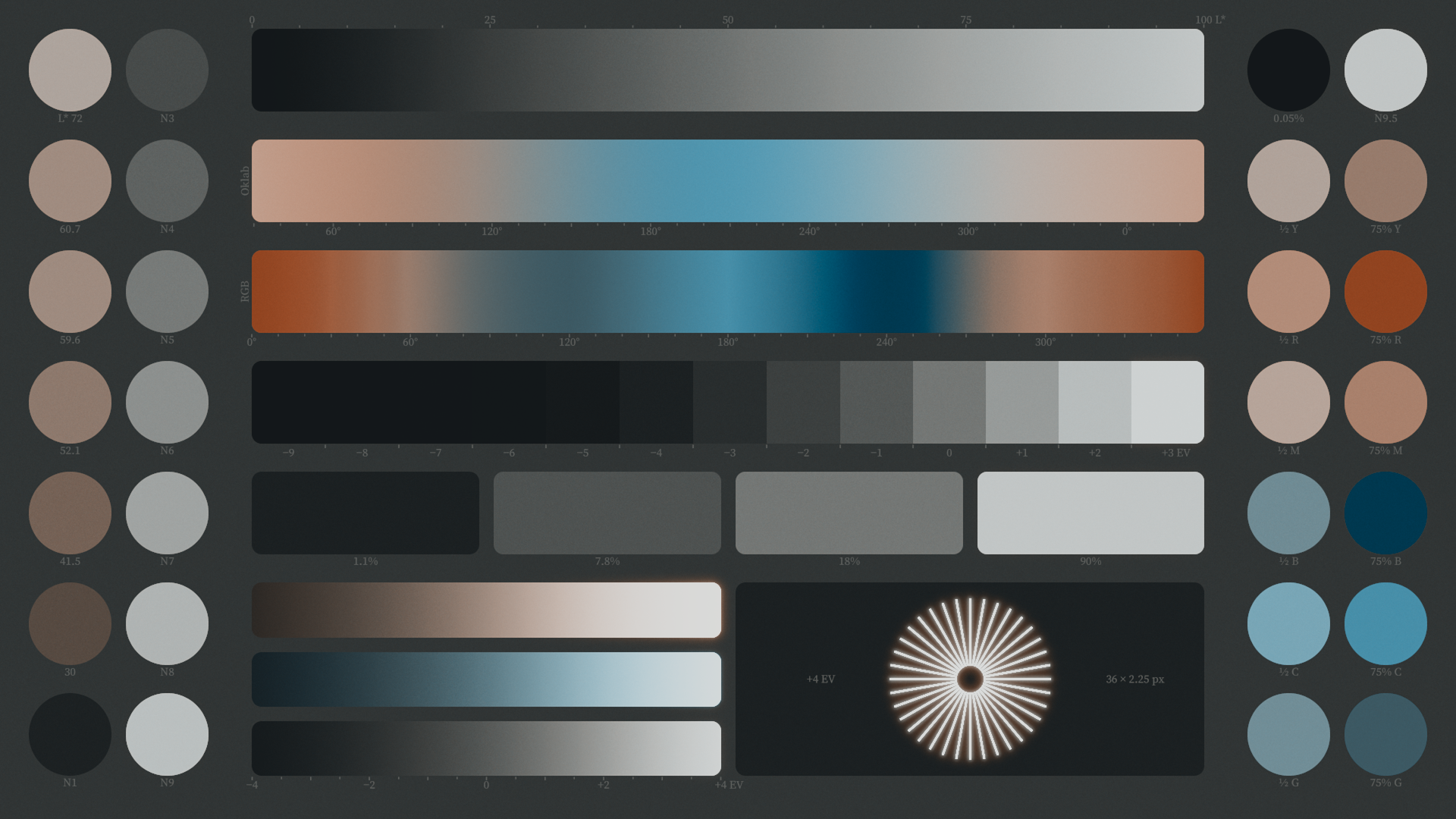
Ein von der Kopie inspiriertes Zweifarbmodell, keine Reproduktion von Trucolor, gezeigt nach Ansco Color Negative 843. Es teilt Farbstoffe und Auszugsempfindlichkeiten mit Ashigrains Trucolor-Verfahrensmodell, die ihrerseits aus benannten Annahmen abgeleitet sind, und seine beiden Kopierkurven sind auf das neutralste Grau abgestimmte Annahmen. Für ihn sind weder MTF noch Körnigkeit veröffentlicht.
Kennlinien und Datengrundlage des Modells
Vergleiche Herstellerdaten und Ashigrains Reaktion auf denselben Achsen. Die Kurven zeigen, wie das Modell an seinen Quellen kalibriert ist; sie belegen keine Übereinstimmung mit auf Film aufgenommenen Bildern.
Kennlinienantwort
Modellgrenzen
Diese Bilder zeigen das Filmmodell in Anwendung. Spektralantwort, Licht und Betrachtungsbedingungen enthalten Näherungen. Halation, Bloom, Korngröße, Bildstand und Flackern sind nicht für jeden Film vollständig vermessen. Eine echte Filmaufnahme hängt auch von Entwicklung und Kopierlichtabstimmung ab.
- Dies ist ein von der Trucolor-Kopie inspiriertes Zweifarbmodell, keine Reproduktion davon. In den Quellen gibt es keine Kennlinie, spektrale Empfindlichkeit, kein Farbstoffspektrum, keine MTF- oder Körnigkeitsmessung einer Trucolor-Kopie.
- Farbstoffe und Auszugsempfindlichkeiten sind die von Ashigrains Trucolor-Verfahrensmodell, ihrerseits aus benannten Annahmen abgeleitet, geleitet von einem SMPE-Bericht von 1948.
- Die beiden Kopierkurven (Gamma 2.6 für den rotorangen Auszug und 2.0 für den blaugrünen) sind Annahmen, gewählt für das neutralste Grau; zwei Farbstoffe können kein exaktes Neutral bilden.
- Das Modell führt die beiden Auszüge in einem dreischichtigen Pfad: Die blaue Schicht kopiert den grünen Auszug, und es gibt keinen Gelbfarbstoff.
- Die Silbertonspur und die doppelseitige Beschichtung sind erfasst, werden aber nicht modelliert. Für ihn sind weder MTF noch Körnigkeit veröffentlicht.
- Die Quelle gibt keine Spektren von Kopierlampe oder Filtern an. Ihre spektrale Wirkung ist angenähert.
- Modelliertes Projektionsstreulicht hebt die Schwarztöne auf der Leinwand an. Seine Stärke ist angenommen, da die verfügbaren Quellen sie nicht messen. Daraus lässt sich kein gemessener Projektionskontrast ableiten.
Schwarzschildeffekt: nicht modelliert. Die Belichtungszeit hat bei diesem Film keine Wirkung.
Filmleitfaden: Annahmen und praktische Entscheidungen
Diese Vorschau kombiniert den Printfilm mit dem genannten Kameranegativ. Der Print hat in diesem Vergleich keinen eigenen Belichtungsindex und keine separat gemessene Kornantwort.
Quellen
- Process: Journal of the SMPE vol. 50 (Jan-Jun 1948), incl. Report of SMPE Progress Committee (June 1948), pp.523-542, archive.org item journalofsociety50socirich (Prelinger Library scan), file journalofsociety50socirich.pdf (derivative, 47493669 bytes), S. 550
- Reconstructed: Journal of the SMPE vol. 50 (Jan-Jun 1948), incl. Report of SMPE Progress Committee (June 1948), pp.523-542, archive.org item journalofsociety50socirich (Prelinger Library scan), file journalofsociety50socirich.pdf (derivative, 47493669 bytes), S. 550
Hol diesen Film in dein Grading.
Alle Filme in einem Kauf, ohne Abo.
€199 + VAT