 Ashigrain
Farbkopie · Kopierfilm
Du Pont Color Release Positive Type 275
Eine gelatinefreie Farbkopie aus drei Auszügen.
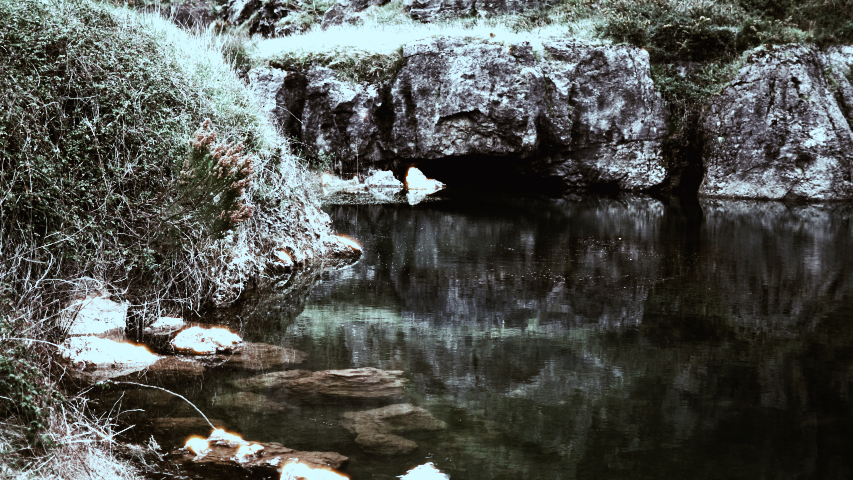
Du Pont Type 275, a gelatin-free separation release print reconstructed from its 1950 paper: the model derives three separation records from the negative and prints each at a contrast of 2.5. Original vs Ashigrain.
Auf einen Blick
- Eingeführt
- um 1949
- Prozess
- Du Pont Type 275 coupling colour development (p-aminodiethylaniline developer; develop, wash, first fix, bleach, second fix)
- Maximale Dichte
- ≈ 4,7
Über den Film
Du Pont Type 275 war ein Farb-Verleihpositiv, das nie in einer Kamera belichtet wurde: Es wurde in einer Passerkopiermaschine von drei Schwarzweiß-Auszugsnegativen kopiert, jedes durch ein schmalbandiges Filter.
Ingenieure der Photo Products Department von Du Pont in Parlin, New Jersey, stellten es am 11 Oktober 1949 auf der SMPE-Tagung in Hollywood vor, und ihr Aufsatz erschien im November 1950. Die chromogene Entwicklung durch Kupplung ging auf Rudolph Fischers Patent von 1912 zurück, doch Du Pont ersetzte die Gelatine ganz: Das Bindemittel jeder Schicht war ein synthetisches Polymer, ein Acetal des Polyvinylalkohols, das die farbbildenden Gruppen selbst trug, sodass der Kuppler nicht wandern konnte. Der Aufsatz stellte dies als Beseitigung der Gelatine aus einem kommerziellen fotografischen Produkt dar, und drei verschiedene Bindemittel waren nötig, eines für jeden subtraktiven Farbstoff. Von oben bildete eine blauempfindliche Schicht Purpur aus dem Grünauszug, eine rot sensibilisierte Schicht Blaugrün aus dem Rotauszug und eine grünempfindliche Schicht Gelb aus dem Blauauszug, wobei ein gelber Farbstoff blaues Licht von den unteren Schichten fernhielt. Die Schichten waren für einen Kopierkontrast von 2.5 aus Auszügen gleichen Kontrasts ausgelegt, und eine Lichthofschutz-Rückschicht wurde in der Entwicklung entfärbt und löste sich in den Wässerungen ab. Ton ließ sich als purpurne Farbstoffspur oder als Silbersulfidspur tragen, und der Aufsatz meldete einen etwas besseren Störabstand als bei Schwarzweiß-Verleihpositiv. Die Timeline of Historical Film Colors datiert DuPont Color Film Type 275 auf 1949 bis 1953, und der Aufsatz nennt Type 875 als Version auf Sicherheitsunterlage.
Quellen zu dieser Geschichte
- Synthetic Color-Forming Binders for Photographic Emulsions (Journal of the SMPTE 55, November 1950, pp. 455–476), A. B. Jennings, W. A. Stanton and J. P. Weiss (Du Pont), Internet Archive
- DuPont Color Film Type 275, Timeline of Historical Film Colors, University of Zurich
Der Look
Du Pont Color Release Positive Type 275 war ein Farb-Verleihkopierfilm von etwa 1949, passgenau von drei Schwarzweiß-Auszugsnegativen statt von einem Farbnegativ kopiert. Seine drei Schichten nutzten synthetische farbbildende Bindemittel statt Gelatine. Die Version von Ashigrain ist rekonstruiert und wird nach Ansco Color Negative 843 gezeigt.





Geeignet für
- Verleihkopien-Farbe der späten 1940er
- Kopieren von Auszugsnegativen
- Auszugs- und Negativkopie im Vergleich
Kopierfilme vergleichen
The same Vision3 500T night frame on each print film: how deep the blacks go, how the highlights roll off and how the colour separates.
The same Vision3 500T night frame on each print film: how deep the blacks go, how the highlights roll off and how the colour separates.
The same Vision3 500T night frame on each print film: how deep the blacks go, how the highlights roll off and how the colour separates.
The same Vision3 500T night frame on each print film: how deep the blacks go, how the highlights roll off and how the colour separates.
The same Vision3 500T night frame on each print film: how deep the blacks go, how the highlights roll off and how the colour separates.
The same Vision3 500T night frame on each print film: how deep the blacks go, how the highlights roll off and how the colour separates.
The same Vision3 500T night frame on each print film: how deep the blacks go, how the highlights roll off and how the colour separates.
The same Vision3 500T night frame on each print film: how deep the blacks go, how the highlights roll off and how the colour separates.
The same Vision3 500T night frame on each print film: how deep the blacks go, how the highlights roll off and how the colour separates.
The same Vision3 500T night frame on each print film: how deep the blacks go, how the highlights roll off and how the colour separates.
The same Vision3 500T night frame on each print film: how deep the blacks go, how the highlights roll off and how the colour separates.
The same Vision3 500T night frame on each print film: how deep the blacks go, how the highlights roll off and how the colour separates.
The same Vision3 500T night frame on each print film: how deep the blacks go, how the highlights roll off and how the colour separates.
The same Vision3 500T night frame on each print film. On this two-colour print (a labelled surrogate) every colour falls between blue-green and red-orange: how deep the blacks go, how the highlights roll off and which lights keep their hue.
The same Vision3 500T night frame on each print film: how deep the blacks go, how the highlights roll off and how the colour separates.
The same Vision3 500T night frame on each print film: how deep the blacks go, how the highlights roll off and how the colour separates.
The same Vision3 500T night frame on each print film: how deep the blacks go, how the highlights roll off and how the colour separates.
The same Vision3 500T night frame on each print film: how deep the blacks go, how the highlights roll off and how the colour separates.
The same Vision3 500T night frame on each print film: how deep the blacks go, how the highlights roll off and how the colour separates.
The same Vision3 500T night frame on each print film: how deep the blacks go, how the highlights roll off and how the colour separates.
The same Vision3 500T night frame on each print film: how deep the blacks go, how the highlights roll off and how the colour separates.
The same Vision3 500T night frame on each print film: how deep the blacks go, how the highlights roll off and how the colour separates.
The same Vision3 500T night frame on each print film: how deep the blacks go, how the highlights roll off and how the colour separates.
The same Vision3 500T night frame on each print film: how deep the blacks go, how the highlights roll off and how the colour separates.
The same Vision3 500T night frame on each print film. On this blue-sensitive black-and-white print the colour negative turns grey: how deep the blacks go, how the highlights roll off and how dark the reds and greens print.
The same Vision3 500T night frame on each print film: how deep the blacks go, how the highlights roll off and how the colour separates.
The same Vision3 500T night frame on each print film. On this blue-sensitive black-and-white print the colour negative turns grey: how deep the blacks go, how the highlights roll off and how dark the red neon and skin print.
The same Vision3 500T night frame on each print film: how deep the blacks go, how the highlights roll off and how the colour separates.
The same Vision3 500T night frame on each print film. On this black-and-white print the colour negative turns grey: how deep the blacks go, how the highlights roll off and how the coloured lights and skin translate to grey.
The same Vision3 500T night frame on each print film. On this blue-sensitive black-and-white print the colour negative turns grey: how deep the blacks go, how the highlights roll off and how the coloured lights and skin translate to grey.
The same Vision3 500T night frame on each print film: how deep the blacks go, how the highlights roll off and how the colour separates.
The same Vision3 500T night frame on each print film: how deep the blacks go, how the highlights roll off and how the colour separates.
The same Vision3 500T night frame on each print film: how deep the blacks go, how the highlights roll off and how the colour separates.
The same Vision3 500T night frame on each print film: how deep the blacks go, how the highlights roll off and how the colour separates.
The same Vision3 500T night frame on each print film: how deep the blacks go, how the highlights roll off and how the colour separates.
The same Vision3 500T night frame on each print film. On this two-colour print (a labelled surrogate) every colour falls between a blue and a red dye: how deep the blacks go, how the highlights roll off and which lights keep their hue.
The same Vision3 500T night frame on each print film: how deep the blacks go, how the highlights roll off and how the colour separates.
Dasselbe Nachtbild auf Kodak Vision3 500T, auf jeden Printfilm kopiert.
- Kodak Vision Premier Color Print Film 2393
- Eastman Color SP Print Film 5383
- Eastman Color Print Film 5384
- Fujifilm Eterna-CP 3521XD
- Du Pont Color Release Positive Type 275
- Fujifilm Eterna-CP 3523XD
- Kodak Vision Color Print Film 2383
- Fujifilm Eterna-CP 3513DI
- Eastman EXR Color Print Film 5386
- Eastman Color Print Film 5381 (1972)
- Eastman Color Print Film 5385
- Agfa CP30 Colour Print Film
- SuperCinecolor
- Cinecolor (two-colour)
- Gevacolor Positive 953
- Gevacolor Print 9.85
- Gevacolor Print 986
- Gevacolor Print 982
- Ferraniacolor Positive
- 3M Color Positive 650
- Fujicolor Positive F-CP 3510
- Fujicolor Positive F-CP 3519
- Fujifilm Eterna-CP 3512
- Eastman Color Print 5381 (1950)
- Eastman Fine Grain Release Positive 5302
- Ansco Color Print 848
- Kodak B&W Print Film 2302
- Svema TsP-11
- Svema MZ-3
- ORWO PF 2 Positive Print Film
- Technicolor Dye Transfer (1997 revival)
- Svema TsP-8R
- Shostka Colour Positive (1950s)
- Technicolor Dye Transfer (Process IV)
- Gasparcolor Print
- Trucolor Print (two-colour)
- Kodak Vision Color Teleprint Film 2395
Wissenschaft und Quellen

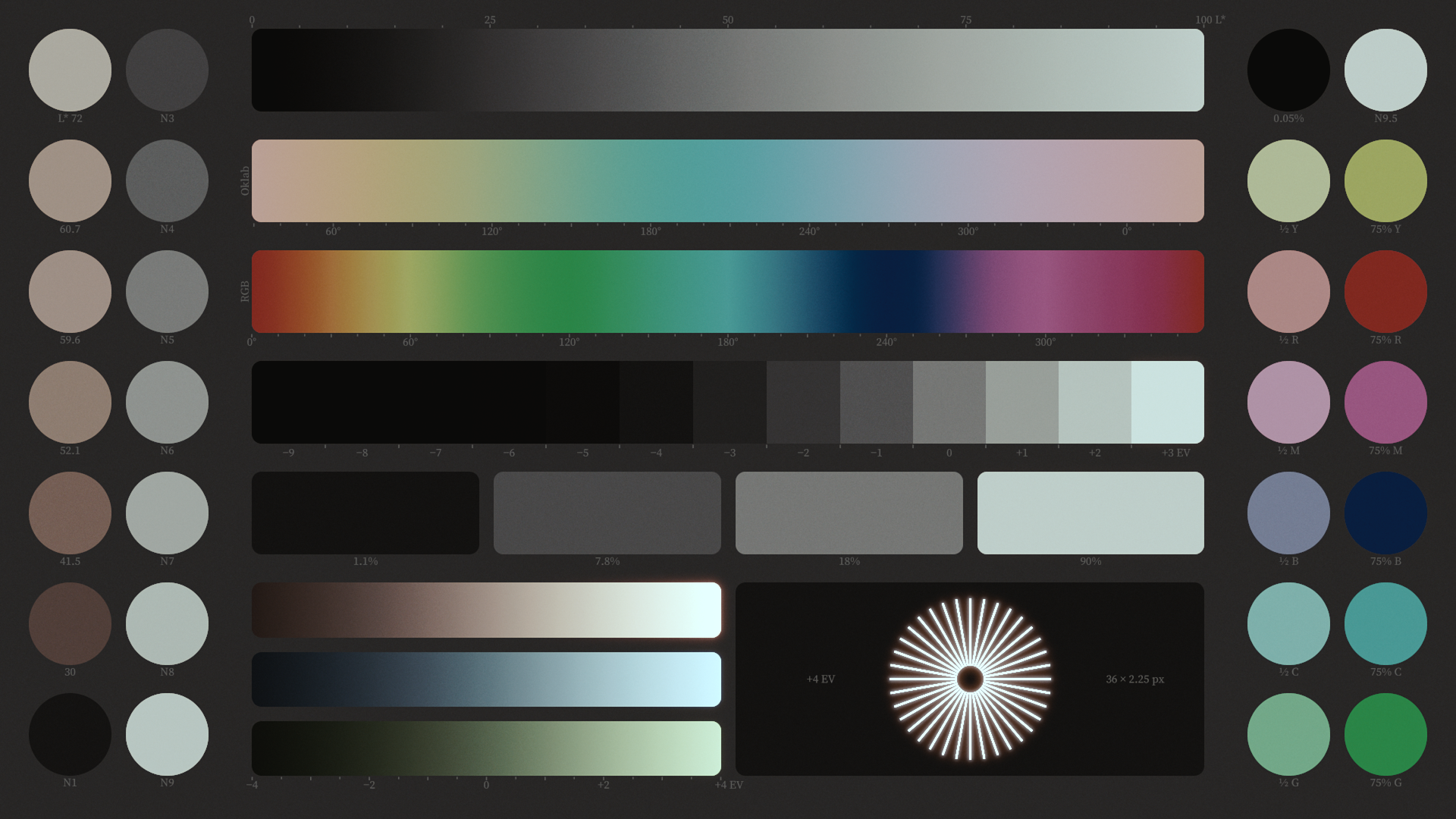
Eine Auszugskopie, rekonstruiert statt gemessen, gezeigt nach Ansco Color Negative 843. Ihre Kurven und Farbstoffe sind aus dem SMPTE-Aufsatz von Du Pont von 1950 nachgezeichnet, und ihre spektralen Empfindlichkeiten sind benannte Formen auf dem Spektrogramm des Aufsatzes. Das Modell leitet aus dem Negativ drei Schwarzweiß-Auszüge ab und kopiert jeden mit dem Sollkontrast des Aufsatzes von 2.5.
Kennlinien und Datengrundlage des Modells
Vergleiche Herstellerdaten und Ashigrains Reaktion auf denselben Achsen. Die Kurven zeigen, wie das Modell an seinen Quellen kalibriert ist; sie belegen keine Übereinstimmung mit auf Film aufgenommenen Bildern.
Kennlinienantwort
Modellgrenzen
Diese Bilder zeigen das Filmmodell in Anwendung. Spektralantwort, Licht und Betrachtungsbedingungen enthalten Näherungen. Halation, Bloom, Korngröße, Bildstand und Flackern sind nicht für jeden Film vollständig vermessen. Eine echte Filmaufnahme hängt auch von Entwicklung und Kopierlichtabstimmung ab.
- Dies ist ein rekonstruiertes Modell von Du Pont Type 275. Seine Schichtkurven und Farbstoffe sind aus dem Aufsatz von 1950 nachgezeichnet, der Dichten bei der Wellenlänge der maximalen Absorption jedes Farbstoffs druckt, keine Status-A-Dichten; sie als äquivalente Neutraldichten zu lesen ist eine Näherung.
- Das Spektrogramm des Aufsatzes hat keine Empfindlichkeitsachse, daher sind die drei spektralen Empfindlichkeiten benannte Formen auf seinen gedruckten Maxima (440, 550 und 710 nm), mit angenommenen Flanken bei 360 und 760 nm.
- Das Modell kopiert Type 275 von einem Farbnegativ: Es leitet aus dem Negativ drei Auszüge ab und kopiert jeden mit dem Sollkontrast des Aufsatzes von 2.5. Die Neutralskala, wie im Aufsatz gezeichnet, hat einen Gradienten von etwa 2.24.
- Die nachgezeichneten Schichtfüße laufen unterhalb einer äquivalenten Dichte von etwa 0.55 auseinander, daher ergibt ein neutraler Auszugssatz grün-cyanfarbene Lichter.
- Die Farbstoffe sind nur von etwa 415 bis 680 nm gedruckt; das Modell hält außerhalb dieses Bereichs die Randwerte.
- Schichtfolge, synthetische Bindemittel, schmalbandige Kopierfilter, Lichthofschutz-Rückschicht und Tonspuren sind erfasst, aber nicht modelliert. Für sie sind weder MTF noch Körnigkeit gedruckt.
- Die Quelle gibt keine Spektren von Kopierlampe oder Filtern an. Ihre spektrale Wirkung ist angenähert.
- Modelliertes Projektionsstreulicht hebt die Schwarztöne auf der Leinwand an. Seine Stärke ist angenommen, da die verfügbaren Quellen sie nicht messen. Daraus lässt sich kein gemessener Projektionskontrast ableiten.
Schwarzschildeffekt: nicht modelliert. Die Belichtungszeit hat bei diesem Film keine Wirkung.
Filmleitfaden: Annahmen und praktische Entscheidungen
Diese Vorschau kombiniert den Printfilm mit dem genannten Kameranegativ. Der Print hat in diesem Vergleich keinen eigenen Belichtungsindex und keine separat gemessene Kornantwort.
Quellen
- Characteristic curves: Jennings, Stanton and Weiss: Synthetic Color-Forming Binders for Photographic Emulsions (J. SMPTE 55, Nov. 1950) in Journal of the Society of Motion Picture Engineers vol. 55 (Jul-Dec 1950), archive.org item journalofsociety55socirich, file journalofsociety55socirich.pdf (Prelinger Library scan, 680 pages), S. 470
- Process: Jennings, Stanton and Weiss: Synthetic Color-Forming Binders for Photographic Emulsions (J. SMPTE 55, Nov. 1950) in Journal of the Society of Motion Picture Engineers vol. 55 (Jul-Dec 1950), archive.org item journalofsociety55socirich, file journalofsociety55socirich.pdf (Prelinger Library scan, 680 pages), S. 470
Hol diesen Film in dein Grading.
Alle Filme in einem Kauf, ohne Abo.
€199 + VAT