 Ashigrain
Positiva a colori · Pellicole positive
Technicolor Dye Transfer (Process IV)
Trasferimento di coloranti in tricromia, la classica copia Technicolor.
A labelled surrogate of three-colour dye transfer, rendered as the 1950s print step from a colour negative, with a faint key image of the green record. Original vs Ashigrain.
In sintesi
- Introduzione
- 1932
- Fuori produzione
- Processo
- three separation records printed onto matrix film, developed to hardened gelatin reliefs, imbibed with cyan, magenta and yellow dyes and transferred in register onto a blank
- Densità massima
- ≈ 2,8
Sulla pellicola
Il procedimento in tricromia a trasferimento di coloranti di Technicolor, noto come Process IV, fu mostrato per la prima volta in Flowers and Trees di Disney nel 1932, e Becky Sharp (1935) fu il primo lungometraggio dal vero realizzato con esso.
Una cinepresa con divisore di fascio esponeva tre registrazioni in bianco e nero; ciascuna era stampata su una pellicola matrice il cui rilievo di gelatina assorbiva il colorante e lo trasferiva su una pellicola vergine, con la registrazione rossa che stampava il ciano, la verde il magenta e la blu il giallo. Fino agli anni Cinquanta sulla pellicola vergine si stampava prima una tenue immagine chiave in bianco e nero della registrazione verde, per aiutare la nitidezza percepita, e il modello di Ashigrain la include. Film Atlas definisce il sistema lo standard del settore, e Technicolor dominò il cinema a colori dalla metà degli anni Trenta agli anni Cinquanta, con film come A Star Is Born (1937), Gone with the Wind (1939), The Red Shoes (1948) e Singin' in the Rain (1952). Technicolor aprì nel 1936 un laboratorio britannico a Harmondsworth, vicino a Londra, e i suoi coloranti cambiarono nel tempo: durante la guerra usò coloranti americani, e i coloranti del laboratorio britannico differivano da quelli di Hollywood. Dai primi anni Cinquanta Technicolor realizzò le sue copie a trasferimento di coloranti da negativi Eastman Color anziché da registrazioni a tre pellicole, il passaggio di stampa che Ashigrain modella. Film Atlas definisce quelle copie stabili nel colore, a differenza delle copie Eastman Color dell’epoca. La stampa a trasferimento di coloranti da negativi a colori continuò finché Technicolor negli Stati Uniti non la interruppe verso il 1975, e gli stabilimenti britannico e italiano nel 1978.
Fonti di questa storia
- Three-Color Technicolor (Céline Ruivo), Film Atlas (FIAF / George Eastman Museum)
- Technicolor No. IV: Three-strip, Timeline of Historical Film Colors, University of Zurich
- The Technicolor Process of Three-Color Cinematography (J. A. Ball, J. SMPE 1935), American WideScreen Museum
- Technicolor prints from color negatives (Richard W. Haines), Film Atlas (FIAF / George Eastman Museum)
Il look
Le copie a trasferimento di coloranti di Technicolor prendevano coloranti ciano, magenta e giallo da tre matrici a rilievo di gelatina e li trasferivano su una pellicola vergine, lo standard del settore dalla metà degli anni Trenta. La versione di Ashigrain è un sostituto dichiarato, un modello ispirato alla copia e non una riproduzione. Rende il passaggio di stampa da un negativo a colori.



Ideale per
- Musical e melodrammi della Hollywood classica
- Colori saturi di costumi e scenografie
- Kolossal degli anni Cinquanta stampati da negativi a colori
Confronta le pellicole positive
The same Vision3 500T night frame on each print film: how deep the blacks go, how the highlights roll off and how the colour separates.
The same Vision3 500T night frame on each print film: how deep the blacks go, how the highlights roll off and how the colour separates.
The same Vision3 500T night frame on each print film: how deep the blacks go, how the highlights roll off and how the colour separates.
The same Vision3 500T night frame on each print film: how deep the blacks go, how the highlights roll off and how the colour separates.
The same Vision3 500T night frame on each print film: how deep the blacks go, how the highlights roll off and how the colour separates.
The same Vision3 500T night frame on each print film: how deep the blacks go, how the highlights roll off and how the colour separates.
The same Vision3 500T night frame on each print film: how deep the blacks go, how the highlights roll off and how the colour separates.
The same Vision3 500T night frame on each print film: how deep the blacks go, how the highlights roll off and how the colour separates.
The same Vision3 500T night frame on each print film: how deep the blacks go, how the highlights roll off and how the colour separates.
The same Vision3 500T night frame on each print film: how deep the blacks go, how the highlights roll off and how the colour separates.
The same Vision3 500T night frame on each print film: how deep the blacks go, how the highlights roll off and how the colour separates.
The same Vision3 500T night frame on each print film: how deep the blacks go, how the highlights roll off and how the colour separates.
The same Vision3 500T night frame on each print film: how deep the blacks go, how the highlights roll off and how the colour separates.
The same Vision3 500T night frame on each print film. On this two-colour print (a labelled surrogate) every colour falls between blue-green and red-orange: how deep the blacks go, how the highlights roll off and which lights keep their hue.
The same Vision3 500T night frame on each print film: how deep the blacks go, how the highlights roll off and how the colour separates.
The same Vision3 500T night frame on each print film: how deep the blacks go, how the highlights roll off and how the colour separates.
The same Vision3 500T night frame on each print film: how deep the blacks go, how the highlights roll off and how the colour separates.
The same Vision3 500T night frame on each print film: how deep the blacks go, how the highlights roll off and how the colour separates.
The same Vision3 500T night frame on each print film: how deep the blacks go, how the highlights roll off and how the colour separates.
The same Vision3 500T night frame on each print film: how deep the blacks go, how the highlights roll off and how the colour separates.
The same Vision3 500T night frame on each print film: how deep the blacks go, how the highlights roll off and how the colour separates.
The same Vision3 500T night frame on each print film: how deep the blacks go, how the highlights roll off and how the colour separates.
The same Vision3 500T night frame on each print film: how deep the blacks go, how the highlights roll off and how the colour separates.
The same Vision3 500T night frame on each print film: how deep the blacks go, how the highlights roll off and how the colour separates.
The same Vision3 500T night frame on each print film. On this blue-sensitive black-and-white print the colour negative turns grey: how deep the blacks go, how the highlights roll off and how dark the reds and greens print.
The same Vision3 500T night frame on each print film: how deep the blacks go, how the highlights roll off and how the colour separates.
The same Vision3 500T night frame on each print film. On this blue-sensitive black-and-white print the colour negative turns grey: how deep the blacks go, how the highlights roll off and how dark the red neon and skin print.
The same Vision3 500T night frame on each print film: how deep the blacks go, how the highlights roll off and how the colour separates.
The same Vision3 500T night frame on each print film. On this black-and-white print the colour negative turns grey: how deep the blacks go, how the highlights roll off and how the coloured lights and skin translate to grey.
The same Vision3 500T night frame on each print film. On this blue-sensitive black-and-white print the colour negative turns grey: how deep the blacks go, how the highlights roll off and how the coloured lights and skin translate to grey.
The same Vision3 500T night frame on each print film: how deep the blacks go, how the highlights roll off and how the colour separates.
The same Vision3 500T night frame on each print film: how deep the blacks go, how the highlights roll off and how the colour separates.
The same Vision3 500T night frame on each print film: how deep the blacks go, how the highlights roll off and how the colour separates.
The same Vision3 500T night frame on each print film: how deep the blacks go, how the highlights roll off and how the colour separates.
The same Vision3 500T night frame on each print film: how deep the blacks go, how the highlights roll off and how the colour separates.
The same Vision3 500T night frame on each print film. On this two-colour print (a labelled surrogate) every colour falls between a blue and a red dye: how deep the blacks go, how the highlights roll off and which lights keep their hue.
The same Vision3 500T night frame on each print film: how deep the blacks go, how the highlights roll off and how the colour separates.
Lo stesso fotogramma notturno su Kodak Vision3 500T, stampato su ogni positivo.
- Kodak Vision Premier Color Print Film 2393
- Eastman Color SP Print Film 5383
- Eastman Color Print Film 5384
- Fujifilm Eterna-CP 3521XD
- Du Pont Color Release Positive Type 275
- Fujifilm Eterna-CP 3523XD
- Kodak Vision Color Print Film 2383
- Fujifilm Eterna-CP 3513DI
- Eastman EXR Color Print Film 5386
- Eastman Color Print Film 5381 (1972)
- Eastman Color Print Film 5385
- Agfa CP30 Colour Print Film
- SuperCinecolor
- Cinecolor (two-colour)
- Gevacolor Positive 953
- Gevacolor Print 9.85
- Gevacolor Print 986
- Gevacolor Print 982
- Ferraniacolor Positive
- 3M Color Positive 650
- Fujicolor Positive F-CP 3510
- Fujicolor Positive F-CP 3519
- Fujifilm Eterna-CP 3512
- Eastman Color Print 5381 (1950)
- Eastman Fine Grain Release Positive 5302
- Ansco Color Print 848
- Kodak B&W Print Film 2302
- Svema TsP-11
- Svema MZ-3
- ORWO PF 2 Positive Print Film
- Technicolor Dye Transfer (1997 revival)
- Svema TsP-8R
- Shostka Colour Positive (1950s)
- Technicolor Dye Transfer (Process IV)
- Gasparcolor Print
- Trucolor Print (two-colour)
- Kodak Vision Color Teleprint Film 2395
Scienza e fonti

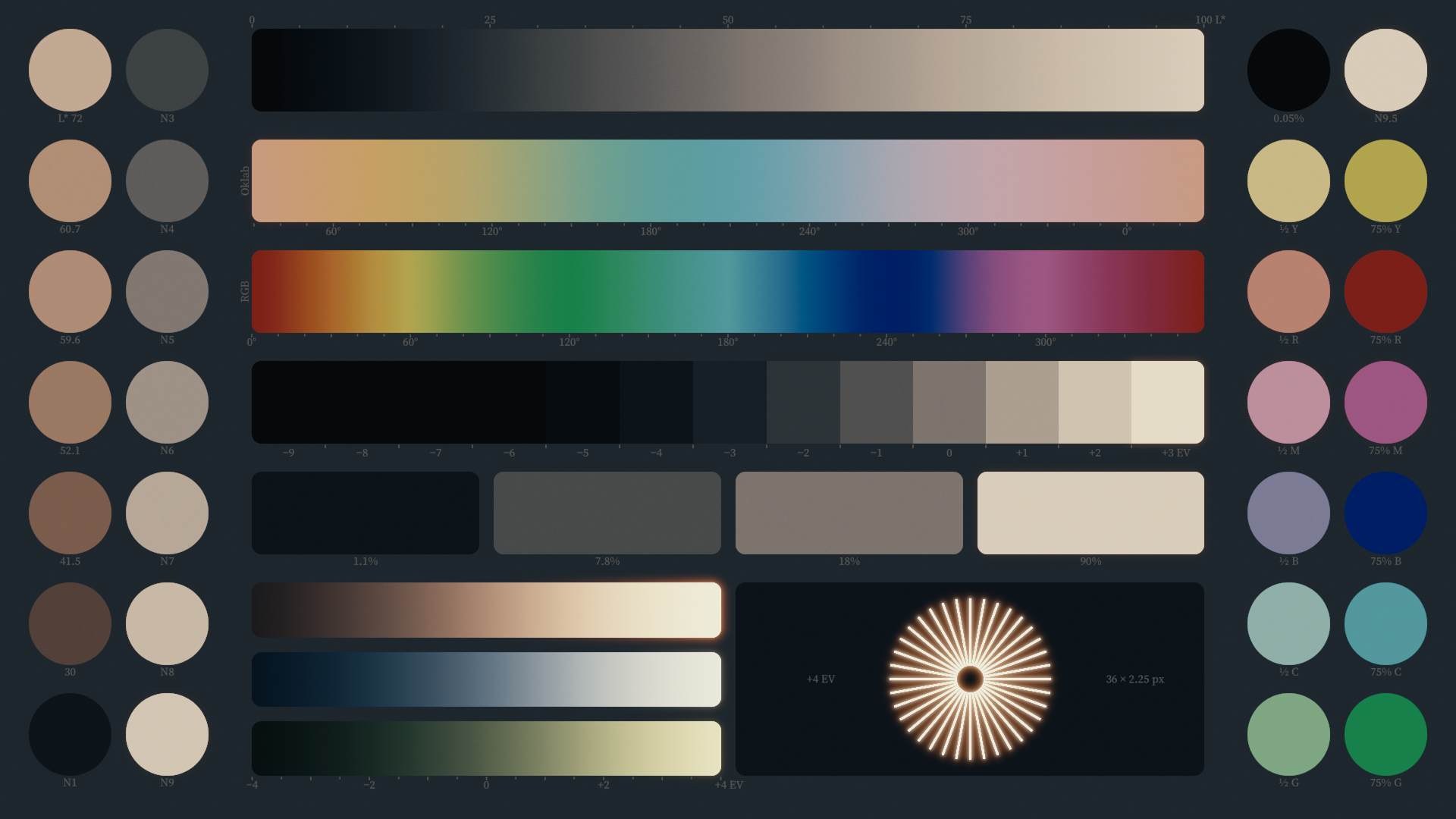
Un modello in tricromia ispirato alla copia, non una riproduzione del trasferimento di coloranti Technicolor, mostrato dopo Eastman Color Negative 5247. Non esiste alcuna curva, filtro di selezione, gamma della matrice o misura dei coloranti, quindi ogni curva e ogni forma dei coloranti è generata da ipotesi dichiarate, guidate dalla descrizione di Ball del 1935 e da fonti d’archivio; è inclusa una tenue immagine chiave della registrazione verde.
Curve di risposta e basi del modello
Confronta i dati del produttore con la risposta di Ashigrain sugli stessi assi. Queste curve mostrano come il modello è calibrato sulle fonti; non dimostrano una corrispondenza con immagini riprese su pellicola.
Risposta caratteristica
Limiti del modello
Queste immagini mostrano il modello di pellicola in uso. Risposta spettrale, luce e condizioni di visione includono approssimazioni; aloni, bagliore, dimensione della grana, instabilità e sfarfallio non sono misurati completamente per ogni film. Una ripresa reale dipende anche dallo sviluppo e dal bilanciamento della stampa.
- Si tratta di un modello in tricromia ispirato alle copie Technicolor a trasferimento di coloranti, non di una riproduzione del procedimento originale.
- Nelle fonti non esiste alcuna curva caratteristica, filtro di selezione, gamma della matrice o spettro dei coloranti di una copia Technicolor. Ogni curva è generata da ipotesi dichiarate, guidate dalla descrizione del sistema di Ball del 1935 e da descrizioni d’archivio.
- Il modello rende il passaggio di stampa da un negativo a colori, come lo eseguiva la stampatrice di matrici dai primi anni Cinquanta; le registrazioni da cinepresa a tre pellicole non sono modellate.
- Le tre sensibilità di registrazione, l’unica curva di stampa comune a tutte le registrazioni (gamma della matrice 2.6) e i coloranti di trasferimento gaussiani sono ipotesi; larghezze e intensità dei coloranti sono state scelte per il grigio più neutro.
- La tenue immagine chiave della registrazione verde è modellata come una densità d’argento neutra di intensità ipotizzata.
- La fonte non dà spettri della lampada o dei filtri della stampatrice. La loro risposta spettrale è approssimata.
- Il velo di proiezione modellato solleva i neri sullo schermo. La sua intensità è assunta perché le fonti disponibili non la misurano; non stabilisce quindi un contrasto di proiezione misurato.
Reciprocità: non modellata. Il tempo di esposizione non ha effetto su questa pellicola.
Guida alle pellicole: ipotesi e scelte pratiche
Questa anteprima combina il positivo con il negativo da ripresa indicato. In questo confronto, il positivo non ha un indice di esposizione separato né una propria risposta misurata della grana.
Fonti
- Process: J. A. Ball, The Technicolor Process of Three-Color Cinematography (American WideScreen Museum transcription), widescreenmuseum.com/oldcolor/ball.htm as served 2026-10-28 (transcription; figures ballpic1a.gif, ballpic2.gif not registered), p. 1
- Reconstructed: J. A. Ball, The Technicolor Process of Three-Color Cinematography (American WideScreen Museum transcription), widescreenmuseum.com/oldcolor/ball.htm as served 2026-10-28 (transcription; figures ballpic1a.gif, ballpic2.gif not registered), p. 1
Porta questa pellicola nella tua correzione colore.
Tutte le pellicole in un unico acquisto, senza abbonamento.
€199 + VAT