 Ashigrain
Positiva a colori · Pellicole positive
Du Pont Color Release Positive Type 275
Una copia a colori senza gelatina da tre selezioni.
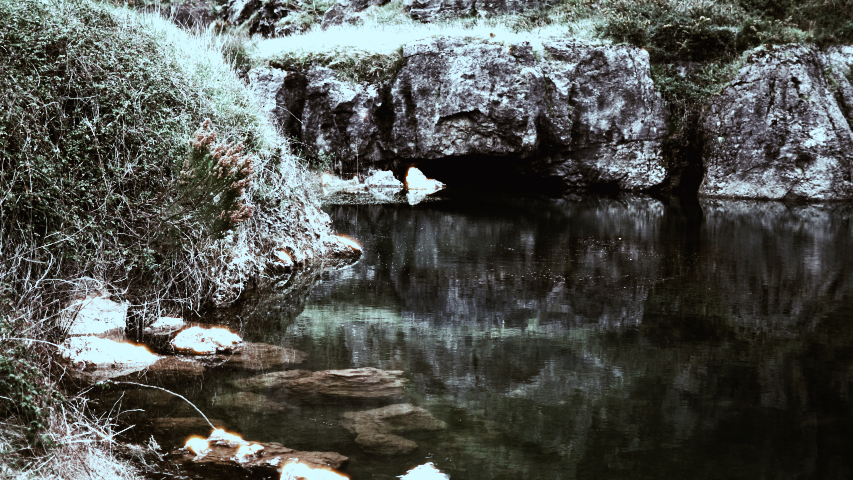
Du Pont Type 275, a gelatin-free separation release print reconstructed from its 1950 paper: the model derives three separation records from the negative and prints each at a contrast of 2.5. Original vs Ashigrain.
In sintesi
- Introduzione
- intorno al 1949
- Processo
- Du Pont Type 275 coupling colour development (p-aminodiethylaniline developer; develop, wash, first fix, bleach, second fix)
- Densità massima
- ≈ 4,7
Sulla pellicola
Du Pont Type 275 era un positivo di distribuzione a colori mai esposto in cinepresa: veniva stampato in una stampatrice a registro da tre negativi di selezione in bianco e nero, ciascuno attraverso un filtro a banda stretta.
Ingegneri del Photo Products Department di Du Pont a Parlin, New Jersey, lo presentarono al congresso SMPE di Hollywood l'11 ottobre 1949, e il loro articolo uscì nel novembre 1950. Lo sviluppo cromogeno per copulazione risaliva al brevetto di Rudolph Fischer del 1912, ma Du Pont sostituì del tutto la gelatina: il legante di ogni strato era un polimero sintetico, un acetale dell'alcol polivinilico, che portava esso stesso i gruppi cromogeni, così il copulante non poteva migrare. L'articolo lo presentava come l'eliminazione della gelatina da un prodotto fotografico commerciale, e servivano tre leganti diversi, uno per ciascun colorante sottrattivo. Dall'alto, uno strato sensibile al blu formava il magenta dalla selezione verde, uno strato sensibilizzato al rosso il ciano dalla selezione rossa e uno strato sensibile al verde il giallo dalla selezione blu, con un colorante giallo che teneva la luce blu lontana dagli strati inferiori. Gli strati erano progettati per un contrasto di stampa di 2.5 da selezioni di pari contrasto, e uno strato antialone sul retro si decolorava nello sviluppo e si scioglieva nei lavaggi. Il sonoro poteva essere portato da una colonna di colorante magenta o di solfuro d'argento, e l'articolo riportava un rapporto segnale/rumore leggermente migliore del positivo di distribuzione in bianco e nero. La Timeline of Historical Film Colors data DuPont Color Film Type 275 dal 1949 al 1953, e l'articolo indica Type 875 come la versione su supporto di sicurezza.
Fonti di questa storia
- Synthetic Color-Forming Binders for Photographic Emulsions (Journal of the SMPTE 55, November 1950, pp. 455–476), A. B. Jennings, W. A. Stanton and J. P. Weiss (Du Pont), Internet Archive
- DuPont Color Film Type 275, Timeline of Historical Film Colors, University of Zurich
Il look
Du Pont Color Release Positive Type 275 era una pellicola per copie di distribuzione a colori del 1949 circa, stampata a registro da tre negativi di selezione in bianco e nero anziché da un negativo a colori. I suoi tre strati usavano leganti cromogeni sintetici al posto della gelatina. La versione di Ashigrain è ricostruita e mostrata dopo Ansco Color Negative 843.





Ideale per
- Colore da copia di distribuzione di fine anni 1940
- Stampa da negativi di selezione
- Confrontare stampa da selezioni e da negativo
Confronta le pellicole positive
The same Vision3 500T night frame on each print film: how deep the blacks go, how the highlights roll off and how the colour separates.
The same Vision3 500T night frame on each print film: how deep the blacks go, how the highlights roll off and how the colour separates.
The same Vision3 500T night frame on each print film: how deep the blacks go, how the highlights roll off and how the colour separates.
The same Vision3 500T night frame on each print film: how deep the blacks go, how the highlights roll off and how the colour separates.
The same Vision3 500T night frame on each print film: how deep the blacks go, how the highlights roll off and how the colour separates.
The same Vision3 500T night frame on each print film: how deep the blacks go, how the highlights roll off and how the colour separates.
The same Vision3 500T night frame on each print film: how deep the blacks go, how the highlights roll off and how the colour separates.
The same Vision3 500T night frame on each print film: how deep the blacks go, how the highlights roll off and how the colour separates.
The same Vision3 500T night frame on each print film: how deep the blacks go, how the highlights roll off and how the colour separates.
The same Vision3 500T night frame on each print film: how deep the blacks go, how the highlights roll off and how the colour separates.
The same Vision3 500T night frame on each print film: how deep the blacks go, how the highlights roll off and how the colour separates.
The same Vision3 500T night frame on each print film: how deep the blacks go, how the highlights roll off and how the colour separates.
The same Vision3 500T night frame on each print film: how deep the blacks go, how the highlights roll off and how the colour separates.
The same Vision3 500T night frame on each print film. On this two-colour print (a labelled surrogate) every colour falls between blue-green and red-orange: how deep the blacks go, how the highlights roll off and which lights keep their hue.
The same Vision3 500T night frame on each print film: how deep the blacks go, how the highlights roll off and how the colour separates.
The same Vision3 500T night frame on each print film: how deep the blacks go, how the highlights roll off and how the colour separates.
The same Vision3 500T night frame on each print film: how deep the blacks go, how the highlights roll off and how the colour separates.
The same Vision3 500T night frame on each print film: how deep the blacks go, how the highlights roll off and how the colour separates.
The same Vision3 500T night frame on each print film: how deep the blacks go, how the highlights roll off and how the colour separates.
The same Vision3 500T night frame on each print film: how deep the blacks go, how the highlights roll off and how the colour separates.
The same Vision3 500T night frame on each print film: how deep the blacks go, how the highlights roll off and how the colour separates.
The same Vision3 500T night frame on each print film: how deep the blacks go, how the highlights roll off and how the colour separates.
The same Vision3 500T night frame on each print film: how deep the blacks go, how the highlights roll off and how the colour separates.
The same Vision3 500T night frame on each print film: how deep the blacks go, how the highlights roll off and how the colour separates.
The same Vision3 500T night frame on each print film. On this blue-sensitive black-and-white print the colour negative turns grey: how deep the blacks go, how the highlights roll off and how dark the reds and greens print.
The same Vision3 500T night frame on each print film: how deep the blacks go, how the highlights roll off and how the colour separates.
The same Vision3 500T night frame on each print film. On this blue-sensitive black-and-white print the colour negative turns grey: how deep the blacks go, how the highlights roll off and how dark the red neon and skin print.
The same Vision3 500T night frame on each print film: how deep the blacks go, how the highlights roll off and how the colour separates.
The same Vision3 500T night frame on each print film. On this black-and-white print the colour negative turns grey: how deep the blacks go, how the highlights roll off and how the coloured lights and skin translate to grey.
The same Vision3 500T night frame on each print film. On this blue-sensitive black-and-white print the colour negative turns grey: how deep the blacks go, how the highlights roll off and how the coloured lights and skin translate to grey.
The same Vision3 500T night frame on each print film: how deep the blacks go, how the highlights roll off and how the colour separates.
The same Vision3 500T night frame on each print film: how deep the blacks go, how the highlights roll off and how the colour separates.
The same Vision3 500T night frame on each print film: how deep the blacks go, how the highlights roll off and how the colour separates.
The same Vision3 500T night frame on each print film: how deep the blacks go, how the highlights roll off and how the colour separates.
The same Vision3 500T night frame on each print film: how deep the blacks go, how the highlights roll off and how the colour separates.
The same Vision3 500T night frame on each print film. On this two-colour print (a labelled surrogate) every colour falls between a blue and a red dye: how deep the blacks go, how the highlights roll off and which lights keep their hue.
The same Vision3 500T night frame on each print film: how deep the blacks go, how the highlights roll off and how the colour separates.
Lo stesso fotogramma notturno su Kodak Vision3 500T, stampato su ogni positivo.
- Kodak Vision Premier Color Print Film 2393
- Eastman Color SP Print Film 5383
- Eastman Color Print Film 5384
- Fujifilm Eterna-CP 3521XD
- Du Pont Color Release Positive Type 275
- Fujifilm Eterna-CP 3523XD
- Kodak Vision Color Print Film 2383
- Fujifilm Eterna-CP 3513DI
- Eastman EXR Color Print Film 5386
- Eastman Color Print Film 5381 (1972)
- Eastman Color Print Film 5385
- Agfa CP30 Colour Print Film
- SuperCinecolor
- Cinecolor (two-colour)
- Gevacolor Positive 953
- Gevacolor Print 9.85
- Gevacolor Print 986
- Gevacolor Print 982
- Ferraniacolor Positive
- 3M Color Positive 650
- Fujicolor Positive F-CP 3510
- Fujicolor Positive F-CP 3519
- Fujifilm Eterna-CP 3512
- Eastman Color Print 5381 (1950)
- Eastman Fine Grain Release Positive 5302
- Ansco Color Print 848
- Kodak B&W Print Film 2302
- Svema TsP-11
- Svema MZ-3
- ORWO PF 2 Positive Print Film
- Technicolor Dye Transfer (1997 revival)
- Svema TsP-8R
- Shostka Colour Positive (1950s)
- Technicolor Dye Transfer (Process IV)
- Gasparcolor Print
- Trucolor Print (two-colour)
- Kodak Vision Color Teleprint Film 2395
Scienza e fonti

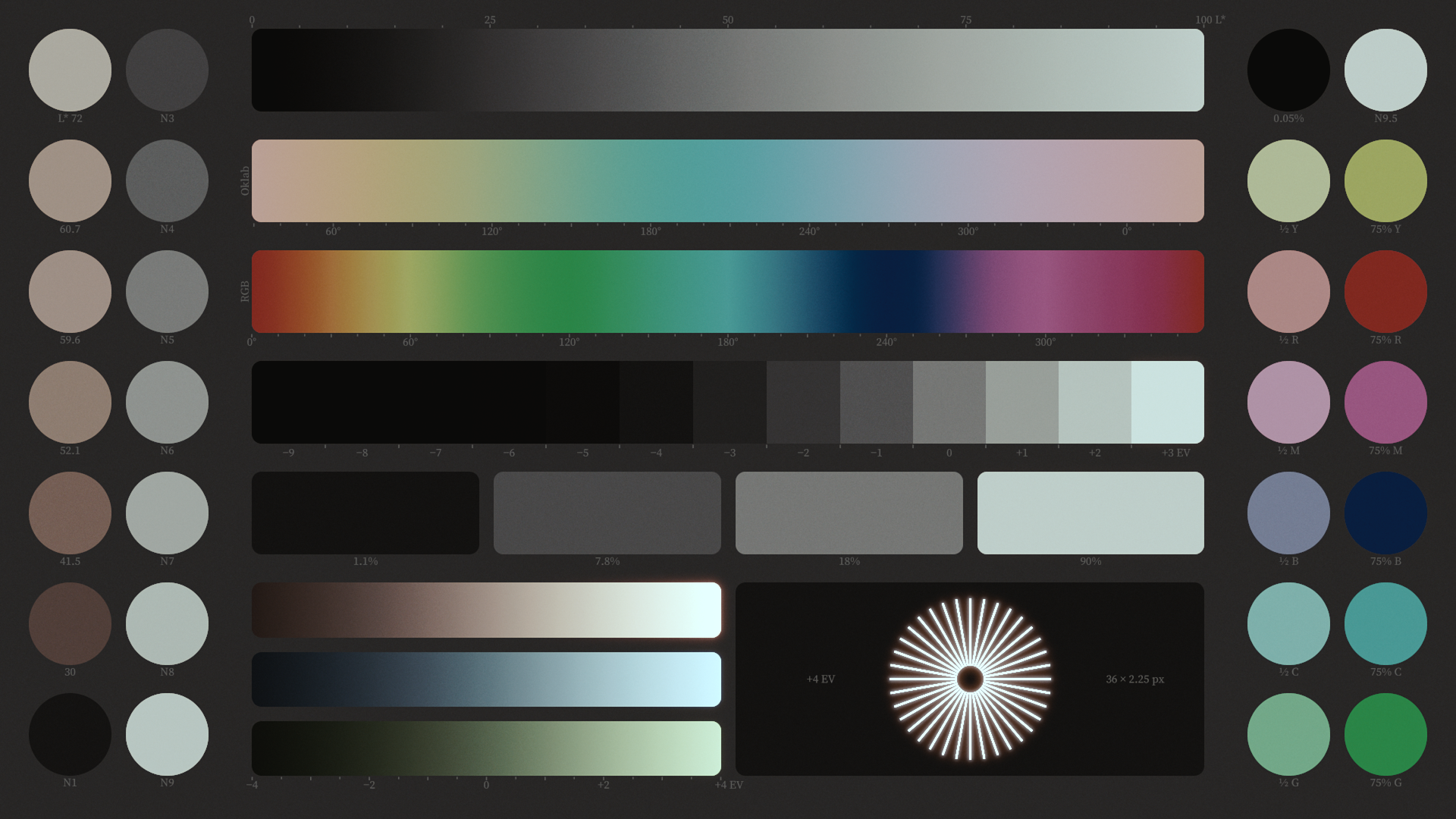
Una copia da selezioni, ricostruita anziché misurata, mostrata dopo Ansco Color Negative 843. Curve e coloranti sono ricalcati dall'articolo SMPTE di Du Pont del 1950 e le sensibilità spettrali sono forme denominate sullo spettrogramma dell'articolo. Il modello ricava dal negativo tre selezioni in bianco e nero e stampa ciascuna al contrasto di progetto dell'articolo, 2.5.
Curve di risposta e basi del modello
Confronta i dati del produttore con la risposta di Ashigrain sugli stessi assi. Queste curve mostrano come il modello è calibrato sulle fonti; non dimostrano una corrispondenza con immagini riprese su pellicola.
Risposta caratteristica
Limiti del modello
Queste immagini mostrano il modello di pellicola in uso. Risposta spettrale, luce e condizioni di visione includono approssimazioni; aloni, bagliore, dimensione della grana, instabilità e sfarfallio non sono misurati completamente per ogni film. Una ripresa reale dipende anche dallo sviluppo e dal bilanciamento della stampa.
- Questo è un modello ricostruito di Du Pont Type 275. Curve degli strati e coloranti sono ricalcati dall'articolo del 1950, che stampa densità alla lunghezza d'onda di massimo assorbimento di ciascun colorante, non densità Status A; leggerle come densità neutre equivalenti è un'approssimazione.
- Lo spettrogramma dell'articolo non ha un asse di sensibilità, quindi le tre sensibilità spettrali sono forme denominate sui picchi stampati (440, 550 e 710 nm), con fianchi presunti a 360 e 760 nm.
- Il modello stampa Type 275 da un negativo a colori: ne ricava tre selezioni e stampa ciascuna al contrasto di progetto dell'articolo, 2.5. La scala neutra come disegnata nell'articolo ha un gradiente di circa 2.24.
- I piedi delle curve ricalcati si separano sotto una densità equivalente di circa 0.55, quindi un set di selezioni neutro stampa alte luci verde-ciano.
- I coloranti sono stampati solo da circa 415 a 680 nm; il modello mantiene i valori ai bordi fuori da quell'intervallo.
- Ordine degli strati, leganti sintetici, filtri di stampa a banda stretta, strato antialone sul retro e colonne sonore sono registrati ma non modellati. Per essa non sono stampate né MTF né granularità.
- La fonte non dà spettri della lampada o dei filtri della stampatrice. La loro risposta spettrale è approssimata.
- Il velo di proiezione modellato solleva i neri sullo schermo. La sua intensità è assunta perché le fonti disponibili non la misurano; non stabilisce quindi un contrasto di proiezione misurato.
Reciprocità: non modellata. Il tempo di esposizione non ha effetto su questa pellicola.
Guida alle pellicole: ipotesi e scelte pratiche
Questa anteprima combina il positivo con il negativo da ripresa indicato. In questo confronto, il positivo non ha un indice di esposizione separato né una propria risposta misurata della grana.
Fonti
- Characteristic curves: Jennings, Stanton and Weiss: Synthetic Color-Forming Binders for Photographic Emulsions (J. SMPTE 55, Nov. 1950) in Journal of the Society of Motion Picture Engineers vol. 55 (Jul-Dec 1950), archive.org item journalofsociety55socirich, file journalofsociety55socirich.pdf (Prelinger Library scan, 680 pages), p. 470
- Process: Jennings, Stanton and Weiss: Synthetic Color-Forming Binders for Photographic Emulsions (J. SMPTE 55, Nov. 1950) in Journal of the Society of Motion Picture Engineers vol. 55 (Jul-Dec 1950), archive.org item journalofsociety55socirich, file journalofsociety55socirich.pdf (Prelinger Library scan, 680 pages), p. 470
Porta questa pellicola nella tua correzione colore.
Tutte le pellicole in un unico acquisto, senza abbonamento.
€199 + VAT