 Ashigrain
Colour print · Print film
Trucolor Print (two-colour)
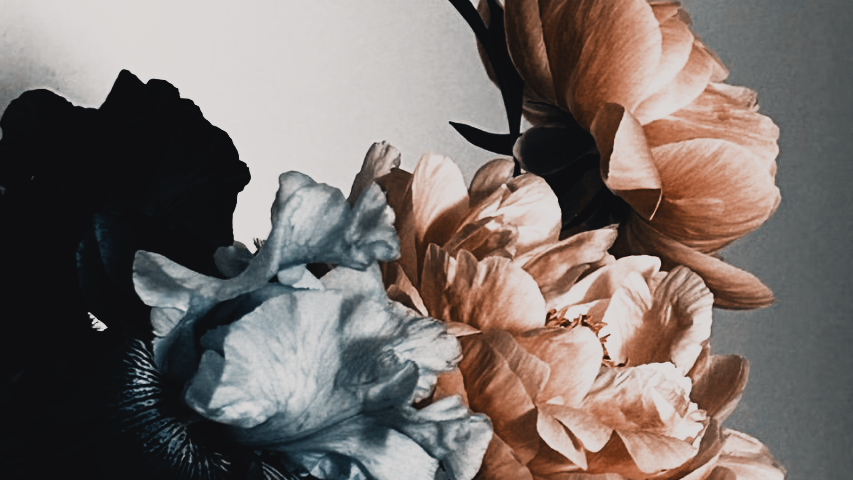
Trucolor's two-colour print, dyed blue and red.
A labelled surrogate of Trucolor's two-colour print, a blue dye on one side and a red dye on the other: a two-record image with a narrow gamut. Original vs Ashigrain.
At a glance
- Introduced
- mid 1940s
- Discontinued
- Process
- Trucolor double-coated coupler print (one colour developer forms a blue dye on one side and a red dye on the other; silver bleached and fixed out; silver-compound sound track)
- Maximum density
- ≈ 2.6
About the film
Trucolor was a two-colour print process run by Consolidated Film Industries, the laboratory of Republic Pictures.
Brian Coe, quoted by the Timeline of Historical Film Colors, says it was used in 1946 for Out California Way. Coe calls it the only significant new two-colour process after the Second World War, when most two-colour methods other than Cinecolor were obsolete, and the American WideScreen Museum describes it as Republic's counterpart to Cinecolor. Prints were made from bipack negatives, mostly for second features. A 1948 report of the Society of Motion Picture Engineers describes the print film as a safety base coated on both sides with positive emulsions containing colour couplers, one forming a blue dye and the other a red dye in the same developer. Bleach and fix then removed the silver, leaving two dye images, while the sound track remained a silver compound. Coe says that after 1950 Trucolor used modern colour films, and that by 1954 the two-colour process was obsolete and its last printing service had closed.
Sources for this history
- Trucolor 2 color, Timeline of Historical Film Colors
- Report of SMPE Progress Committee (Journal of the SMPE 50, June 1948, pp. 523–542), Society of Motion Picture Engineers, Internet Archive
- Cinecolor, American WideScreen Museum
The look
Trucolor was a two-colour print process of Consolidated Film Industries, Republic Pictures' laboratory, in use by 1946. Its film was coated on both sides, forming a blue dye on one and a red dye on the other. Ashigrain's version is a labelled surrogate, a model inspired by the print rather than a reproduction.

Best for
- Republic second features of the late 1940s
- Comparing Trucolor with Cinecolor
- Two-colour period pastiche
Compare print films
The same Vision3 500T night frame on each print film: how deep the blacks go, how the highlights roll off and how the colour separates.
The same Vision3 500T night frame on each print film: how deep the blacks go, how the highlights roll off and how the colour separates.
The same Vision3 500T night frame on each print film: how deep the blacks go, how the highlights roll off and how the colour separates.
The same Vision3 500T night frame on each print film: how deep the blacks go, how the highlights roll off and how the colour separates.
The same Vision3 500T night frame on each print film: how deep the blacks go, how the highlights roll off and how the colour separates.
The same Vision3 500T night frame on each print film: how deep the blacks go, how the highlights roll off and how the colour separates.
The same Vision3 500T night frame on each print film: how deep the blacks go, how the highlights roll off and how the colour separates.
The same Vision3 500T night frame on each print film: how deep the blacks go, how the highlights roll off and how the colour separates.
The same Vision3 500T night frame on each print film: how deep the blacks go, how the highlights roll off and how the colour separates.
The same Vision3 500T night frame on each print film: how deep the blacks go, how the highlights roll off and how the colour separates.
The same Vision3 500T night frame on each print film: how deep the blacks go, how the highlights roll off and how the colour separates.
The same Vision3 500T night frame on each print film: how deep the blacks go, how the highlights roll off and how the colour separates.
The same Vision3 500T night frame on each print film: how deep the blacks go, how the highlights roll off and how the colour separates.
The same Vision3 500T night frame on each print film. On this two-colour print (a labelled surrogate) every colour falls between blue-green and red-orange: how deep the blacks go, how the highlights roll off and which lights keep their hue.
The same Vision3 500T night frame on each print film: how deep the blacks go, how the highlights roll off and how the colour separates.
The same Vision3 500T night frame on each print film: how deep the blacks go, how the highlights roll off and how the colour separates.
The same Vision3 500T night frame on each print film: how deep the blacks go, how the highlights roll off and how the colour separates.
The same Vision3 500T night frame on each print film: how deep the blacks go, how the highlights roll off and how the colour separates.
The same Vision3 500T night frame on each print film: how deep the blacks go, how the highlights roll off and how the colour separates.
The same Vision3 500T night frame on each print film: how deep the blacks go, how the highlights roll off and how the colour separates.
The same Vision3 500T night frame on each print film: how deep the blacks go, how the highlights roll off and how the colour separates.
The same Vision3 500T night frame on each print film: how deep the blacks go, how the highlights roll off and how the colour separates.
The same Vision3 500T night frame on each print film: how deep the blacks go, how the highlights roll off and how the colour separates.
The same Vision3 500T night frame on each print film: how deep the blacks go, how the highlights roll off and how the colour separates.
The same Vision3 500T night frame on each print film. On this blue-sensitive black-and-white print the colour negative turns grey: how deep the blacks go, how the highlights roll off and how dark the reds and greens print.
The same Vision3 500T night frame on each print film: how deep the blacks go, how the highlights roll off and how the colour separates.
The same Vision3 500T night frame on each print film. On this blue-sensitive black-and-white print the colour negative turns grey: how deep the blacks go, how the highlights roll off and how dark the red neon and skin print.
The same Vision3 500T night frame on each print film: how deep the blacks go, how the highlights roll off and how the colour separates.
The same Vision3 500T night frame on each print film. On this black-and-white print the colour negative turns grey: how deep the blacks go, how the highlights roll off and how the coloured lights and skin translate to grey.
The same Vision3 500T night frame on each print film. On this blue-sensitive black-and-white print the colour negative turns grey: how deep the blacks go, how the highlights roll off and how the coloured lights and skin translate to grey.
The same Vision3 500T night frame on each print film: how deep the blacks go, how the highlights roll off and how the colour separates.
The same Vision3 500T night frame on each print film: how deep the blacks go, how the highlights roll off and how the colour separates.
The same Vision3 500T night frame on each print film: how deep the blacks go, how the highlights roll off and how the colour separates.
The same Vision3 500T night frame on each print film: how deep the blacks go, how the highlights roll off and how the colour separates.
The same Vision3 500T night frame on each print film: how deep the blacks go, how the highlights roll off and how the colour separates.
The same Vision3 500T night frame on each print film. On this two-colour print (a labelled surrogate) every colour falls between a blue and a red dye: how deep the blacks go, how the highlights roll off and which lights keep their hue.
The same Vision3 500T night frame on each print film: how deep the blacks go, how the highlights roll off and how the colour separates.
The same Kodak Vision3 500T night frame, printed on each film.
- Kodak Vision Premier Color Print Film 2393
- Eastman Color SP Print Film 5383
- Eastman Color Print Film 5384
- Fujifilm Eterna-CP 3521XD
- Du Pont Color Release Positive Type 275
- Fujifilm Eterna-CP 3523XD
- Kodak Vision Color Print Film 2383
- Fujifilm Eterna-CP 3513DI
- Eastman EXR Color Print Film 5386
- Eastman Color Print Film 5381 (1972)
- Eastman Color Print Film 5385
- Agfa CP30 Colour Print Film
- SuperCinecolor
- Cinecolor (two-colour)
- Gevacolor Positive 953
- Gevacolor Print 9.85
- Gevacolor Print 986
- Gevacolor Print 982
- Ferraniacolor Positive
- 3M Color Positive 650
- Fujicolor Positive F-CP 3510
- Fujicolor Positive F-CP 3519
- Fujifilm Eterna-CP 3512
- Eastman Color Print 5381 (1950)
- Eastman Fine Grain Release Positive 5302
- Ansco Color Print 848
- Kodak B&W Print Film 2302
- Svema TsP-11
- Svema MZ-3
- ORWO PF 2 Positive Print Film
- Technicolor Dye Transfer (1997 revival)
- Svema TsP-8R
- Shostka Colour Positive (1950s)
- Technicolor Dye Transfer (Process IV)
- Gasparcolor Print
- Trucolor Print (two-colour)
- Kodak Vision Color Teleprint Film 2395
Science & sources

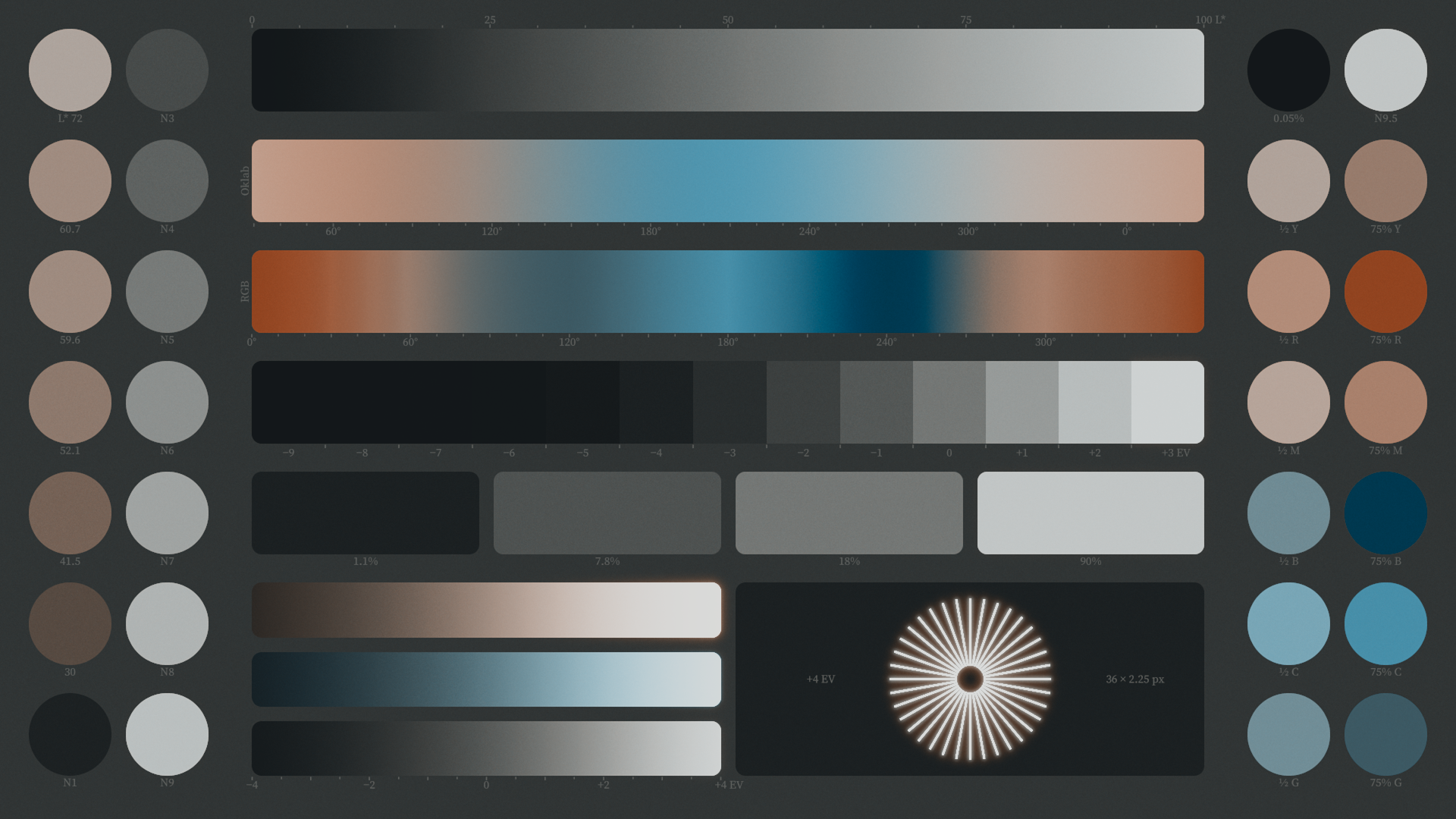
A two-colour model inspired by the print, not a reproduction of Trucolor, shown after Ansco Color Negative 843. It shares the dyes and record sensitivities of Ashigrain's Trucolor process model, themselves derived from named assumptions, and its two print curves are assumptions tuned for the most neutral grey. No MTF or granularity is printed for it.
Response curves and the evidence behind the model
Compare manufacturer data with Ashigrain’s response on the same axes. These curves show how the model is calibrated to its sources; they do not establish a match to photographed film.
Characteristic response
Model limits
These images show the film model in use. Spectral response, lighting and viewing conditions include approximations. Halation, bloom, grain size, weave and flicker are not fully measured for each film. The look of real film also depends on development and print timing.
- This is a two-colour model inspired by the Trucolor print, rather than a reproduction of it. No characteristic curve, spectral sensitivity, dye spectrum, MTF or grain measurement of a Trucolor print exists in the sources.
- The dyes and record sensitivities are those of Ashigrain's Trucolor process model, themselves derived from named assumptions guided by a 1948 SMPE report.
- The two print curves (gamma 2.6 for the red-orange record and 2.0 for the blue-green record) are assumptions chosen for the most neutral grey; two dyes cannot make an exact neutral.
- The model runs the two records in a three-layer path: the blue layer copies the green record and there is no yellow dye.
- The silver sound track and the two-sided coating are recorded but not modelled. No MTF or granularity is printed for it.
- The source gives no printer lamp or filter spectra. Their spectral response is approximated.
- The available sources do not measure veiling flare during projection. The model approximates its contribution to lifted blacks on screen, so the result is not a measured projection contrast.
Reciprocity: not modelled. Exposure time has no effect on this film.
Film guide: assumptions and practical choices
This preview combines the print film with the named camera negative. In this comparison, the print has no separate exposure index or measured grain response.
Sources
- Process: Journal of the SMPE vol. 50 (Jan-Jun 1948), incl. Report of SMPE Progress Committee (June 1948), pp.523-542, archive.org item journalofsociety50socirich (Prelinger Library scan), file journalofsociety50socirich.pdf (derivative, 47493669 bytes), p. 550
- Reconstructed: Journal of the SMPE vol. 50 (Jan-Jun 1948), incl. Report of SMPE Progress Committee (June 1948), pp.523-542, archive.org item journalofsociety50socirich (Prelinger Library scan), file journalofsociety50socirich.pdf (derivative, 47493669 bytes), p. 550