 Ashigrain
Black-and-white print · Print film
Eastman Fine Grain Release Positive 5302
Kodak's fine-grain black-and-white release positive.
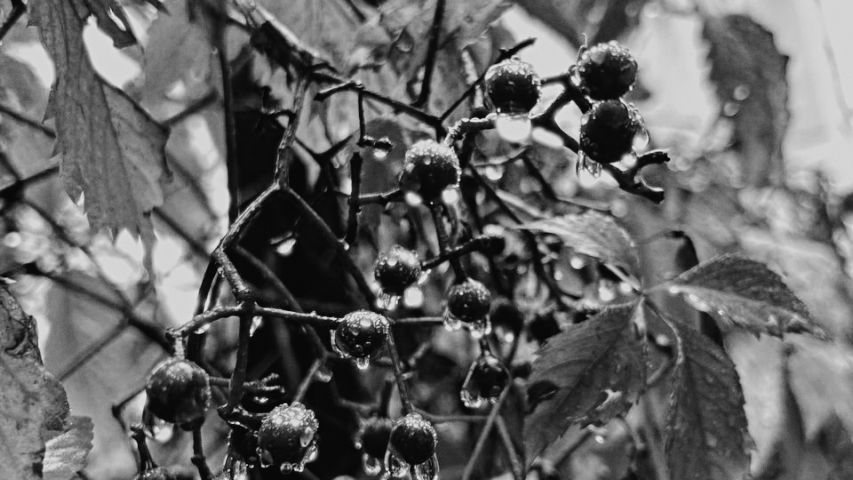
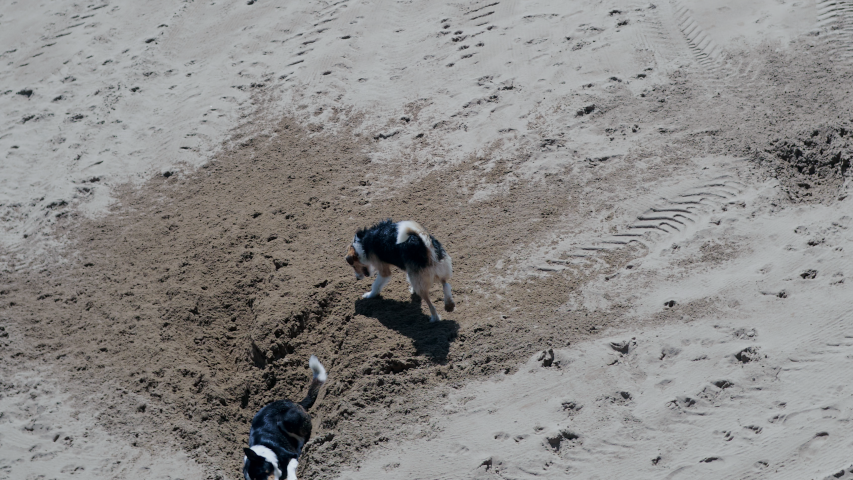
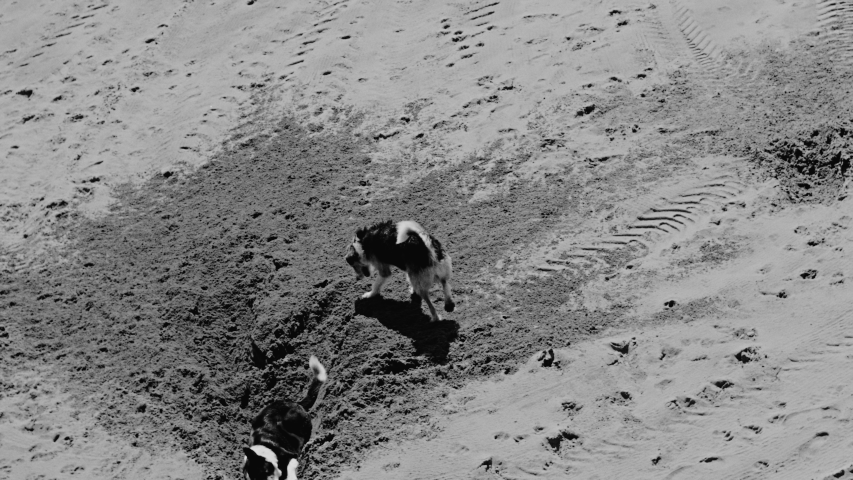
Kodak's fine-grain acetate release positive, from its 2008 datasheet at a gamma of about 2.47: classic black-and-white release-print contrast. Original vs Ashigrain.
At a glance
- Introduced
- 1950
- Discontinued
- Process
- KODAK Developer D-97, 70 F (21 C), to control gamma 2.4-2.6
- Maximum density
- ≈ 3.4
About the film
Eastman Fine Grain Release Positive Film was Kodak's fine-grain black-and-white positive for making release prints from black-and-white negatives, coded 5302 in 35 mm and 7302 in 16 mm.
Kodak's chronology dates it to 1950, as the safety-base replacement for the nitrate release positive 1302, in a conversion that Kodak says began in 1948 and took about four years. It is blue-sensitive, responding only to light from about 400 to 510 nm, and is coated on acetate base. Laboratories developed it in Kodak's D-97 developer to a control gamma of 2.4 to 2.6; the datasheet plots five development times from 2 to 9 minutes, and 3½ minutes falls inside that range. Its datasheet gives a diffuse RMS granularity of 8 at a net visual density of 1.0. Kodak's chronology says the same emulsion was used for 5306, a print film on lenticular support for colour kinescope recording. It is a different film from Kodak's later Black-and-White Print Film 2302: Kodak says their sensitometry differs, and 2302 is coated on ESTAR polyester rather than acetate. Kodak's chronology lists 5302 and 7302 as discontinued, and Ashigrain's curves come from the November 2008 edition of the datasheet.
Sources for this history
- EASTMAN Fine Grain Release Positive Film 5302 / 7302 Technical Data (H-1-5302, November 2008), Eastman Kodak Company
- EASTMAN Fine Grain Release Positive Film 5302 / 7302 Technical Data (H-1-5302, February 1999), Eastman Kodak Company
- Chronology of Film, Eastman Kodak Company
The look
Eastman Fine Grain Release Positive 5302 is Kodak's blue-sensitive black-and-white film for release prints from black-and-white negatives, on acetate safety base. It is developed in D-97 to a control gamma of 2.4 to 2.6. A colour negative can also print on it: reds and greens come out dark.



Best for
- Printing Double-X negatives
- Classic black-and-white release-print looks
- Comparing 5302 with Kodak 2302
Compare print films
The same Vision3 500T night frame on each print film: how deep the blacks go, how the highlights roll off and how the colour separates.
The same Vision3 500T night frame on each print film: how deep the blacks go, how the highlights roll off and how the colour separates.
The same Vision3 500T night frame on each print film: how deep the blacks go, how the highlights roll off and how the colour separates.
The same Vision3 500T night frame on each print film: how deep the blacks go, how the highlights roll off and how the colour separates.
The same Vision3 500T night frame on each print film: how deep the blacks go, how the highlights roll off and how the colour separates.
The same Vision3 500T night frame on each print film: how deep the blacks go, how the highlights roll off and how the colour separates.
The same Vision3 500T night frame on each print film: how deep the blacks go, how the highlights roll off and how the colour separates.
The same Vision3 500T night frame on each print film: how deep the blacks go, how the highlights roll off and how the colour separates.
The same Vision3 500T night frame on each print film: how deep the blacks go, how the highlights roll off and how the colour separates.
The same Vision3 500T night frame on each print film: how deep the blacks go, how the highlights roll off and how the colour separates.
The same Vision3 500T night frame on each print film: how deep the blacks go, how the highlights roll off and how the colour separates.
The same Vision3 500T night frame on each print film: how deep the blacks go, how the highlights roll off and how the colour separates.
The same Vision3 500T night frame on each print film: how deep the blacks go, how the highlights roll off and how the colour separates.
The same Vision3 500T night frame on each print film. On this two-colour print (a labelled surrogate) every colour falls between blue-green and red-orange: how deep the blacks go, how the highlights roll off and which lights keep their hue.
The same Vision3 500T night frame on each print film: how deep the blacks go, how the highlights roll off and how the colour separates.
The same Vision3 500T night frame on each print film: how deep the blacks go, how the highlights roll off and how the colour separates.
The same Vision3 500T night frame on each print film: how deep the blacks go, how the highlights roll off and how the colour separates.
The same Vision3 500T night frame on each print film: how deep the blacks go, how the highlights roll off and how the colour separates.
The same Vision3 500T night frame on each print film: how deep the blacks go, how the highlights roll off and how the colour separates.
The same Vision3 500T night frame on each print film: how deep the blacks go, how the highlights roll off and how the colour separates.
The same Vision3 500T night frame on each print film: how deep the blacks go, how the highlights roll off and how the colour separates.
The same Vision3 500T night frame on each print film: how deep the blacks go, how the highlights roll off and how the colour separates.
The same Vision3 500T night frame on each print film: how deep the blacks go, how the highlights roll off and how the colour separates.
The same Vision3 500T night frame on each print film: how deep the blacks go, how the highlights roll off and how the colour separates.
The same Vision3 500T night frame on each print film. On this blue-sensitive black-and-white print the colour negative turns grey: how deep the blacks go, how the highlights roll off and how dark the reds and greens print.
The same Vision3 500T night frame on each print film: how deep the blacks go, how the highlights roll off and how the colour separates.
The same Vision3 500T night frame on each print film. On this blue-sensitive black-and-white print the colour negative turns grey: how deep the blacks go, how the highlights roll off and how dark the red neon and skin print.
The same Vision3 500T night frame on each print film: how deep the blacks go, how the highlights roll off and how the colour separates.
The same Vision3 500T night frame on each print film. On this black-and-white print the colour negative turns grey: how deep the blacks go, how the highlights roll off and how the coloured lights and skin translate to grey.
The same Vision3 500T night frame on each print film. On this blue-sensitive black-and-white print the colour negative turns grey: how deep the blacks go, how the highlights roll off and how the coloured lights and skin translate to grey.
The same Vision3 500T night frame on each print film: how deep the blacks go, how the highlights roll off and how the colour separates.
The same Vision3 500T night frame on each print film: how deep the blacks go, how the highlights roll off and how the colour separates.
The same Vision3 500T night frame on each print film: how deep the blacks go, how the highlights roll off and how the colour separates.
The same Vision3 500T night frame on each print film: how deep the blacks go, how the highlights roll off and how the colour separates.
The same Vision3 500T night frame on each print film: how deep the blacks go, how the highlights roll off and how the colour separates.
The same Vision3 500T night frame on each print film. On this two-colour print (a labelled surrogate) every colour falls between a blue and a red dye: how deep the blacks go, how the highlights roll off and which lights keep their hue.
The same Vision3 500T night frame on each print film: how deep the blacks go, how the highlights roll off and how the colour separates.
The same Kodak Vision3 500T night frame, printed on each film.
- Kodak Vision Premier Color Print Film 2393
- Eastman Color SP Print Film 5383
- Eastman Color Print Film 5384
- Fujifilm Eterna-CP 3521XD
- Du Pont Color Release Positive Type 275
- Fujifilm Eterna-CP 3523XD
- Kodak Vision Color Print Film 2383
- Fujifilm Eterna-CP 3513DI
- Eastman EXR Color Print Film 5386
- Eastman Color Print Film 5381 (1972)
- Eastman Color Print Film 5385
- Agfa CP30 Colour Print Film
- SuperCinecolor
- Cinecolor (two-colour)
- Gevacolor Positive 953
- Gevacolor Print 9.85
- Gevacolor Print 986
- Gevacolor Print 982
- Ferraniacolor Positive
- 3M Color Positive 650
- Fujicolor Positive F-CP 3510
- Fujicolor Positive F-CP 3519
- Fujifilm Eterna-CP 3512
- Eastman Color Print 5381 (1950)
- Eastman Fine Grain Release Positive 5302
- Ansco Color Print 848
- Kodak B&W Print Film 2302
- Svema TsP-11
- Svema MZ-3
- ORWO PF 2 Positive Print Film
- Technicolor Dye Transfer (1997 revival)
- Svema TsP-8R
- Shostka Colour Positive (1950s)
- Technicolor Dye Transfer (Process IV)
- Gasparcolor Print
- Trucolor Print (two-colour)
- Kodak Vision Color Teleprint Film 2395
Science & sources

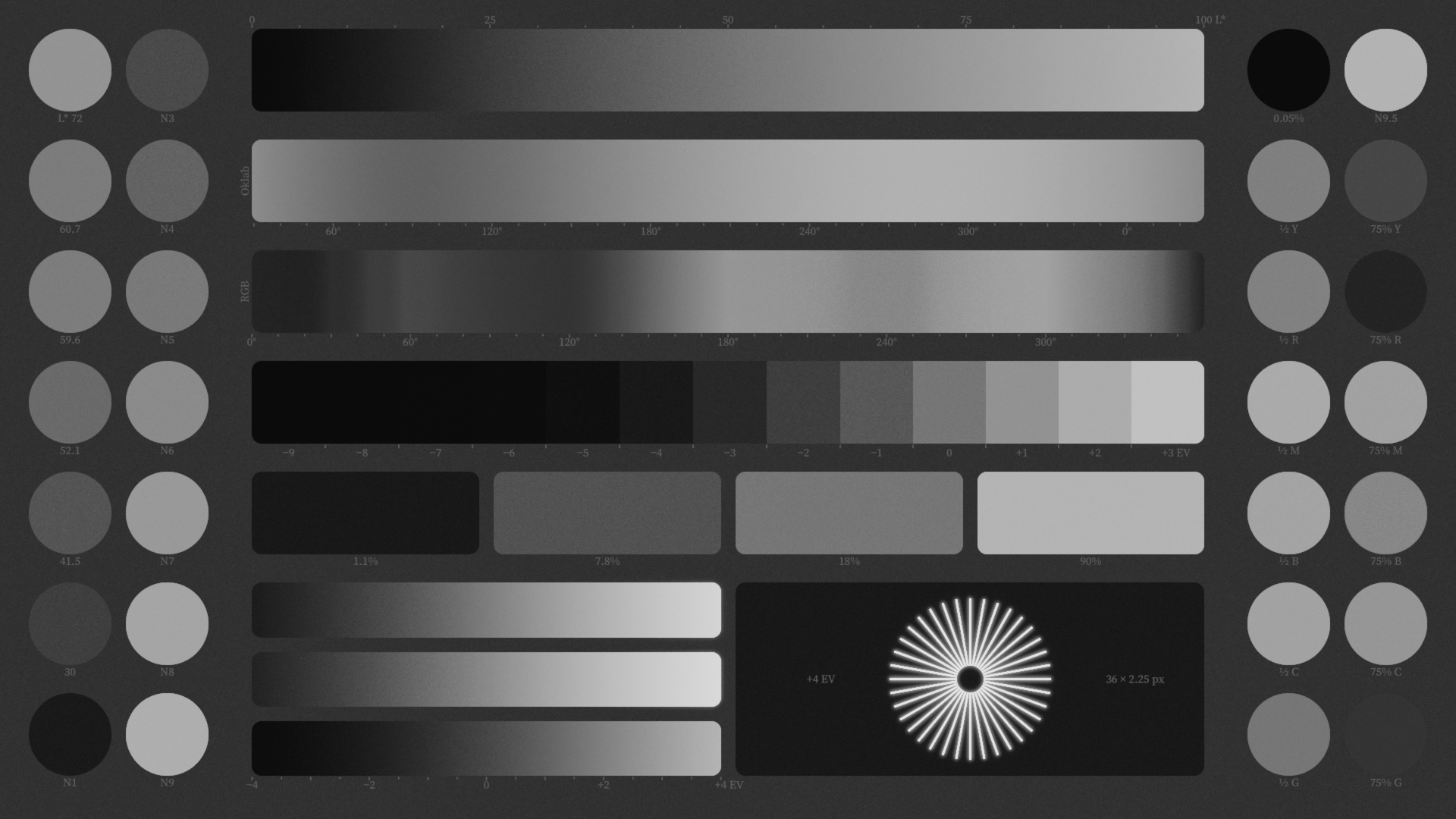
A blue-sensitive black-and-white release-print film, shown after Eastman Double-X 5222. Its curve, spectral sensitivity and MTF are digitised from Kodak's 2008 datasheet, using the 3½-minute D-97 curve. The result combines the negative and the print.
Response curves and the evidence behind the model
Compare manufacturer data with Ashigrain’s response on the same axes. These curves show how the model is calibrated to its sources; they do not establish a match to photographed film.
Characteristic response
Model limits
These images show the film model in use. Spectral response, lighting and viewing conditions include approximations. Halation, bloom, grain size, weave and flicker are not fully measured for each film. The look of real film also depends on development and print timing.
- The silver image has no dye chart and is taken as spectrally neutral.
- The film is blue-sensitive (about 400–510 nm as printed); its sensitivity beyond 510 nm is not charted.
- The characteristic curve is the sheet's 3½ minute D-97 curve (gamma about 2.47 visual), one of five printed development times, so contrast at other development is not modelled. The toe below log E −0.4 is not charted.
- Granularity is printed only as one diffuse RMS value of 8; no granularity curve is published.
- The MTF is affected by development-adjacency effects, which the model does not reproduce.
- The source gives printer settings but no lamp or filter spectra. Black-and-white print timing is modelled.
- The datasheet is read from mirror copies; Kodak no longer publishes it.
Reciprocity: not modelled. Exposure time has no effect on this film.
Film guide: assumptions and practical choices
Sources
- Characteristic curves: EASTMAN Fine Grain Release Positive Film 5302 / 7302 Technical Data, H-1-5302, p. 2
- Process: EASTMAN Fine Grain Release Positive Film 5302 / 7302 Technical Data, H-1-5302, p. 2