 Ashigrain
Copia en color · Película de copia
Trucolor Print (two-colour)
La copia bicolor de Trucolor, teñida de azul y rojo.
A labelled surrogate of Trucolor's two-colour print, a blue dye on one side and a red dye on the other: a two-record image with a narrow gamut. Original vs Ashigrain.
De un vistazo
- Lanzamiento
- mediados de la década de 1940
- Descatalogada
- Proceso
- Trucolor double-coated coupler print (one colour developer forms a blue dye on one side and a red dye on the other; silver bleached and fixed out; silver-compound sound track)
- Densidad máxima
- ≈ 2,6
Sobre la película
Trucolor fue un proceso de copia bicolor gestionado por Consolidated Film Industries, el laboratorio de Republic Pictures.
Brian Coe, citado por la Timeline of Historical Film Colors, dice que se usó en 1946 para Out California Way. Coe lo considera el único proceso bicolor nuevo importante después de la Segunda Guerra Mundial, cuando la mayoría de los métodos bicolores aparte de Cinecolor estaban obsoletos, y el American WideScreen Museum lo describe como la réplica de Republic a Cinecolor. Las copias se hacían a partir de negativos bipack, sobre todo para películas de serie B. Un informe de 1948 de la Society of Motion Picture Engineers describe la película de copia como un soporte de seguridad emulsionado por ambas caras con emulsiones positivas que contenían acopladores de color, uno que formaba un tinte azul y otro un tinte rojo en el mismo revelador. El blanqueo y el fijado eliminaban después la plata y dejaban dos imágenes de tinte, mientras la banda sonora seguía siendo un compuesto de plata. Coe dice que después de 1950 Trucolor usó películas en color modernas, y que en 1954 el proceso bicolor estaba obsoleto y su último servicio de copia había cerrado.
Fuentes de esta historia
- Trucolor 2 color, Timeline of Historical Film Colors
- Report of SMPE Progress Committee (Journal of the SMPE 50, June 1948, pp. 523–542), Society of Motion Picture Engineers, Internet Archive
- Cinecolor, American WideScreen Museum
El aspecto
Trucolor fue un proceso de copia bicolor de Consolidated Film Industries, el laboratorio de Republic Pictures, en uso ya en 1946. Su película estaba emulsionada por ambas caras y formaba un tinte azul en una y un tinte rojo en la otra. La versión de Ashigrain es un sustituto declarado, un modelo inspirado en la copia y no una reproducción.

Ideal para
- Películas de serie B de Republic de finales de los cuarenta
- Comparar Trucolor con Cinecolor
- Pastiche de época bicolor
Compara películas de positivado
The same Vision3 500T night frame on each print film: how deep the blacks go, how the highlights roll off and how the colour separates.
The same Vision3 500T night frame on each print film: how deep the blacks go, how the highlights roll off and how the colour separates.
The same Vision3 500T night frame on each print film: how deep the blacks go, how the highlights roll off and how the colour separates.
The same Vision3 500T night frame on each print film: how deep the blacks go, how the highlights roll off and how the colour separates.
The same Vision3 500T night frame on each print film: how deep the blacks go, how the highlights roll off and how the colour separates.
The same Vision3 500T night frame on each print film: how deep the blacks go, how the highlights roll off and how the colour separates.
The same Vision3 500T night frame on each print film: how deep the blacks go, how the highlights roll off and how the colour separates.
The same Vision3 500T night frame on each print film: how deep the blacks go, how the highlights roll off and how the colour separates.
The same Vision3 500T night frame on each print film: how deep the blacks go, how the highlights roll off and how the colour separates.
The same Vision3 500T night frame on each print film: how deep the blacks go, how the highlights roll off and how the colour separates.
The same Vision3 500T night frame on each print film: how deep the blacks go, how the highlights roll off and how the colour separates.
The same Vision3 500T night frame on each print film: how deep the blacks go, how the highlights roll off and how the colour separates.
The same Vision3 500T night frame on each print film: how deep the blacks go, how the highlights roll off and how the colour separates.
The same Vision3 500T night frame on each print film. On this two-colour print (a labelled surrogate) every colour falls between blue-green and red-orange: how deep the blacks go, how the highlights roll off and which lights keep their hue.
The same Vision3 500T night frame on each print film: how deep the blacks go, how the highlights roll off and how the colour separates.
The same Vision3 500T night frame on each print film: how deep the blacks go, how the highlights roll off and how the colour separates.
The same Vision3 500T night frame on each print film: how deep the blacks go, how the highlights roll off and how the colour separates.
The same Vision3 500T night frame on each print film: how deep the blacks go, how the highlights roll off and how the colour separates.
The same Vision3 500T night frame on each print film: how deep the blacks go, how the highlights roll off and how the colour separates.
The same Vision3 500T night frame on each print film: how deep the blacks go, how the highlights roll off and how the colour separates.
The same Vision3 500T night frame on each print film: how deep the blacks go, how the highlights roll off and how the colour separates.
The same Vision3 500T night frame on each print film: how deep the blacks go, how the highlights roll off and how the colour separates.
The same Vision3 500T night frame on each print film: how deep the blacks go, how the highlights roll off and how the colour separates.
The same Vision3 500T night frame on each print film: how deep the blacks go, how the highlights roll off and how the colour separates.
The same Vision3 500T night frame on each print film. On this blue-sensitive black-and-white print the colour negative turns grey: how deep the blacks go, how the highlights roll off and how dark the reds and greens print.
The same Vision3 500T night frame on each print film: how deep the blacks go, how the highlights roll off and how the colour separates.
The same Vision3 500T night frame on each print film. On this blue-sensitive black-and-white print the colour negative turns grey: how deep the blacks go, how the highlights roll off and how dark the red neon and skin print.
The same Vision3 500T night frame on each print film: how deep the blacks go, how the highlights roll off and how the colour separates.
The same Vision3 500T night frame on each print film. On this black-and-white print the colour negative turns grey: how deep the blacks go, how the highlights roll off and how the coloured lights and skin translate to grey.
The same Vision3 500T night frame on each print film. On this blue-sensitive black-and-white print the colour negative turns grey: how deep the blacks go, how the highlights roll off and how the coloured lights and skin translate to grey.
The same Vision3 500T night frame on each print film: how deep the blacks go, how the highlights roll off and how the colour separates.
The same Vision3 500T night frame on each print film: how deep the blacks go, how the highlights roll off and how the colour separates.
The same Vision3 500T night frame on each print film: how deep the blacks go, how the highlights roll off and how the colour separates.
The same Vision3 500T night frame on each print film: how deep the blacks go, how the highlights roll off and how the colour separates.
The same Vision3 500T night frame on each print film: how deep the blacks go, how the highlights roll off and how the colour separates.
The same Vision3 500T night frame on each print film. On this two-colour print (a labelled surrogate) every colour falls between a blue and a red dye: how deep the blacks go, how the highlights roll off and which lights keep their hue.
The same Vision3 500T night frame on each print film: how deep the blacks go, how the highlights roll off and how the colour separates.
El mismo fotograma nocturno de Kodak Vision3 500T, positivado en cada película.
- Kodak Vision Premier Color Print Film 2393
- Eastman Color SP Print Film 5383
- Eastman Color Print Film 5384
- Fujifilm Eterna-CP 3521XD
- Du Pont Color Release Positive Type 275
- Fujifilm Eterna-CP 3523XD
- Kodak Vision Color Print Film 2383
- Fujifilm Eterna-CP 3513DI
- Eastman EXR Color Print Film 5386
- Eastman Color Print Film 5381 (1972)
- Eastman Color Print Film 5385
- Agfa CP30 Colour Print Film
- SuperCinecolor
- Cinecolor (two-colour)
- Gevacolor Positive 953
- Gevacolor Print 9.85
- Gevacolor Print 986
- Gevacolor Print 982
- Ferraniacolor Positive
- 3M Color Positive 650
- Fujicolor Positive F-CP 3510
- Fujicolor Positive F-CP 3519
- Fujifilm Eterna-CP 3512
- Eastman Color Print 5381 (1950)
- Eastman Fine Grain Release Positive 5302
- Ansco Color Print 848
- Kodak B&W Print Film 2302
- Svema TsP-11
- Svema MZ-3
- ORWO PF 2 Positive Print Film
- Technicolor Dye Transfer (1997 revival)
- Svema TsP-8R
- Shostka Colour Positive (1950s)
- Technicolor Dye Transfer (Process IV)
- Gasparcolor Print
- Trucolor Print (two-colour)
- Kodak Vision Color Teleprint Film 2395
Ciencia y fuentes

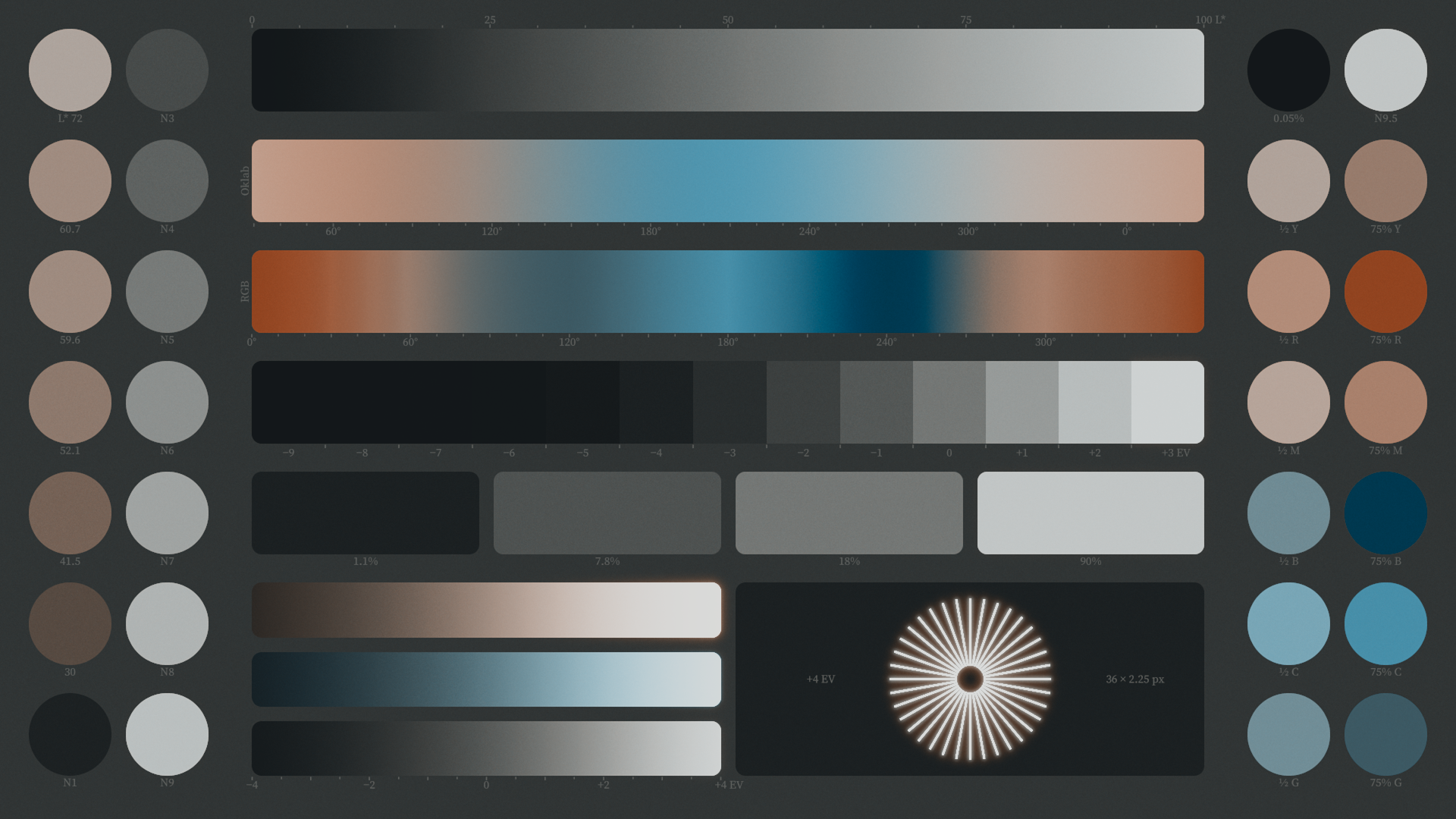
Un modelo bicolor inspirado en la copia, no una reproducción de Trucolor, mostrado tras Ansco Color Negative 843. Comparte los tintes y las sensibilidades de registro del modelo del proceso Trucolor de Ashigrain, derivados a su vez de suposiciones declaradas, y sus dos curvas de copia son suposiciones ajustadas para el gris más neutro. No se publica MTF ni granularidad para ella.
Curvas de respuesta y fundamentos del modelo
Compara los datos del fabricante con la respuesta de Ashigrain sobre los mismos ejes. Estas curvas muestran cómo se calibra el modelo con sus fuentes; no demuestran una coincidencia con imágenes fotografiadas en película.
Respuesta característica
Límites del modelo
Estas imágenes muestran el modelo de película en uso. La respuesta espectral, la iluminación y las condiciones de visualización incluyen aproximaciones; el halo, el resplandor, el tamaño del grano, la inestabilidad y el parpadeo no están medidos por completo para cada película. Una captura real también depende del revelado y del ajuste de positivado.
- Es un modelo bicolor inspirado en la copia Trucolor, no una reproducción de ella. En las fuentes no existe ninguna curva característica, sensibilidad espectral, espectro de tinte, MTF ni medición de grano de una copia Trucolor.
- Los tintes y las sensibilidades de registro son los del modelo del proceso Trucolor de Ashigrain, derivados a su vez de suposiciones declaradas guiadas por un informe SMPE de 1948.
- Las dos curvas de copia (gamma 2.6 para el registro rojo anaranjado y 2.0 para el verde azulado) son suposiciones elegidas para el gris más neutro; dos tintes no pueden dar un neutro exacto.
- El modelo ejecuta los dos registros en una vía de tres capas: la capa azul copia el registro verde y no hay colorante amarillo.
- La banda sonora de plata y la emulsión por ambas caras se registran, pero no se modelan. No se publica MTF ni granularidad para ella.
- La fuente no da espectros de la lámpara ni de los filtros de la positivadora. Su respuesta espectral es aproximada.
- El velo de proyección modelado eleva los negros en pantalla. Su intensidad es un supuesto porque las fuentes disponibles no lo miden; por tanto, no establece un contraste de proyección medido.
Reciprocidad: no modelada. El tiempo de exposición no tiene efecto en esta película.
Guía de películas: supuestos y opciones prácticas
Esta vista previa combina el positivo con el negativo de cámara indicado. En esta comparación, el positivo no tiene un índice de exposición ni una respuesta de grano medida propios.
Fuentes
- Process: Journal of the SMPE vol. 50 (Jan-Jun 1948), incl. Report of SMPE Progress Committee (June 1948), pp.523-542, archive.org item journalofsociety50socirich (Prelinger Library scan), file journalofsociety50socirich.pdf (derivative, 47493669 bytes), p. 550
- Reconstructed: Journal of the SMPE vol. 50 (Jan-Jun 1948), incl. Report of SMPE Progress Committee (June 1948), pp.523-542, archive.org item journalofsociety50socirich (Prelinger Library scan), file journalofsociety50socirich.pdf (derivative, 47493669 bytes), p. 550
Lleva esta película a tu etalonaje.
Todas las películas incluidas en una sola compra, sin suscripción.
€199 + VAT